Livewire End of Life (EOL) Dates and End of Support (EOS) Dates
Livewire end of life (EOL) and end of support (EOS) dates: 2 Livewire versions have reached EOL, including Livewire 2 (EOL date: Aug 20, 2023) — no longer receiving security updates or patches. Livewire 4.4.9 is the current supported release — 2 versions in active support. Also see Backdrop end of life dates for related end-of-life information.
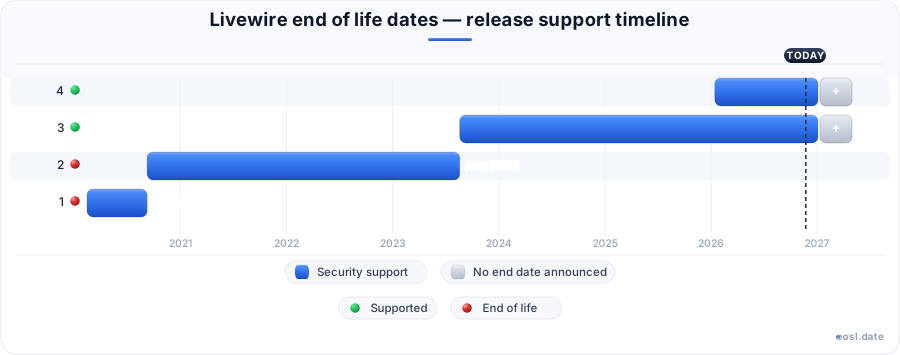
Currently Supported Livewire Releases - Active EOS/EOSL Support (2)
Livewire End of Life (EOL) Releases - No Longer Supported (2)
Your Livewire end of life date isn't printed on any calendar: it arrives when the version of this framework you run stops getting fixes. This guide shows how to read that support signal for your web app, what each release changed, and how to plan an upgrade before it hurts.
What Livewire End of Life Means for Your Laravel App
Livewire doesn't publish a dated schedule the way Laravel does, so you infer it from two places: Laravel's changelog and the maintainers' announcements. Laravel and its first-party packages follow semantic versioning. Minor and patch releases shouldn't break your code, while a major release can. That's why Laravel's docs tell you to pin a version constraint such as ^12.0 in Composer, and why backwards compatibility is only promised inside one major line. Treat Livewire the same way: keep maintenance of the package on a schedule rather than waiting for something to fail.
Support Policy: When a Laravel Version Becomes Unsupported
Laravel's support policy gives each release 18 months of bug fixes and two years of security fixes. Once a release drops out of both windows it no longer receives patches, and neither does any Livewire app depending on it.
| Laravel | PHP | Bug fixes until | Security patches until |
|---|---|---|---|
| 11 | 8.2 - 8.4 | September 3rd, 2025 | March 12th, 2026 |
| 12 | 8.2 - 8.5 | August 13th, 2026 | February 24th, 2027 |
| 13 | 8.3 - 8.5 | Q3 2027 | Q1 2028 |
Laravel 13 Dates and Your Livewire Version
If you're on Laravel 11, its security window has already closed, so your Livewire support depends on a base you can no longer rely on. Moving to Laravel 12 or 13 first is the safer order.
Livewire PHP and Laravel Compatibility by Version
Each Livewire major line works with a fixed range of PHP and Laravel versions, so the range tells you what else has to change when you upgrade.
| Livewire | PHP | Laravel |
|---|---|---|
| 4 | 8.1 - 8.5 | 10 - 13 |
| 3 | 8.1 - 8.5 | 10 - 13 |
| 2 | 7.2.5 - 8.2 | 7 - 10 |
| 1 | 7.2 - 8.0 | 5.6 - 8 |
Versions 3 and 4 share the same ranges, so moving from one to the other doesn't force a new PHP or Laravel release. Compatibility isn't the same as support, though: a Laravel release that Livewire still accepts may already be outside its own security window, as the table above shows for Laravel 11.
Livewire Release Schedule and Deprecating Old Majors
In 2021 the maintainer announced on GitHub that Livewire would stop tagging major releases alongside Laravel's yearly cycle. Keeping them in sync was too costly, so the release schedule became independent and a major version ships whenever the team judges it ready. Developers get new features sooner, but there's no fixed calendar to plan around, so watch for deprecating notices in each release.
Livewire 4 Release Notes
Livewire 4 arrived in January 2026, and add-ons are already following it: the Statamic addon added Livewire 4 support in its 5.1.0 release. Livewire publishes no dated cutoff for older majors, so read the official upgrade guide and release notes on GitHub to see what v4 means for your v3 app.
Livewire 3 Changes and Deprecated Habits
Livewire 3 was the biggest shift for any Livewire build in use today. It injects its own assets and Alpine automatically, supports hot reloading without losing state, and adds wire:navigate for page transitions plus lazy loading of heavy parts of a component. The old wire:model behavior of updating on every keystroke is deprecated in favor of explicit wire:model.live. New annotation-style attributes bring better reactivity for nested components, and you can run small JavaScript actions without a server round trip, which cuts needless requests in your web app.
Lifecycle Hooks Across Each Livewire Version
Hook behavior in each component is an upgrade risk when you leave an unsupported release. The lifecycle hooks run in a set order for every component: boot, mount, render and dehydrate on first load, then hydrate its properties, boot and your action, render and dehydrate on later requests. A fix in 2.7.0 added a booted hook that runs after mount and hydrate, so code that relies on hook order can break when you move between versions.
Starter Kits and Packages with Security Fixes
Unsupported code stops getting patches: Breeze and Jetstream no longer receive updates, since Laravel 12 introduced starter kits for React, Svelte, Vue and Livewire. The Livewire kit uses Tailwind, Flux UI and Volt. Third-party packages move at their own pace: the Statamic addon's changelog shows a dependency bump made to resolve security issues after a Dependabot alert, and a dropped Laravel 11 test lane. Read each package's release notes for compatibility before you update. Check each addon's supported Laravel and Livewire range too, as Statamic sites must with the Statamic addon.
Upgrade Checklist Before a Version Turns Unsupported
- Find your installed Livewire version by running
composer show livewire/livewire | grep versions. - Confirm your Laravel and PHP versions against the support and compatibility tables above.
- Read the documentation's upgrade guide for every skipped major version.
- List breaking changes in your own components and in each dependency.
- Upgrade in a branch, then run your tests before you update production.