Joomla! End of Life (EOL) Dates and End of Support (EOS) Dates
Joomla! end of life (EOL) and end of support (EOS) dates: 2 Joomla! versions have reached EOL, including Joomla! 4 (EOL date: Oct 14, 2025) — no longer receiving security updates or patches. Joomla! 6.2.0 is the current supported release, with support through Oct 16, 2029 — 2 versions in active support. Also see Backdrop EOSL dates for related end-of-life information.
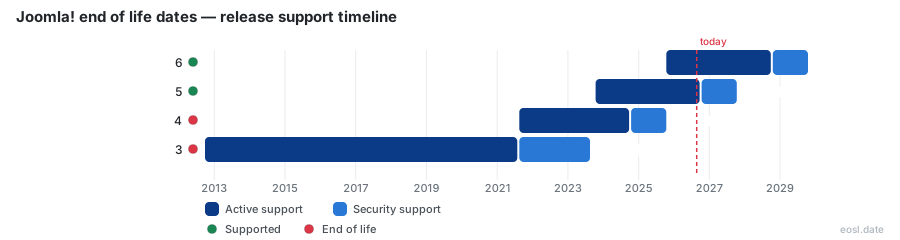
Currently Supported Joomla! Releases - Active EOS/EOSL Support (2)
Joomla! End of Life (EOL) Releases - No Longer Supported (2)
Running an older site and wondering how long it stays safe? Joomla! end of life dates tell you when this open source content management system, a free CMS software package, stops receiving security updates, and knowing them protects your website before an unpatched flaw does. Under the current policy every major CMS release gets four years of support, so the EOL date for each series is predictable, and the sections below list every one for the CMS, with advice for developers and site owners alike.
Joomla! End of Life Dates by Version
The table lists the end of life milestones for each of the CMS versions, taken from the project's published roadmap. The latest release of a series is the only stable release you should run, and the "supported until" columns show the last day that series receives fixes.
| Series | Release date | Bug fixes until | Security until | Status |
|---|---|---|---|---|
| 3.x | 27 Sep 2012 | 17 Aug 2021 | 17 Aug 2023 | Unsupported |
| 4.x | 17 Aug 2021 | 15 Oct 2024 | 14 Oct 2025 | Unsupported |
| 5.x | 17 Oct 2023 | 13 Oct 2026 | 12 Oct 2027 | Security-only |
| 6.x | 14 Oct 2025 | 17 Oct 2028 | 16 Oct 2029 | Active support |
The newest stable version in each series today is 6.2.0, 5.4.10, 4.4.14 and 3.10.12. The CMS versions page and each series' version history page list exact builds, and a second look at the version history shows which build you run.
Joomla 3 and Older Unsupported Releases
Joomla 3 is unsupported since 17 August 2023, and its final build, Joomla 3.10.12, appeared on 11 July 2023. Earlier branches ended long ago: Joomla 2.5 end of life came on 31 December 2014, and Joomla 1.5, which shipped with a limited "legacy mode" for old extensions, stopped on 30 September 2012. The old lifecycle mixed long-term support with short-term support releases until 2014, and when 3.3 raised the PHP requirement, extended security support for 3.2 ran six more months. All of these are unsupported today.
Joomla 4.x End-of-Life and Its Release Date
Joomla 4 shipped on 17 August 2021. It had three years of bug fixes, until 15 October 2024, then a final year of security fixes until 14 October 2025. Joomla 4.x end-of-life became official the day Joomla 5.4 and Joomla 6 arrived, and the last build was Joomla 4.4, version 4.4.14, on 30 September 2025. Any vulnerability found now stays unpatched, so the four years are over.
Joomla 5.4 and Joomla 6.2 Supported Versions
Joomla 5.4 left regular bugfix support on 13 October 2026, and security coverage runs until 12 October 2027. Joomla 6.2, released the same day, sits in a series with bug fixes until 17 October 2028 and the project recommends it for new installations. The first alpha of 6.3 starts on 24 November 2026, a second alpha follows in December, and beta builds arrive in February 2027, but pre-release code never belongs on a live site.
Supported Releases and Security Support Explained
The list of supported releases follows one rule from the project's development strategy: every major version stays supported for four years, and a minimum of two of those are active development. Read the release notes of each update, because a security release is a prompt to upgrade straight away.
Active Support and Regular Bugfix Coverage
Active support means new features reach a series in minor releases, alongside a regular bugfix cadence. Once that phase ends, as it did for the 5.x line this month, no more bugs are fixed unless they carry a security risk. Only the bug fixes that protect you continue.
Security Updates and Patches
After active support, security patches still arrive for one more year. These cover vulnerabilities and other security issues that attackers actively probe, and sites do get hacked through unpatched components shortly before a fix lands. Subscribe to the security announcements feed so a critical patch never passes unnoticed.
Long-Term Support Versus Security-Only Support
Early releases such as 1.5 and 2.5 were labelled LTS, with irregular long-term support windows. The current model is simpler: each series ends with a security-only phase, described by the project as a security fix only period, with no feature work and no routine bug fixes.
Release Cycle and Roadmap: How EOL Dates Get Set
The release cycle is public, so you can plan years ahead. The roadmap on the developer site lists each schedule, tentative dates included, and every major version follows the same pattern. The code lives on GitHub, and third parties publish the dates as an API, an iCalendar calendar and an RSS feed.
Semantic Versioning and Each Minor Release
Since April 2014 the project follows semantic versioning: every minor release must preserve backwards compatibility, and breaking changes wait for the next major release. Bridge versions, such as 3.10 and 4.4, ease the move between series, while Joomla 5.4 included backports of Joomla 6 API changes and automated core updates. New features land in a series only during its active phase.
Release Team, Maintenance Team and Volunteers
The release team plans, tests and distributes each build, while the maintenance team reviews patches and decides what merges. Both consist of volunteers from the community, and together with developers they publish the support dates you plan around, so any Joomla specialist you hire works from the same schedule.
Upgrade Planning Before Your Joomla Version Becomes Unsupported
Plan to upgrade at least six months before the security date, and migrate sooner if your site holds customer data. Every software upgrade carries risk, and the community of site owners reports the same lesson, so use a staging copy to test every upgrade before touching the live website, and the official downloads page always carries the newest package, and you should only download software from there.
Migration Paths and One-Click Updates
Within a series a one-click update is enough, and one-click updates also cover minor jumps such as 5.2 to 5.4. Between series, a 4.x site normally moves to 5.4 first and then to 6, while an old 3.10 site needs a full migration. Pick the latest version in your target series, and run the one-click update from the administrator panel rather than copying files across installations. The 5.4 compatibility plugin helps extensions prepare for 6.
PHP and Hosting Provider Checks
Your hosting provider decides which PHP version runs, so check it first. Joomla 5 raised the minimum PHP and MySQL versions (or an equivalent MariaDB), and the database must meet the target series' minimum before the update runs. A PHP version that is itself out of support leaves the site exposed just as an unsupported Joomla series does, so your hosting must cover the target series.
Extensions, Templates and Third-Party Code
Extensions and templates often stop receiving updates before the core series does, which leaves a site exposed even while the core is still supported, and they decide whether an upgrade succeeds. Each third-party extension, plugin and template needs a release built for the new series, so list them, trim unused ones as a small optimisation step, check each developer's compatibility notice (developers publish these in their own change logs) and replace abandoned ones.
Joomla CMS Versions, History and Unsupported Branches
Compare CMS versions on the official page, which tracks every branch ever released, from 1.0 to the current series, and it is the quickest check on whether a build is supported. Whether you publish web content for a small community or a large one, other platforms such as WordPress and Drupal publish their own lifecycles, and market share does not change when a Joomla branch stops receiving fixes.
Version History From Mambo to Today
Joomla began as a fork of Mambo on 17 August 2005, and version 1.0 followed in September that year. The full version history then runs through 1.5, 2.5, 3.x, 4.x, 5.x and 6.x. Community discussion on the forum shaped many of those choices, and the community's feedback led to the current schedule.
Framework, Open Source Matters and Governance
The project is run by volunteers supported by Open Source Matters, Inc., and the Joomla Framework, a separate PHP framework, can be used independently of the CMS, which is released under the GPL. Its own framework releases follow a separate roadmap from the CMS dates, so confirm any date in the documentation and on GitHub before you plan around it.