Kotlin End of Life (EOL) Dates and End of Support (EOS) Dates
Kotlin end of life (EOL) and end of support (EOS) dates: 11 Kotlin versions have reached EOL, including Kotlin 2.3 (EOL date: Jun 03, 2026) — no longer receiving security updates or patches. Kotlin 2.4.21 is the current supported release. Also see Azul Zulu lifecycle dates for related end-of-life information.
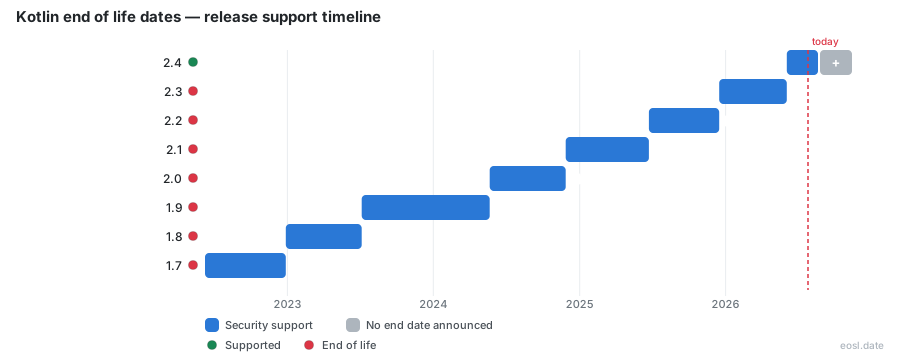
Currently Supported Kotlin Releases - Active EOS/EOSL Support (1)
| Release | Released | Security Support | Latest |
|---|---|---|---|
| 2.4 | (5 months ago) | Active | 2.4.21 (1 month and 1 week ago) |
Kotlin End of Life (EOL) Releases - No Longer Supported (11)
| Release | Released | Security Support | Latest |
|---|---|---|---|
| 2.3 | (11 months ago) | (5 months ago) | 2.3.21 (6 months ago) |
| 2.2 | (1 year and 4 months ago) | (11 months ago) | 2.2.21 (1 year ago) |
| 2.1 | (1 year and 11 months ago) | (1 year and 4 months ago) | 2.1.21 (1 year and 6 months ago) |
| 2.0 | (2 years and 6 months ago) | (1 year and 11 months ago) | 2.0.21 (2 years and 1 month ago) |
| 1.9 | (3 years and 4 months ago) | (2 years and 6 months ago) | 1.9.25 (2 years and 4 months ago) |
| 1.8 | (3 years and 10 months ago) | (3 years and 4 months ago) | 1.8.22 (3 years and 5 months ago) |
| 1.7 | (4 years and 5 months ago) | (3 years and 10 months ago) | 1.7.22 (3 years and 11 months ago) |
| 1.6 | (5 years ago) | (4 years and 5 months ago) | 1.6.21 (4 years and 7 months ago) |
| 1.5 | (5 years and 6 months ago) | (4 years and 11 months ago) | 1.5.32 (4 years and 11 months ago) |
| 1.4 | (6 years and 3 months ago) | (5 years and 6 months ago) | 1.4.32 (5 years and 7 months ago) |
| 1.3 | (8 years ago) | (6 years and 3 months ago) | 1.3.72 (6 years and 7 months ago) |
Checking Kotlin End of Life dates tells you whether the version in your build still gets fixes, and right now only the 2.4 line is fully supported. Kotlin is a cross-platform, statically typed programming language from JetBrains with strong type inference, and it ships on a predictable schedule, and each line loses its fixes about when the next language release ships, so you can plan months ahead. This guide lists every version, its end date, and what you should do before yours loses its fixes.
Kotlin End of Life Status: Which Versions Are Supported
The latest release is Kotlin 2.4.21, a bug fix build published on October 8, 2026. Every older line has already lost its patches, because the project has historically fixed only the newest line. On GitHub, the JetBrains repository also lists 2.5.0-Beta2 as a pre-release, which signals that the next language release is close. A pre-release is for testing only, so keep it out of production.
If your project still compiles with Kotlin 2.3 or earlier, treat it as unsupported: no new patch will be backported to it, and the compiler plugins you depend on keep moving forward without you. Only the newest line is under active support.
Latest Patch Versions
- Kotlin 2.4: 2.4.21, released October 8, 2026
- Kotlin 2.3: 2.3.21, released April 23, 2026
- Kotlin 2.2: 2.2.21, released October 23, 2025
- Kotlin 2.1: 2.1.21, released May 13, 2025
Kotlin Versions and Their Support Dates
The table below follows the endoflife.date record, which tracks each series from the GitHub releases. Each one stops receiving fixes about when the next language release arrives, apart from the new 18-month rule that starts with 2.4.
| Series | Released | Support ended | Latest patch |
|---|---|---|---|
| Kotlin 2.4 | June 3, 2026 | December 3, 2027 (scheduled) | 2.4.21 |
| Kotlin 2.3 | December 16, 2025 | June 3, 2026 | 2.3.21 |
| Kotlin 2.2 | June 23, 2025 | December 16, 2025 | 2.2.21 |
| Kotlin 2.1 | November 27, 2024 | June 23, 2025 | 2.1.21 |
| Kotlin 2.0 | May 21, 2024 | November 27, 2024 | 2.0.21 |
| Kotlin 1.9 | July 6, 2023 | May 21, 2024 | 1.9.25 |
| Kotlin 1.8 | December 28, 2022 | July 6, 2023 | 1.8.22 |
| Kotlin 1.7 | June 9, 2022 | December 28, 2022 | 1.7.22 |
| Kotlin 1.6 | November 15, 2021 | June 9, 2022 | 1.6.21 |
| Kotlin 1.5 | April 26, 2021 | November 29, 2021 | 1.5.32 |
| Kotlin 1.4 | August 14, 2020 | April 26, 2021 | 1.4.32 |
| Kotlin 1.3 | October 29, 2018 | August 14, 2020 | 1.3.72 |
The next series, Kotlin 2.5, is planned for December 2026.
Kotlin 2.4 Support Window
Kotlin 2.4 was released on June 3, 2026, and its support window runs to December 3, 2027. This is the first line covered by the 18-month commitment described below.
How the 18-Month Window Is Counted
Kotlin 2.4 stops receiving fixes 18 months after its June 3, 2026 release, which puts the cutoff at December 3, 2027. The clock starts on the language release date, not on the latest patch, so builds such as 2.4.20 share that cutoff rather than getting their own.
How the Kotlin Release Process Works
Since Kotlin 2.0.0, the team has followed a fixed release cycle with three kinds of builds, and knowing which is which helps you read any version number. The six-month rhythm is the reason a line can age out so quickly.
Language Releases and Tooling Releases
Language releases (2.x.0) bring major changes and tooling updates, and arrive once every six months. Tooling releases (2.x.20) land about three months after the matching language release and carry performance improvements, bug fixes and new features. Performance gains alone never extend a line's life, though; only the dates do. Each language release replaces the previous line as the supported one. Teams often upgrade for performance, but the performance case matters less than the cutoff date, and the API they rely on only gets fixed on a supported line.
Bug Fix Releases and Early Access Preview Builds
Bug fix releases (2.x.y) follow them with no exact schedule. Before each language release, the team publishes several test builds through the Early Access Preview, known as EAP, so you can try new features before they go stable. Each of those builds is tagged as a pre-release on GitHub.
Upcoming Kotlin Releases and the Release Schedule
The approximate release schedule from JetBrains lists 2.5.0 for December 2026 and 2.5.20 for March 2027. If that cadence holds, Kotlin 2.3 users will already be roughly a year behind the newest language release when 2.5.0 lands, which is a good reason to move now. When 2.5.0 ships, the 2.4 line moves from newest to previous under the 18-month rule.
Security Support for the Kotlin Standard Library
From Kotlin 2.4.0, the standard library for the JVM has an 18-month window for each line. A language release and the builds after it count as one line. When a security vulnerability affects the standard library, JetBrains ships a patched build based on the latest release in the line, plus bug fix builds for every line still inside its window. Its public API stays the same in those patches, so the change is low risk, and no API break should block the update.
What Security Fixes Ship Together
Suppose the newest build is 2.4.20 and a flaw appears: the fix goes into 2.4.20 only, not into 2.4.0. So you need the latest patch of your line, not just the right line number. Once a line is past its window, no such patch is released for it.
Support Policy for Older Releases
For anything before 2.4, the rules are looser. The endoflife.date page notes that the Kotlin support policy is not clearly defined, and that usually only the latest version sees active development and receives bug and security fixes. Plan on the newest line being the only safe one.
The oldest lines are long gone. Kotlin 1.9 stopped getting fixes in May 2024, and Kotlin 1.8 stopped in July 2023. Kotlin 1.5 and Kotlin 1.4 are older still, ending in November and April of 2021. If you are on Kotlin 1.9 or Kotlin 1.8, move to a current line first; if you are stuck on Kotlin 1.5 or Kotlin 1.4, move in stages and read the notes for each hop.
API Compatibility Across Versions
Development supports the three previous API versions along with the current stable one. In practice you can compile with a newer compiler while keeping an older API version for library compatibility, using the API version compiler option, but that does not extend your fixes. Your dependency authors still need to publish against a supported release. Every API they call must exist in your chosen API version, so check each API in the reference, and expect a deprecated API to warn before the API is removed. The Gradle API and each experimental API opt-in follow the same rule, and none of them extends your fixes.
Updating Before End of Support
To upgrade, change the Kotlin version in your build system. Review any kotlinx libraries too, since libraries created with earlier versions may need their own updates. Both build tools read the same version number. If you need the command-line compiler, download it from the GitHub release page.
Updating the Gradle Plugin
In your build.gradle.kts file, change the version of the Kotlin Gradle plugin to the build you want. Gradle then downloads the matching compiler and its runtime on the next sync, and Gradle 9.0 is supported since Kotlin 2.3.0. The Gradle plugin also exposes its own API for build logic, and that API is versioned with the plugin.
plugins {
    kotlin("jvm") version "2.4.21"
}
Updating with Maven
In your pom.xml file, set the property used by the Maven plugin:
<properties>
    <kotlin.version>2.4.21</kotlin.version>
</properties>
Checking Whether Your Release Has Ended
Open your build file, find the plugin version and the API version setting, and look it up in the table above. You can also run kotlinc-native -version for the native toolchain, or ask the compiler for its version on the JVM. If your series has ended, plan the move to 2.4 before the next language release.
Kotlin Support in IntelliJ IDEA and Android Studio
Kotlin has full out-of-the-box support in IntelliJ IDEA and Android Studio. The Kotlin plugin is bundled with the latest IDE versions, so you do not need to update the plugin separately; you only change the version in your build scripts. IDE plugin support follows the bundled Kotlin version, so older IDE builds only support their older bundled line.
Release Line Targets: JVM, Native, JS and Wasm
Kotlin mainly targets the JVM but also compiles to JavaScript and to native code through LLVM. Support for each target moves with the release line, so an unsupported compiler affects all of them at once.
Kotlin/JVM and Java 25 Compatibility
On the JVM, Kotlin interoperates fully with Java and relies on the Java Class Library. Kotlin 2.3.0 added support for Java 25, and each new Java version needs a compiler that knows it. Older compiler versions will not gain support for newer JDKs, so a team moving to a new Java or JVM runtime should move Kotlin first.
Kotlin/Native and Kotlin Multiplatform
Kotlin/Native shares business logic between native iOS and Android apps, and Kotlin Multiplatform builds on it. Apple target support changes between versions, so an old compiler can stop building for current Xcode.
Kotlin/JS and Kotlin/Wasm
Kotlin/JS powers frontend work, for example with React, so the JavaScript output depends on the compiler. Kotlin/Wasm compiles for WebAssembly. Both receive fixes only in supported lines, and JavaScript interop APIs such as JsExport are tied to the version you compile with.
Breaking Changes and Deprecations After Support Has Ended
Once your line stops getting fixes, you still build against it, but every deprecation passes you by. Each language release lists breaking changes and deprecations, and the compatibility guide explains each one. Upgrading one line at a time keeps the number of changes you handle manageable, and a deprecated API usually survives a few releases before removal.
Stable, Experimental and Beta Features
Features move from experimental to beta to stable. Kotlin 2.3.0 promoted several to stable, while the unused return value checker stayed experimental. Experimental features carry no support guarantee, even on a supported line, so do not ship production code on them; they can change or disappear between releases, and an experimental API carries no compatibility promise.
Reading the Changelog Before Support Ends
Every build has a changelog on GitHub, and the kotlinlang.org documentation adds release notes for each language release. Open the changelog before upgrading and check the new features, performance entries and any API changes, because an API change is what usually breaks an upgrade. The GitHub releases page groups fixes by area, such as the Analysis API, the compiler backend, or the Gradle plugin. Bugs are tracked in YouTrack, and every changelog line links to its YouTrack issue.
Compatibility Guide and Migration Help
For each language release there is a compatibility guide, and the IDE migration tools help move older projects. If you hit problems, ask in the Slack channel or file an issue on YouTrack or GitHub. You can follow releases with the RSS feed, or the GitHub releases page in your reader, so you never miss another date.