Python End of Life (EOL) Dates and End of Support (EOS) Dates
Python end of life (EOL) and end of support (EOS) dates: 13 Python versions have reached EOL, including Python 3.10 (EOL date: Oct 01, 2026) — no longer receiving security updates or patches. Python 3.15.2 is the current supported release, with support through Oct 31, 2031 — 5 versions in active support. Also see Azul Zulu EOSL dates for related end-of-life information.
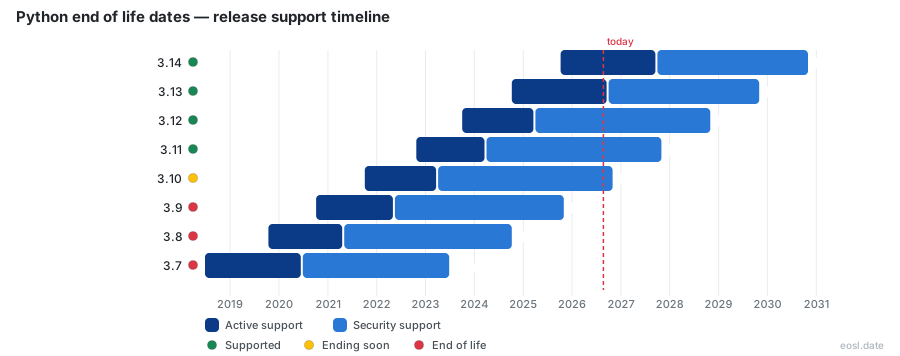
Currently Supported Python Releases - Active EOS/EOSL Support (5)
| Release | Pep | Released | Security Support | Active Support | Latest |
|---|---|---|---|---|---|
| 3.15 | PEP-0790 | (1 month and 4 days ago) | (in 4 years and 11 months) | (in 1 year and 10 months) | 3.15.2 (2 weeks and 5 days ago) |
| 3.14 | PEP-0745 | (1 year and 1 month ago) | (in 3 years and 11 months) | (in 10 months) | 3.14.10 (2 weeks and 5 days ago) |
| 3.13 | PEP-0719 | (2 years and 1 month ago) | (in 2 years and 11 months) | (1 month and 1 week ago) | 3.13.18 (2 weeks and 5 days ago) |
| 3.12 | PEP-0693 | (3 years and 1 month ago) | (in 1 year and 11 months) | (1 year and 7 months ago) | 3.12.16 (2 weeks and 5 days ago) |
| 3.11 | PEP-0664 | (4 years ago) | (in 11 months) | (2 years and 7 months ago) | 3.11.18 (2 weeks and 5 days ago) |
Python End of Life (EOL) Releases - No Longer Supported (13)
| Release | Pep | Released | Security Support | Active Support | Latest |
|---|---|---|---|---|---|
| 3.10 | PEP-0619 | (5 years and 1 month ago) | (1 month and 1 week ago) | (3 years and 7 months ago) | 3.10.22 (1 month and 1 week ago) |
| 3.9 | PEP-0596 | (6 years and 1 month ago) | (1 year ago) | (4 years and 5 months ago) | 3.9.25 (1 year ago) |
| 3.8 | PEP-0569 | (7 years ago) | (2 years and 1 month ago) | (5 years and 6 months ago) | 3.8.20 (2 years and 2 months ago) |
| 3.7 | PEP-0537 | (8 years and 4 months ago) | (3 years and 4 months ago) | (6 years and 4 months ago) | 3.7.17 (3 years and 5 months ago) |
| 3.6 | PEP-0494 | (9 years and 10 months ago) | (4 years and 10 months ago) | (7 years and 10 months ago) | 3.6.15 (5 years and 2 months ago) |
| 3.5 | PEP-0478 | (11 years and 2 months ago) | (6 years and 1 month ago) | — | 3.5.10 (6 years and 2 months ago) |
| 3.4 | PEP-0429 | (12 years and 7 months ago) | (7 years and 7 months ago) | — | 3.4.10 (7 years and 7 months ago) |
| 3.3 | PEP-0398 | (14 years and 1 month ago) | (9 years and 1 month ago) | — | 3.3.7 (9 years and 1 month ago) |
| 3.2 | PEP-0392 | (15 years and 8 months ago) | (10 years and 8 months ago) | — | 3.2.6 (12 years and 1 month ago) |
| 2.7 | PEP-0373 | (16 years and 4 months ago) | (6 years and 10 months ago) | — | 2.7.18 (6 years and 6 months ago) |
| 3.1 | PEP-0375 | (17 years and 4 months ago) | (14 years and 7 months ago) | — | 3.1.5 (14 years and 7 months ago) |
| 3.0 | PEP-0361 | (17 years and 11 months ago) | (17 years and 4 months ago) | — | 3.0.1 (17 years and 9 months ago) |
| 2.6 | PEP-0361 | (18 years and 1 month ago) | (13 years ago) | — | 2.6.9 (13 years ago) |
Python end of life is the moment the Python Software Foundation stops shipping security patches for a release of the programming language, so every new vulnerability in that version stays open for good. Use these Python EOL dates to see which Python version you can still trust, which one just lost support, and how long you have to move.
Python End of Life: How the Support Lifecycle Works
Every release follows the plan set out in PEP 602, so the Python lifecycle is predictable. Before launch, a branch passes through feature and prerelease stages. After the first release, the bug-fix phase lasts about two years: you get bug fixes, security fixes and regular binary releases roughly every two months. The status key calls this maintenance mode, the stable release stage, and it is the period of active support for Python.
Then the security-only phase runs about three years, and only security fixes land. New source-only builds appear when needed, with no installers. About five years in, the branch reaches its final phase, a code freeze: the tree is closed and CPython accepts no more patches.
Bug Fixes, Security Fixes and the Status Key
Bug fixes stop first; fixes for flaws continue until the final release of the branch. Security support is the part that matters most.
Why the Python Software Foundation Ends Support After Five Years
Volunteers maintain every Python branch, and five years keeps that workload manageable. The foundation sets the plan, and the people who run each branch can nudge dates by a few days.
Python End-of-Life Dates and the Full Chart
The table below lists the release schedule for every branch that still matters, taken from the Python developer guide. Read it as a support timeline: if a row says EOL, that Python version no longer receives a single fix, and you should plan a move now. The same release schedule is also published as a calendar and an RSS feed on endoflife.date, which also offers a JSON API for scripts, so you can track every release schedule change automatically.
| Version | First release | End of life | Status | PEP |
|---|---|---|---|---|
| 3.15 | 2026-10-09 | 2031-10 | bugfix | PEP 790 |
| 3.14 | 2025-10-07 | 2030-10 | bugfix | PEP 745 |
| 3.13 | 2024-10-07 | 2029-10 | security | PEP 719 |
| 3.12 | 2023-10-02 | 2028-10 | security | PEP 693 |
| 3.11 | 2022-10-24 | 2027-10 | security | PEP 664 |
| 3.10 | 2021-10-04 | 2026-10-01 | end-of-life | PEP 619 |
| 3.9 | 2020-10-05 | 2025-10-31 | end-of-life | PEP 596 |
| 3.8 | 2019-10-14 | 2024-10-07 | end-of-life | PEP 569 |
| 2.7 | 2010-07-03 | 2020-01-01 | end-of-life | PEP 373 |
Supported Versions: Python 3.11 Through 3.15
Python 3.11, Python 3.12, Python 3.13, Python 3.14 and Python 3.15 are the supported versions today. The newest, Python 3.15, only just left its release candidate stage, and each of these branches gets five years of life. The latest build of each is listed on the Python download page.
Unsupported Versions and the Release Manager Schedule
Every older branch is among the unsupported versions. A single release manager sets the final deadline for each branch, so the release schedule can move by days, and trackers of Python versions sometimes disagree.
Python 3.10: When Support Ended and What Follows
The developer guide lists Python 3.10 as end-of-life from 1 October 2026, and some trackers round that to the end of the month. Either way, support ended for 3.10 this month. Python 3.9 went first, on 31 October 2025, with 3.9.25 as its last build, and Python 3.9 still runs in a great many places.
Once a branch is frozen, every new CVE stays unpatched. A flaw like the tarfile bug fixed across 3.8 through 3.12 in 2024 would never reach Python 3.9 today, and a similar CVE found next year would be treated the same way. Libraries and frameworks also drop old versions from their CI/CD matrices, so the tools you rely on stop getting fixes too. Pattern matching and stricter type hints arrived in Python 3.10, which makes code written for it hard to move back to Python 3.9. Compliance teams treat an unmaintained runtime in production as an audit finding, and Python 3.9 on a public server is exactly that.
Red Hat RHEL 9 and Distribution Support Past Python EOL
Python 3.9 reached end of life upstream on 31 October 2025, yet your OS vendor can keep the Python 3.9 interpreter alive. Red Hat ships it with RHEL 9 and will backport fixes for the life of that operating system, to about 2032. That upstream status does not apply to the vendor build: the team chooses what to backport, and backported patches for critical or important CVEs ship, while lower-severity bugs stay open. Newer application streams on RHEL 8 offer 3.11 and 3.12 instead.
Ubuntu, Debian and Amazon Linux Coverage
Ubuntu LTS 22.04 ships Python 3.10 and gets security updates through April 2027, or April 2032 with Ubuntu Pro. Debian and Fedora publish their own Python packages on their own schedules, Debian often pinning an older branch for years, and Amazon Linux 2023 ships Python 3.9. Docker images, containers and cloud runtimes get none of this protection unless you pick a supported tag. Windows follows Microsoft platform lifetimes, and Python 3.8 was the last build that ran on Windows 7.
Security Vulnerabilities in End of Life Python Versions
Running an EOL interpreter is a security decision. The packages and libraries around it keep moving, and the wider ecosystem stops testing against it. "Security-only" support also affects your dependencies: once a release leaves active support, enterprise web applications and machine learning stacks hit compatibility issues first. Treat any flaw disclosed after the freeze as permanent, since no upstream patch will come.
Python 2.7 and Older Python Release Lines
The last Python 2 branch, Python 2.7, reached end of life on 1 January 2020, and its final build, 2.7.18, shipped in April 2020. Guido van Rossum led the move to Python 3, which launched as Python 3.0 in December 2008 and broke compatibility with Python 2 on purpose. The 2to3 tool helped for years, and legacy distutils code still breaks, but with no fixes since 2.7 went EOL, Python 2 style code simply needs a port. Python 3.7, Python 3.6 and Python 3.5 are long past support, and Python 3.0 itself ended in 2009. Python 2 is gone, and Python 2 code needs a port.
Python Lifecycle Planning: Upgrade and Migration Options
The safest plan has three steps: find what you run, pick a supported target, and test the move.
Check Your Python Version
Run python --version (or python3 --version) in each environment, then read the Python version against the table above. Check CI images, containers and servers, not only laptops.
Upgrade to a Supported Release
Moving to Python 3.12 or later is the clean fix. Test dependencies first, because a migration can surface removed modules.
- Inventory every environment that runs Python.
- Check package compatibility with the target.
- Pin the new version in CI before production.
Never-Ending Support and Extended Support
If you cannot move yet, Never-Ending Support from a commercial vendor or distribution extended support buys time, not safety forever.