Gleam End of Life (EOL) Dates and End of Support (EOS) Dates
Gleam end of life (EOL) and end of support (EOS) dates: 18 Gleam versions have reached EOL, including Gleam 1.17 (EOL date: Jul 29, 2026) — no longer receiving security updates or patches. Gleam 1.18.1 is the current supported release — 2 versions in active support. Also see Azul Zulu lifecycle dates for related end-of-life information.
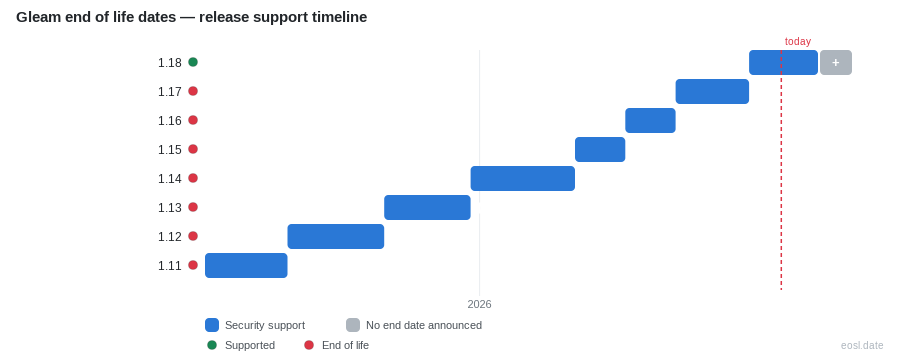
Currently Supported Gleam Releases - Active EOS/EOSL Support (2)
Gleam End of Life (EOL) Releases - No Longer Supported (18)
| Release | Released | Support | Latest |
|---|---|---|---|
| 1.17 | (5 months ago) | (3 months ago) | 1.17.0 (5 months ago) |
| 1.16 | (6 months ago) | (5 months ago) | 1.16.0 (6 months ago) |
| 1.15 | (7 months ago) | (6 months ago) | 1.15.4 (7 months ago) |
| 1.14 | (10 months ago) | (7 months ago) | 1.14.0 (10 months ago) |
| 1.13 | (1 year ago) | (10 months ago) | 1.13.0 (1 year ago) |
| 1.12 | (1 year and 3 months ago) | (1 year ago) | 1.12.0 (1 year and 3 months ago) |
| 1.11 | (1 year and 5 months ago) | (1 year and 3 months ago) | 1.11.1 (1 year and 5 months ago) |
| 1.10 | (1 year and 6 months ago) | (1 year and 5 months ago) | 1.10.0 (1 year and 6 months ago) |
| 1.9 | (1 year and 8 months ago) | (1 year and 6 months ago) | 1.9.1 (1 year and 8 months ago) |
| 1.8 | (1 year and 9 months ago) | (1 year and 8 months ago) | 1.8.1 (1 year and 9 months ago) |
| 1.7 | (1 year and 10 months ago) | (1 year and 9 months ago) | 1.7.0 (1 year and 10 months ago) |
| 1.6 | (1 year and 11 months ago) | (1 year and 10 months ago) | 1.6.3 (1 year and 11 months ago) |
| 1.5 | (2 years and 1 month ago) | (1 year and 11 months ago) | 1.5.1 (2 years and 1 month ago) |
| 1.4 | (2 years and 3 months ago) | (2 years and 1 month ago) | 1.4.1 (2 years and 3 months ago) |
| 1.3 | (2 years and 4 months ago) | (2 years and 3 months ago) | 1.3.2 (2 years and 4 months ago) |
| 1.2 | (2 years and 5 months ago) | (2 years and 4 months ago) | 1.2.1 (2 years and 5 months ago) |
| 1.1 | (2 years and 6 months ago) | (2 years and 5 months ago) | 1.1.1 (6 years and 3 months ago) |
| 1.0 | (2 years and 8 months ago) | (2 years and 6 months ago) | 1.0.0 (2 years and 8 months ago) |
If you are planning around Gleam end of life, the short answer is that no end-of-life date has been announced, and only the latest release is supported. Gleam is a young programming language that moves quickly, so knowing which release you run matters more than any calendar date, and this page explains how to read the current support status for your software.
Gleam End of Life: Is It Still Supported?
Gleam is actively maintained, and its latest release, 1.19.2, shipped on 12 October 2026. Tracking sites such as endoflife.date note that the project does not publish a formal support schedule. Judging by recent releases, only the newest stable release receives fixes, so the support you can count on is whatever the current line gets.
In practice, you should treat any older version as unsupported. Run gleam --version to see what your toolchain reports, then compare it with the latest release before you plan an upgrade.
Which Gleam Supported Release Gets Updates?
A traditional long-term support model keeps several older versions alive for years. Gleam does not work that way: the supported release is simply the most recent one, and new fixes land there first. That makes upgrades routine maintenance, not a rare migration project.
The project is open source under the Apache 2.0 license, so you can read the source code, follow changes in the repository on GitHub and read the changelog and documentation that accompany each version.
Gleam Programming Language Release Timeline
The milestones below show how quickly the language matured from a conference talk to a stable 1.x line.
| Milestone | Date | What happened |
|---|---|---|
| First appearance | June 2016 | Louis Pilfold created Gleam for a conference talk |
| First numbered version | 15 April 2019 | Early compiler and syntax became publicly usable |
| JavaScript target | v0.16 | Code could now compile to JavaScript as well as Erlang |
| Stable release | 4 March 2024 | Version 1.0.0 declared the language stable |
| Current release | 12 October 2026 | Version 1.19.2, with the toolchain written in Rust |
How the Gleam Language Runs on the Erlang VM
Gleam compiles to Erlang source code, which then runs on the Erlang VM, the same runtime behind systems like WhatsApp. It is a concurrent, fault tolerant and scalable foundation: multi-core actor based concurrency, fast immutable data structures and a garbage collector that never stops the world. Gleam even has its own type-safe take on OTP, Erlang's actor framework.
Because the runtime is decades old, the platform your Gleam backend sits on is not what limits its lifespan. The risk to watch is the language and its tooling, not the virtual machine.
BEAM Ecosystem Support
As part of the wider BEAM ecosystem, Gleam can call code written in Erlang and Elixir, so a Gleam server can reuse thousands of published packages. It can also target JavaScript, which means the same code can run in a browser, on a web server or anywhere JavaScript runs, and it generates TypeScript definitions for the outside world. That second target is a hedge against any single runtime or API changing.
Is the Gleam Programming Language Production Ready?
Yes. Version 1.0 in March 2024 marked the language as production ready, and a community-maintained list tracks companies using it. In April 2025 Thoughtworks placed Gleam in the Assess ring of its Technology Radar, and in the 2025 Stack Overflow Developer Survey it ranked as the second most admired language, with 70% of its users wanting to keep using it.
A published roadmap and regular releases suggest a healthy project, though the lack of a written support policy means you should plan to follow the latest release rather than pin a version for years.
Community and Adoption
Adoption is still growing, and the survey's developers say that clear code and friendly tooling drew them in. A 2024 survey with 841 responses found that most users come from ecosystems other than Erlang and Elixir. The community runs a newsletter that sends a few emails per year, and the project is funded by sponsors. Funding from individuals and companies is one of the practical signals that a language will still be maintained next year.
Gleam Lang Type System and Developer Experience
Gleam is a type-safe functional programming language with static typing and inference, so you rarely write annotations yet still get errors before your code runs. There are no null values and no exceptions, and failures use a result type instead. The developer experience is a core design goal, which is a big part of why people adopt it and why they are likely to keep maintaining it.
Pattern Matching and Static Typing
Its type system borrows from Elm, OCaml and Rust. You model data with algebraic data types, branch with pattern matching and rely on immutable data, so values never change unexpectedly. That discipline makes refactoring safer, which is what keeps long-lived projects cheap to upgrade across releases.
Language Server and Refactoring Tools
The toolchain ships as a single native binary containing the compiler, build tool, formatter, package manager and language server. Editors get completion and diagnostics from the language server, and automated refactoring helps when a new version renames or removes something. Having everything in one tool also means fewer separate pieces to fall out of date.
Package Manager and Library Support
Packages and libraries come from the Hex package manager, shared with the rest of the BEAM. Before upgrading, check that each of your dependencies supports the new Gleam version, since a library that stops being updated is often the real reason an older project gets stuck. Keep your project's lock file under version control, read each package's documentation and release notes, and watch the project's feed for new tags.