Keycloak End of Life (EOL) Dates and End of Support (EOS) Dates
Keycloak end of life (EOL) and end of support (EOS) dates: 27 Keycloak versions have reached EOL, including Keycloak 26.7 (EOL date: Oct 01, 2026) — no longer receiving security updates or patches. Keycloak 26.8.2 is the current supported release. Also see Graylog end of life dates for related end-of-life information.
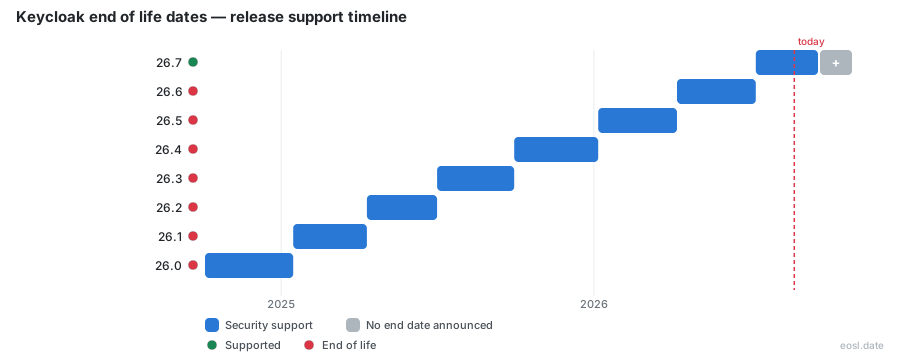
Currently Supported Keycloak Releases - Active EOS/EOSL Support (1)
| Release | Released | Supported | Latest |
|---|---|---|---|
| 26.8 | (1 month and 3 weeks ago) | Active | 26.8.2 (2 weeks and 3 days ago) |
Keycloak End of Life (EOL) Releases - No Longer Supported (27)
| Release | Released | Supported | Latest |
|---|---|---|---|
| 26.7 | (4 months ago) | (1 month and 3 weeks ago) | 26.7.5 (1 month and 3 weeks ago) |
| 26.6 | (7 months ago) | (4 months ago) | 26.6.4 (4 months ago) |
| 26.5 | (10 months ago) | (7 months ago) | 26.5.7 (7 months ago) |
| 26.4 | (1 year and 1 month ago) | (10 months ago) | 26.4.7 (11 months ago) |
| 26.3 | (1 year and 4 months ago) | (1 year and 1 month ago) | 26.3.5 (1 year and 1 month ago) |
| 26.2 | (1 year and 7 months ago) | (1 year and 4 months ago) | 26.2.5 (1 year and 5 months ago) |
| 26.1 | (1 year and 10 months ago) | (1 year and 7 months ago) | 26.1.5 (1 year and 7 months ago) |
| 26.0 | (2 years and 1 month ago) | (1 year and 10 months ago) | 26.0.8 (1 year and 10 months ago) |
| 25.0 | (2 years and 5 months ago) | (2 years and 1 month ago) | 25.0.6 (2 years and 2 months ago) |
| 24.0 | (2 years and 8 months ago) | (2 years and 5 months ago) | 24.0.5 (2 years and 5 months ago) |
| 23.0 | (2 years and 11 months ago) | (2 years and 8 months ago) | 23.0.7 (2 years and 9 months ago) |
| 22.0 | (3 years and 4 months ago) | (2 years and 11 months ago) | 22.0.5 (3 years ago) |
| 21.1 | (3 years and 7 months ago) | (3 years and 4 months ago) | 21.1.2 (3 years and 4 months ago) |
| 21.0 | (3 years and 8 months ago) | (3 years and 7 months ago) | 21.0.2 (3 years and 7 months ago) |
| 20.0 | (4 years ago) | (3 years and 8 months ago) | 20.0.5 (3 years and 9 months ago) |
| 19.0 | (4 years and 3 months ago) | (4 years ago) | 19.0.3 (4 years and 1 month ago) |
| 18.0 | (4 years and 7 months ago) | (4 years and 3 months ago) | 18.0.2 (4 years and 4 months ago) |
| 17.0 | (4 years and 9 months ago) | (4 years and 7 months ago) | 17.0.1 (4 years and 7 months ago) |
| 16.1 | (4 years and 11 months ago) | (4 years and 8 months ago) | 16.1.1 (4 years and 9 months ago) |
| 16.0 | (4 years and 11 months ago) | (4 years and 11 months ago) | 16.0.0 (4 years and 11 months ago) |
| 15.1 | (4 years and 11 months ago) | (4 years and 11 months ago) | 15.1.1 (4 years and 11 months ago) |
| 15.0 | (5 years and 3 months ago) | (4 years and 11 months ago) | 15.0.2 (5 years and 3 months ago) |
| 14.0 | (5 years and 5 months ago) | (5 years and 4 months ago) | 14.0.0 (5 years and 5 months ago) |
| 13.0 | (5 years and 6 months ago) | (5 years and 5 months ago) | 13.0.1 (5 years and 5 months ago) |
| 12.0 | (5 years and 11 months ago) | (5 years and 6 months ago) | 12.0.4 (5 years and 8 months ago) |
| 11.0 | (6 years and 4 months ago) | (5 years and 11 months ago) | 11.0.3 (6 years ago) |
| 10.0 | (6 years and 6 months ago) | (6 years and 4 months ago) | 10.0.2 (6 years and 5 months ago) |
Keycloak End of Life works differently from most software. The project, an open source identity and access management platform for single sign-on, never publishes fixed retirement dates. Instead, only the newest release is actively supported, and every older release stops receiving fixes once the next one ships. This guide shows how to read that policy, when each recent release ended, and how to plan around it.
Keycloak End of Life Explained
Keycloak is maintained by its community and sponsored by Red Hat, so you will not find a vendor calendar that says "version X retires on date Y". What you get is a rolling model: the newest release is the supported one, and everything behind it is superseded.
What end of life means for a release
For a Keycloak release line, end of life simply means the project no longer ships fixes for it. The line keeps running, your realms keep authenticating users, but a bug or flaw found tomorrow will be fixed only in the current release. Third-party trackers such as endoflife.date therefore mark a minor line as ended on the day its successor is published, and the project's own release policy says the same thing in plainer words.
An open source project with no fixed calendar
Keycloak is an open source community project released under the Apache License 2.0. Because nobody sells a promise of support for the free build, the project has no contractual retirement dates to publish. If you need dates you can put in a risk register, you need the commercial route described below.
How the Keycloak Life Cycle Works
The Keycloak life cycle is short and regular. A new minor appears roughly every quarter, a new major arrives every two to three years, and each release is supported until the next one replaces it.
Four minor releases a year
Keycloak plans a quarterly release cadence: four minor releases per year, with patch updates in between. A major version follows every two to three years. The 26.0 release on 4 October 2024 started the current major version, and the 26.x line has since reached 26.8.
Why only the newest release is supported
Only the latest major line receives active development and security fixes. Depending on severity, a flaw is repaired in the current release, or, for lower-severity hardening, in the next one. In practice, that means your install is covered only while it tracks the newest minor, and each batch of patch releases belongs to that line alone.
Latest version and supported versions
As of 27 October 2026 the latest version is 26.8.1, published on 13 October 2026. The only one of the supported versions in the community build is the 26.8 line. Release 26.7 ended on 1 October 2026, the day 26.8 arrived.
Keycloak EOL Dates by Release
Because the project publishes no calendar, the table below works backwards from the dates each release actually shipped. A line is treated as ended when the next minor was released; the last column is the number of days between the two dates.
| Release | Released | Support ended | Days supported |
|---|---|---|---|
| 26.7 | 9 Jul 2026 | 1 Oct 2026 | 84 |
| 26.6 | 8 Apr 2026 | 9 Jul 2026 | 92 |
| 26.5 | 6 Jan 2026 | 8 Apr 2026 | 92 |
| 26.4 | 30 Sep 2025 | 6 Jan 2026 | 98 |
| 26.3 | 2 Jul 2025 | 30 Sep 2025 | 90 |
| 26.2 | 11 Apr 2025 | 2 Jul 2025 | 82 |
| 26.1 | 15 Jan 2025 | 11 Apr 2025 | 86 |
| 26.0 | 4 Oct 2024 | 15 Jan 2025 | 103 |
Release dates and the support window
Across these eight lines the gap between release dates ranges from 82 to 103 days and averages about 91, roughly three months. Treat that as your planning horizon: a community minor you install today will likely be superseded within one quarter. The version history of older lines, back to 1.0 in 2014, is all marked as ended.
Red Hat build of Keycloak Support Policy
If three months is too short, the Red Hat build of Keycloak is the commercial offering built on the community code. Red Hat publishes a phased support policy so customers can plan deployments, and at least two minor versions of the Red Hat build of Keycloak are supported at any time. It is tested and certified on specific platforms and JVMs.
Full support phase
During full support you receive patch updates, critical and important security fixes, moderate CVE fixes, new features and new certifications. A major version of the Red Hat build of Keycloak 26.x stays in this phase until the next major release is available.
Maintenance support phase
When a new major arrives, the previous one moves into maintenance support for at least six months so you can upgrade. Critical and important fixes continue, moderate CVE fixes come at Red Hat's discretion, and new features stop. Red Hat's minor versions arrive about every six months and follow the even-numbered community minors, each receiving patches for roughly twelve months. An extended maintenance support add-on, sometimes called ELS, may be offered on the last minor of a major stream.
Long-term support options
The community build has no long-term support track. Teams that need one usually move to the Red Hat build of Keycloak, which replaces the older Red Hat Single Sign-On (RH-SSO) product. Each major 26.x release carries at least two years of life, and later majors three. Third-party vendors also sell an LTS style service for the community code.
End-of-Life Changes: Deprecation and Removal History
Separate from version retirement, individual components also reach the end of their road. The project marks them deprecated first and takes them out later, so a feature's deprecation is your warning to migrate.
Backwards compatibility between releases
Starting with 26.0, backwards compatibility is guaranteed in minor releases for fully supported features and APIs. When a minor ships breaking changes, they are opt-in, and a deprecated item is not removed until the next major version. Anything labelled preview or experimental can change at any time, so avoid building production flows on it.
Planned removals from the 2022 roadmap
The 2022 release plan shows how the process looks in practice. The WildFly distribution and the legacy Kubernetes Operator were slated to be removed in Keycloak 20, with the Quarkus distribution taking over. The old Admin Console was set to go in Keycloak 21, and several OpenID Connect and SAML adapters, such as Jetty and Tomcat, were removed across 19 and 22. Each removal acted as an end of life for that component: it was simply absent from the supported releases that followed. Many were Java application server integrations, so teams on them had to migrate before they could take the newer release, and the JVMs they ran on mattered.
Keycloak Lifecycle Risks and Upgrade Planning
A Keycloak lifecycle gap matters because identity sits in front of every application you run. An unpatched login server is a high-value target.
Security exposure after a release ends
Once your line is superseded, any new vulnerability or CVE is fixed only in the current release, so a delayed upgrade leaves you carrying known flaws. Keep a regular security review on the calendar, and plan one support check each quarter, in step with the release rhythm.
Move one minor release at a time
Read the upgrade guide and release notes before every jump, then test on a copy of your database. Supported database versions are listed per Keycloak release, so an older PostgreSQL major version that is past its own end date can block the move and force a database change alongside Keycloak.