Harbor End of Life (EOL) Dates and End of Support (EOS) Dates
Harbor end of life (EOL) and end of support (EOS) dates: 16 Harbor versions have reached EOL, including Harbor 2.13 (EOL date: Nov 10, 2026) — no longer receiving security updates or patches. Harbor 2.16.0 is the current supported release — 3 versions in active support. Also see Argo Workflows EOSL dates for related end-of-life information.
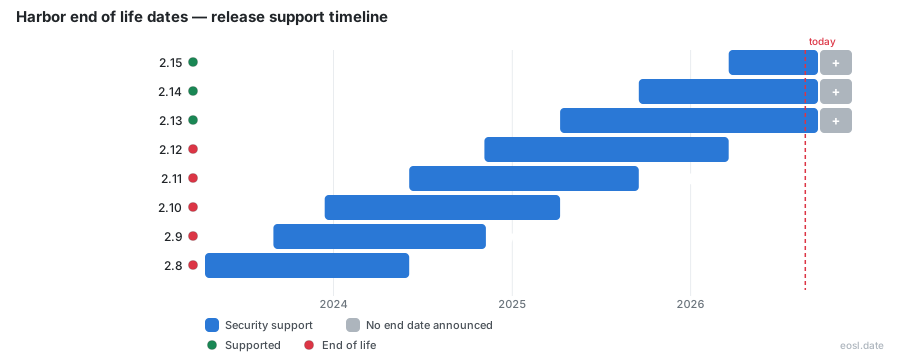
Currently Supported Harbor Releases - Active EOS/EOSL Support (3)
Harbor End of Life (EOL) Releases - No Longer Supported (16)
| Release | Released | Support | Latest |
|---|---|---|---|
| 2.13 | (1 year and 7 months ago) | (1 week and 5 days ago) | 2.13.6 (1 month and 2 weeks ago) |
| 2.12 | (2 years ago) | (8 months ago) | 2.12.4 (1 year and 5 months ago) |
| 2.11 | (2 years and 5 months ago) | (1 year and 2 months ago) | 2.11.2 (2 years ago) |
| 2.10 | (2 years and 11 months ago) | (1 year and 7 months ago) | 2.10.3 (2 years and 4 months ago) |
| 2.9 | (3 years and 2 months ago) | (2 years ago) | 2.9.5 (2 years and 4 months ago) |
| 2.8 | (3 years and 7 months ago) | (2 years and 5 months ago) | 2.8.6 (2 years and 7 months ago) |
| 2.7 | (3 years and 11 months ago) | (2 years and 11 months ago) | 2.7.4 (2 years and 11 months ago) |
| 2.6 | (4 years and 2 months ago) | (3 years and 2 months ago) | 2.6.4 (3 years and 9 months ago) |
| 2.5 | (4 years and 7 months ago) | (3 years and 7 months ago) | 2.5.6 (3 years and 8 months ago) |
| 2.4 | (5 years ago) | (3 years and 11 months ago) | 2.4.3 (4 years and 3 months ago) |
| 2.3 | (5 years and 5 months ago) | (4 years and 2 months ago) | 2.3.5 (4 years and 11 months ago) |
| 2.2 | (5 years and 8 months ago) | (4 years and 7 months ago) | 2.2.4 (5 years ago) |
| 2.1 | (6 years and 2 months ago) | (5 years ago) | 2.1.6 (5 years and 4 months ago) |
| 2.0 | (6 years and 6 months ago) | (5 years and 5 months ago) | 2.0.6 (5 years and 9 months ago) |
| 1.10 | (6 years and 11 months ago) | (5 years and 8 months ago) | 1.10.19 (2 years and 2 months ago) |
| 1.9 | (7 years and 2 months ago) | (6 years and 2 months ago) | 1.9.4 (6 years and 10 months ago) |
Running a container registry past its support window is how unpatched flaws reach production, so Harbor end of life is worth checking before your next upgrade. Harbor is a stable, open source registry for container images and other artifacts, and only its newest minor lines are still fixed. Here is how to tell whether yours is, using the project's own end-of-life data and upgrade rules.
Harbor End of Life: Which Releases Still Get Support
Harbor holds graduated project status at the CNCF but publishes no fixed end-of-life calendar. Tracker sites read it differently: one says the latest three minor lines receive critical community and security fixes, each maintained for roughly nine months, while another notes Harbor follows a "latest version" model where only the newest line is considered current. Either way, an older line is a risk. Treat anything outside the newest three as EOL, with no long-term support promised and no LTS line.
Latest Version and Minor Release Support
A minor release such as 2.15 receives patch version updates (2.15.4 at the time of writing) until newer lines push it out. Check the latest version for your line before you plan anything; a supported release you have not patched is still exposed.
Harbor Releases and Version History
The table below summarises the version history for recent lines, as listed by endoflife.date on 24 October 2026. The vendor behind the project is the open Harbor community, under an Apache License, so the licence never changes the support picture.
| Release | Release date | Support | Latest patch |
|---|---|---|---|
| 2.15 | 20 Mar 2026 | Supported | 2.15.4 |
| 2.14 | 17 Sep 2025 | Supported | 2.14.6 |
| 2.13 | 9 Apr 2025 | Supported | 2.13.6 |
| 2.12 | 5 Nov 2024 | Ended 20 Mar 2026 | 2.12.4 |
| 2.11 | 4 Jun 2024 | Ended 17 Sep 2025 | 2.11.2 |
Release Date and Supported Release Windows
Each line's support ends when the third newer line ships, so the release date of 2.15 closed 2.12. Versions flagged unstable, or tied to a known CVE, deserve a faster move.
Harbor Release Upgrade Policy
The upgrade policy allows upgrades only from the n-2 minor release: going from 2.9 to 2.11 works, from 2.8 to 2.11 does not. An upgrade from an unsupported line therefore means stepping through intermediate versions, so start early. Verify downloads with the signing checks the project publishes, and use tagged releases, never the main branch, in production.
Managing the Harbor Lifecycle with Docker Compose
A compose-based installation gives you the full Harbor lifecycle from a few docker commands run beside docker-compose.yml:
- Stop the stack with
sudo docker-compose stopand restart it withsudo docker-compose start. - Reconfigure by running
sudo docker-compose down -v, editingharbor.yml, thensudo prepareandsudo docker-compose up -d. - Back up the database and registry data under
/databefore any upgrade; that directory holds your images.
This management routine sits on top of Docker Distribution, so run garbage collection to reclaim space, and review replication rules, policies and Helm charts after each configuration change. The same lifecycle applies to any Docker host or Kubernetes install.
Security Issues Once Harbor Reaches EOL
After EOL, security issues are no longer fixed on your line, so new vulnerabilities pile up while your audit trail still expects compliance. Harbor's vulnerability scanning, role based access control and OIDC or LDAP identity integration protect a trusted, multi-tenant, cloud native registry, but only a patched build keeps them reliable. Unsupported code also risks performance and interoperability problems with newer Kubernetes and OCI clients, and auditing tools flag it. Read each security advisory for your line, and treat a critical vulnerability as a reason to upgrade immediately.
Open Source Harbor Community and Enterprise Support After EOL
Harbor is run by the Cloud Native Computing Foundation and a global community, which maintains the open-source edition. An enterprise edition sold by a vendor adds its own support terms, so check them for compatibility with your administration tooling and ask for written dates.