Grafana Loki End of Life (EOL) Dates and End of Support (EOS) Dates
Grafana Loki end of life (EOL) and end of support (EOS) dates: 23 Grafana Loki versions have reached EOL, including Grafana Loki 3.5 (EOL date: Mar 26, 2026) — no longer receiving security updates or patches. Grafana Loki 3.7.10 is the current supported release — 2 versions in active support. Also see Apache Subversion end of support life for related end-of-life information.
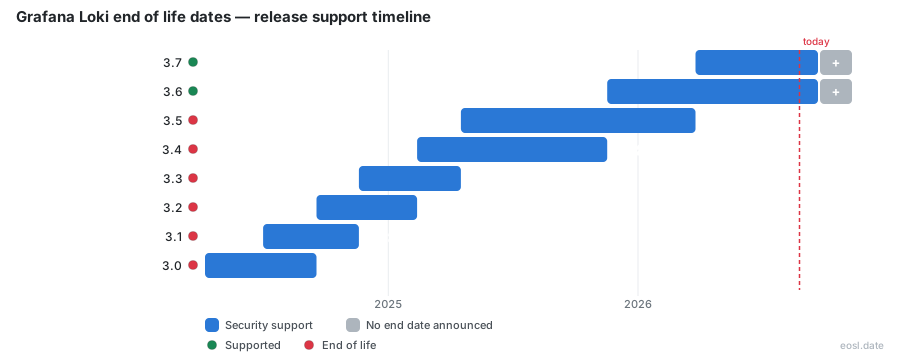
Currently Supported Grafana Loki Releases - Active EOS/EOSL Support (2)
Grafana Loki End of Life (EOL) Releases - No Longer Supported (23)
| Release | Released | Security Support | Latest |
|---|---|---|---|
| 3.5 | (1 year and 7 months ago) | (7 months ago) | 3.5.12 (8 months ago) |
| 3.4 | (1 year and 9 months ago) | (1 year ago) | 3.4.6 (1 year and 2 months ago) |
| 3.3 | (2 years ago) | (1 year and 7 months ago) | 3.3.4 (1 year and 7 months ago) |
| 3.2 | (2 years and 2 months ago) | (1 year and 9 months ago) | 3.2.2 (1 year and 11 months ago) |
| 3.1 | (2 years and 4 months ago) | (2 years ago) | 3.1.2 (2 years and 1 month ago) |
| 3.0 | (2 years and 7 months ago) | (2 years and 2 months ago) | 3.0.1 (2 years and 3 months ago) |
| 2.9 | (3 years and 2 months ago) | (1 year ago) | 2.9.17 (1 year ago) |
| 2.8 | (3 years and 7 months ago) | (2 years and 7 months ago) | 2.8.11 (2 years and 8 months ago) |
| 2.7 | (4 years ago) | (3 years and 2 months ago) | 2.7.7 (3 years and 3 months ago) |
| 2.6 | (4 years and 4 months ago) | (4 years ago) | 2.6.1 (4 years and 4 months ago) |
| 2.5 | (4 years and 7 months ago) | (4 years and 4 months ago) | 2.5.0 (4 years and 7 months ago) |
| 2.4 | (5 years ago) | (4 years and 7 months ago) | 2.4.2 (4 years and 10 months ago) |
| 2.3 | (5 years and 3 months ago) | (5 years ago) | 2.3.0 (5 years and 3 months ago) |
| 2.2 | (5 years and 8 months ago) | (5 years and 3 months ago) | 2.2.1 (5 years and 7 months ago) |
| 2.1 | (5 years and 10 months ago) | (5 years and 8 months ago) | 2.1.0 (5 years and 10 months ago) |
| 2.0 | (6 years ago) | (5 years and 10 months ago) | 2.0.1 (5 years and 10 months ago) |
| 1.6 | (6 years and 3 months ago) | (6 years ago) | 1.6.1 (6 years and 2 months ago) |
| 1.5 | (6 years and 6 months ago) | (6 years and 3 months ago) | 1.5.0 (6 years and 6 months ago) |
| 1.4 | (6 years and 7 months ago) | (6 years and 6 months ago) | 1.4.1 (6 years and 7 months ago) |
| 1.3 | (6 years and 10 months ago) | (6 years and 7 months ago) | 1.3.0 (6 years and 10 months ago) |
| 1.2 | (6 years and 11 months ago) | (6 years and 10 months ago) | 1.2.0 (6 years and 11 months ago) |
| 1.1 | (6 years and 11 months ago) | (6 years and 11 months ago) | 1.1.0 (6 years and 11 months ago) |
| 1.0 | (7 years and 3 months ago) | (6 years and 11 months ago) | 1.0.2 (7 years and 3 months ago) |
Wondering when your logging stack stops getting fixes? The Grafana Loki end of life picture has three parts: Loki has no fixed expiry date, Grafana Agent reached end-of-life on November 1, 2025, and Promtail has its own EOL in March 2026. This guide shows which release lines still get fixes and what you should migrate.
Grafana Loki end of life: what it means for your logs
Loki is a log aggregation system from Grafana Labs, so its end of support matters for every log you store. It is cost-effective because it uses label-based indexing: it indexes a set of labels for each stream instead of the contents of your logs. It is also scalable (horizontally scalable), highly available and multi-tenant, and it is open source. Because it stores logs rather than dashboards or metrics, an unsupported Loki leaves your log pipeline without fixes, even if your visualizations keep working.
The lifecycle question therefore is not "when does Loki die?" but "which release am I running, and is it still patched?"
Does Loki publish a fixed end-of-life schedule?
No. Loki follows a latest-version model with no calendar of EOL dates: only the newest major line is current, and the older release lines remain usable but superseded. Version trackers therefore infer an end date from when a release stops receiving patches. Treat that date as the point where your version is no longer supported, not as a shutdown. Unstable builds are never covered.
Loki EOL support policy and security support
Grafana provides security patches for the last two minor releases of the current major version, plus the last minor release of the previous major version. That is the effective Loki EOL rule: when a newer minor release ships, the oldest covered minor drops out of security support and stops getting bug fixes. A supported release is one still inside that window, and the vendor support you can rely on ends the day it leaves it. Each point release (a patch) only lands on supported lines.
Long-term support and Grafana Cloud
Loki ships no LTS line, so there is no long-term support track to wait for. If you use Grafana Cloud, the hosted service, its support options are separate from this policy and the vendor handles upgrades for you.
Grafana Loki releases and release schedule
A new minor appears roughly every few months, and the release dates below show how quickly older lines drop out. Data is as of late October 2026; confirm against the project's documentation before you act.
| Release | Released | Security support | Latest patch |
|---|---|---|---|
| 3.7 | 26 Mar 2026 | Yes | 3.7.9 (20 Oct 2026) |
| 3.6 | 17 Nov 2025 | Yes | 3.6.19 (20 Oct 2026) |
| 3.5 | 17 Apr 2025 | Ended 26 Mar 2026 | 3.5.12 (11 Mar 2026) |
| 3.4 | 12 Feb 2025 | Ended 17 Nov 2025 | 3.4.6 (09 Sep 2025) |
| 2.9 | 06 Sep 2023 | Ended 07 Nov 2025 | 2.9.17 (07 Nov 2025) |
Latest version of Loki
The latest version is 3.7.9, released on 20 October 2026. If you run anything older than 3.6, plan an upgrade now.
Version history of ended release lines
The version history spans four lines (0, 1, 2 and 3) and 128 versions, 102 of them affected by a CVE. The GitHub project and the release notes list every one, so check them before you pick a target.
Grafana Agent end-of-life and migrating to Grafana Alloy
Grafana Agent Static, Grafana Agent Flow and the Grafana Agent Operator (the Kubernetes operator) reached end-of-life on November 1, 2025. Grafana Agent no longer gets vendor support, security patches or bug fixes. Grafana Alloy, Grafana Labs' distribution of the OpenTelemetry collector, is the replacement, and the project documents how to migrate from the Agent in each mode, as well as from the OpenTelemetry collector or Prometheus. Anything that was deprecated in the Agent now has to be handled during that migration.
Most Loki setups received logs through the Agent, which did more than ship logs. It also forwarded metrics to Prometheus-compatible stores and traces to Tempo or Jaeger, so the same Loki migration can touch your whole pipeline, not just Loki; check the Tempo endpoint settings as carefully as the Loki ones. Teams that visualize all three signals in Grafana dashboards should migrate the log, metric and trace paths together, then compare the dashboards before and after. Each breaking change below comes from the old release notes and matters to a Loki migration because the same Agent configuration often feeds Loki, so check each in your configuration first, because a deprecated option fails quietly until it is removed.
Breaking change: renamed Loki processing stage
In Agent v0.37 the non_indexed_labels stage became structured_metadata, so an old configuration for logs stops working until you rename it. Leave it alone and the pipeline stage fails at load time, which is a clear signal rather than silent data loss.
Breaking change: removed Jaeger trace export
Agent v0.38 removed Jaeger-formatted trace export. If your Agent configuration also feeds Loki, this change sits in the same file as your log pipeline. Send OTLP traces to a Jaeger version that accepts OTLP, or to Tempo, instead. If you still export traces in the old format, plan this change before you move metrics and traces to Alloy, and re-test that Tempo or Jaeger receives them.
Breaking change: HTTP 429 retry default
Agent v0.37 set retry_on_http_429 to true for remote_write metrics. The same configuration file often holds your Loki log pipeline, so review it together. Set it to false explicitly if you need the old behaviour. The default matters most when metrics flow to Prometheus or a hosted backend, because retries help avoid dropped data points during throttling.
Promtail EOL and what replaces it
Promtail, Loki's own log shipper, has also reached EOL, with Grafana's announcement setting March 2026 as the date. Existing Loki server deployments keep running, but Promtail no longer gets fixes. Like the Agent, it is superseded by Alloy, which includes a Promtail migration path, so your Loki servers, queries and dashboards can stay as they are.
Loki lifecycle checklist: plan an upgrade and check your version
Ask the binary which release it is, then compare the answer with the table above:
loki --versionIf the output is older than 3.6, upgrade to the latest minor. Read the release notes first, back up your configuration, and roll out to a staging instance of your log aggregation setup before production. Then confirm that Docker images and Helm charts point to a supported tag.
Act on deprecation notices before removal
Inventory your collectors: replace any Grafana Agent or Promtail instance with Alloy, and clear any deprecated flags from the configuration. A deprecation notice is the vendor's early warning that a later release removes the feature, and the deprecated option may stop working with no further notice. Recheck the Tempo and Prometheus outputs once the new collector runs.