Google Kubernetes Engine End of Life (EOL) Dates and End of Support (EOS) Dates
Google Kubernetes Engine end of life (EOL) and end of support (EOS) dates: 17 Google Kubernetes Engine versions have reached EOL, including Google Kubernetes Engine 1.33 (EOL date: Aug 12, 2026) — no longer receiving security updates or patches. Google Kubernetes Engine 1.34 reaches its End of Support date on Jan 25, 2027 — plan your upgrade path now. Google Kubernetes Engine 1.37.2-gke.1325000 is the current supported release, with support through Dec 22, 2027 — 2 versions in active support. Also see Google Chrome EOSL dates for related end-of-life information.
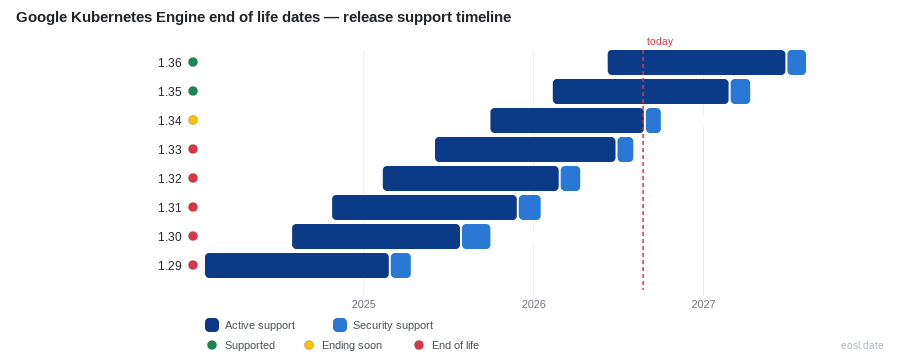
Currently Supported Google Kubernetes Engine Releases - Active EOS/EOSL Support (2)
| Release | Released | Maintenance Support | Active Support | Latest |
|---|---|---|---|---|
| 1.37 | (3 weeks and 5 days ago) | (in 1 year and 1 month) | (in 11 months) | 1.37.2-gke.1325000 (4 days ago) |
| 1.36 | (5 months ago) | (in 8 months) | (in 7 months) | 1.36.5-gke.2370000 (4 days ago) |
Google Kubernetes Engine Releases Nearing End of Life - Support Ending Soon (2)
| Release | Released | Maintenance Support | Active Support | Latest |
|---|---|---|---|---|
| 1.34 | (11 months ago) | (in 2 months) | (in 1 week and 6 days) | 1.34.12-gke.1776000 (4 days ago) |
| 1.35 | (9 months ago) | (in 4 months) | (in 3 months) | 1.35.9-gke.1673000 (1 week ago) |
Google Kubernetes Engine End of Life (EOL) Releases - No Longer Supported (17)
| Release | Released | Maintenance Support | Active Support | Latest |
|---|---|---|---|---|
| 1.33 | (1 year and 5 months ago) | (3 months ago) | (4 months ago) | 1.33.13-gke.2398000 (4 days ago) |
| 1.32 | (1 year and 9 months ago) | (6 months ago) | (8 months ago) | 1.32.13-gke.3070000 (4 days ago) |
| 1.31 | (2 years ago) | (10 months ago) | (11 months ago) | 1.31.14-gke.3042000 (3 weeks and 1 day ago) |
| 1.30 | (2 years and 3 months ago) | (1 year and 1 month ago) | (1 year and 3 months ago) | 1.30.14-gke.2866000 (3 months ago) |
| 1.29 | (2 years and 9 months ago) | (1 year and 7 months ago) | (1 year and 8 months ago) | 1.29.15-gke.2725000 (9 months ago) |
| 1.28 | (2 years and 11 months ago) | (1 year and 9 months ago) | (1 year and 10 months ago) | 1.28.15-gke.3290000 (10 months ago) |
| 1.27 | (3 years and 5 months ago) | (2 years and 1 month ago) | (2 years and 3 months ago) | 1.27.16-gke.2894000 (1 year and 4 months ago) |
| 1.26 | (3 years and 7 months ago) | (2 years and 4 months ago) | (2 years and 6 months ago) | 1.26.15-gke.1469001 (2 years and 4 months ago) |
| 1.25 | (3 years and 11 months ago) | (2 years and 7 months ago) | (2 years and 9 months ago) | 1.25.16-gke.1759000 (2 years and 6 months ago) |
| 1.24 | (4 years and 4 months ago) | (3 years ago) | (3 years and 2 months ago) | 1.24.17-gke.2472000 (2 years and 10 months ago) |
| 1.23 | (4 years and 6 months ago) | (3 years and 3 months ago) | (3 years and 5 months ago) | 1.23.17-gke.10700 (3 years and 3 months ago) |
| 1.22 | (4 years and 8 months ago) | (3 years and 6 months ago) | (3 years and 8 months ago) | 1.22.17-gke.14100 (3 years and 4 months ago) |
| 1.21 | (5 years and 1 month ago) | (3 years and 9 months ago) | (4 years ago) | 1.21.14-gke.18800 (3 years and 7 months ago) |
| 1.20 | (5 years and 5 months ago) | (4 years and 3 months ago) | (4 years and 11 months ago) | 1.20.15-gke.13700 (4 years and 2 months ago) |
| 1.19 | (5 years and 7 months ago) | (4 years and 5 months ago) | (5 years and 1 month ago) | 1.19.16-gke.15700 (4 years and 4 months ago) |
| 1.17 | (5 years and 7 months ago) | (5 years ago) | (5 years and 4 months ago) | 1.17.17-gke.9100 (5 years and 5 months ago) |
| 1.18 | (5 years and 7 months ago) | (4 years and 8 months ago) | (5 years and 3 months ago) | 1.18.20-gke.6000 (5 years and 2 months ago) |
Running a cluster on Google Kubernetes Engine end of life dates in mind keeps you off an unsupported release. GKE is a managed Kubernetes service on Google Cloud, so GKE end of support is not a surprise outage: each version has a published EOL, and Google upgrades any cluster that overstays. Here is how to read those dates and plan around them.
Google Kubernetes Engine End of Life Dates by Kubernetes Version
Every Kubernetes version GKE offers, such as 1.35, passes through two phases once it is generally available: standard support, then maintenance support. Google Cloud provides 14 months of support for a minor version after it reaches the Regular channel, and every patch release inside it follows the same end-of-life dates. Standard support is the window with full fixes and the SLA behind it. The table below shows the end-of-life dates as listed by endoflife.date for the No Channel (static) track of Google Kubernetes Engine.
| Version | Released | Standard support ends | Maintenance support ends |
|---|---|---|---|
| 1.32 | 11 Feb 2025 | 28 Feb 2026 | 11 Apr 2026 |
| 1.33 | 3 Jun 2025 | 30 Jun 2026 | 3 Aug 2026 |
| 1.34 | 30 Sep 2025 | 30 Aug 2026 | 1 Oct 2026 |
| 1.35 | 11 Feb 2026 | 28 Feb 2027 | 11 Apr 2027 |
| 1.36 | 9 Jun 2026 | 30 Jun 2027 | 9 Aug 2027 |
Trackers do not always agree. Another tracker lists 1.34 standard support running to January 2027, so treat any GKE version end of support table as a starting point and confirm the exact day against the Google Cloud release notes before you commit to a deadline. Standard support is the date to plan around; maintenance support is the grace period after it.
GKE Extended Support and the Cluster Management Fee
When standard support ends, extended support can keep an older version alive, but only for clusters on the Extended channel. Extended support adds a charge of $0.50 per cluster-hour on top of the usual $0.10 cluster management fee, so treat extended support pricing as a bridge to an upgrade rather than a place to stay. Google Cloud bills it only while a cluster runs a version past standard support.
How Release Channels Shape GKE End of Support
Google Kubernetes Engine offers three release channels: the Rapid channel, the Regular channel (the default) and Stable. A cluster enrolled in a release channel gets its version and upgrade cadence managed for it, and the end-of-life date for a version is the same whichever channel you pick. Control plane upgrades happen automatically, with or without a channel, and cannot be switched off, so your upgrade strategy is really about timing and testing rather than opting out.
Because node auto-upgrade is on by default for Standard clusters, nodes follow the control plane unless you intervene. Subscribe to security bulletins through the RSS feed, or receive upgrade notices over Pub/Sub.
No Channel Clusters and the Version Skew Policy
A cluster with no channel stays on a static version, and you own the schedule. Node pools may trail the control plane by up to two minor versions under the version skew policy, and in Autopilot, GKE manages the infrastructure and always upgrades nodes to the control plane version. Google Cloud may still upgrade nodes in select cases for compatibility, so a static cluster is not frozen.
Planned Changes, Retirement and Deprecation Notices
Version dates are only half the picture. Google Cloud publishes planned changes for retirements and forced upgrades across Kubernetes releases, and adding them to a calendar means a security-driven change never lands unannounced.
Upcoming Static Version Removal
Managed Kubernetes on Google Cloud is moving away from unenrolled clusters: the option to skip a release channel is deprecated and slated for removal on June 14, 2027, so plan to enrol any static cluster before then.
Identity Service for GKE Deprecation
Identity Service for GKE is deprecated in version 1.36 and earlier, and it is no longer supported from 1.37, which blocks new or upgraded clusters that still have it enabled.
What to Check Before a GKE EOL Upgrade
Upgrading the control plane is the easy part. Workloads break when manifests and Helm charts still call interfaces the new version stopped serving, so read the Kubernetes upgrade guide and the Google Cloud notes for your target first.
Removed APIs and Deprecated API Usage
Search for removed APIs in your repositories, because upgrading a cluster never rewrites stored YAML. One example: the 1.32 release stopped serving the v1beta3 flow-control API versions in favour of v1. Kubernetes moves one minor version at a time, so check every deprecated API between your current and target releases.
Add-ons, Ingress Controllers and Node Images
- Google Cloud manages the built-in add-ons in each Kubernetes release; check the ones you installed yourself, including CSI and CNI drivers.
- Test ingress controllers, cert-manager, a service mesh and autoscalers against their own supported-version matrix.
- Review the node image changes (Container-Optimized OS or Ubuntu), since the kubelet must stay within skew.
Tools That Detect Deprecation Issues
Google Cloud's GKE deprecation insights flag problem calls and can pause an automatic upgrade. Open-source helpers fill the rest: kubent scans a live cluster, Pluto checks files and Helm releases, and kubectl convert rewrites a manifest to a newer API.