Gatekeeper End of Life (EOL) Dates and End of Support (EOS) Dates
Gatekeeper end of life (EOL) and end of support (EOS) dates: 11 Gatekeeper versions have reached EOL, including Gatekeeper 3.21 (EOL date: Jul 09, 2026) — no longer receiving security updates or patches. Gatekeeper 3.23.1 is the current supported release — 2 versions in active support. Also see Envoy EOSL dates for related end-of-life information.
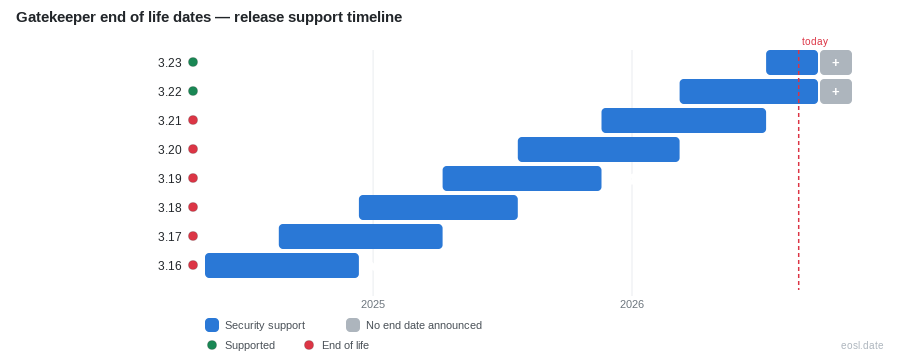
Currently Supported Gatekeeper Releases - Active EOS/EOSL Support (2)
Gatekeeper End of Life (EOL) Releases - No Longer Supported (11)
| Release | Released | Support | Latest |
|---|---|---|---|
| 3.21 | (1 year ago) | (4 months ago) | 3.21.1 (9 months ago) |
| 3.20 | (1 year and 4 months ago) | (8 months ago) | 3.20.1 (1 year and 2 months ago) |
| 3.19 | (1 year and 7 months ago) | (1 year ago) | 3.19.3 (1 year and 4 months ago) |
| 3.18 | (1 year and 11 months ago) | (1 year and 4 months ago) | 3.18.3 (1 year and 6 months ago) |
| 3.17 | (2 years and 3 months ago) | (1 year and 7 months ago) | 3.17.2 (1 year and 10 months ago) |
| 3.16 | (2 years and 6 months ago) | (1 year and 11 months ago) | 3.16.3 (2 years and 6 months ago) |
| 3.15 | (2 years and 9 months ago) | (2 years and 3 months ago) | 3.15.1 (2 years and 8 months ago) |
| 3.14 | (3 years ago) | (2 years and 6 months ago) | 3.14.2 (2 years and 7 months ago) |
| 3.13 | (3 years and 3 months ago) | (2 years and 9 months ago) | 3.13.4 (3 years ago) |
| 3.12 | (3 years and 7 months ago) | (3 years ago) | 3.12.0 (3 years and 7 months ago) |
| 3.11 | (3 years and 10 months ago) | (3 years and 3 months ago) | 3.11.1 (3 years and 6 months ago) |
If you are searching for Gatekeeper end of life dates, first work out which product you run, because three unrelated products share the name. The open source policy controller for Kubernetes has a clear, published schedule, while Nuance's voice biometrics product has no confirmed shutdown date yet, and security teams still need a plan for both.
Gatekeeper end of life: which Gatekeeper do you mean?
Gatekeeper is three different things in search results. The first is the Kubernetes admission project from the Open Policy Agent community. The second is Nuance's cloud-native voice authentication platform used by banks and tax agencies. The third is a proximity login tool for Windows and macOS workstations.
Each has its own owner, its own documentation and its own timeline, so a date quoted for one tells you nothing about the others. The sections below take them in turn, starting with the one that has the most precise public data.
Gatekeeper releases for the Kubernetes policy controller
The policy controller lets platform teams enforce policies on a cluster and strengthen governance without hand-reviewing every manifest. It plugs into admission control, checks each request against your policy rules, and runs an audit pass over resources that already exist. The project's lifecycle tracker lists every Gatekeeper releases line like this:
| Release line | Released | Status | Latest patch |
|---|---|---|---|
| 3.23 | 9 Jul 2026 | Covered | 3.23.1 (27 Aug 2026) |
| 3.22 | 9 Mar 2026 | Covered | 3.22.2 (27 Apr 2026) |
| 3.21 | 19 Nov 2025 | Ended 9 Jul 2026 | 3.21.1 (4 Feb 2026) |
| 3.20 | 24 Jul 2025 | Ended 9 Mar 2026 | 3.20.1 (29 Aug 2025) |
| 3.19 | 9 Apr 2025 | Ended 19 Nov 2025 | 3.19.3 (15 Jul 2025) |
The pattern is predictable: a line loses coverage the day the next one ships, so each stays covered for roughly eight months.
Which versions get bug and security fixes
Only the latest two releases are covered. Today that means 3.23 and 3.22; anything older no longer receives bug fixes or security fixes, so a cluster on 3.20 is exposed to every issue patched since. Treat the rule as the whole policy: it is the simplest answer to what a supported release means here.
Latest version, bug fixes and how to upgrade the controller
The latest version is 3.23.1, published on 27 August 2026. It sits on the 3.23 line, which stays covered until the 3.24 line ships. It makes the generated validating admission policy deterministic to stop a reconcile loop and adds a default failure policy for native validation templates. A pre-release, 3.24.0-beta.0, is already available for testing but is not meant for production.
To upgrade, read the project's change log for your line, then roll out the new chart with Helm. Because the chart pins dependencies such as the Go runtime and OpenTelemetry libraries, a routine update also picks up a new release of those along with security updates. Every release is immutable once published, so test it in a staging cluster first and download only images from the official registry.
Will Microsoft retire Nuance voice biometrics?
The caller-authentication Gatekeeper is the cloud-native successor to the older platform and runs on Azure, so a customer's exit options differ from those of an on-premises estate.
This is the part of the Gatekeeper story that worries enterprise customers. After the acquisition of Nuance by Microsoft closed in March 2022, marketing resources moved elsewhere in 2023, sales teams were let go or reassigned in 2024, and the professional services arm was spun out to HCL. In late 2024 Microsoft announced the end of Nuance's natural language understanding, IVR and speech recognition lines, but gave no matching statement for its voice biometrics products.
Those products help a call centre authenticate callers by voice, which matters for fraud prevention and for customer authentication without PINs. Demand has risen with the deepfake threat, yet Microsoft's own contact centre offering, Dynamics 365 Contact Center, no longer mentions biometrics in its literature, and the in-house Azure AI Speaker Recognition service was due to retire in September 2025. Our reading, from the sources available, is that Microsoft is not pushing the technology forward, although it has not said it will retire it. In the same period, other large cloud vendors also left the market, which narrows the choice of alternatives.
Security Suite extended support
The older Security Suite is the on-premises version. It was in extended support until September 2026, and is understood to reach its formal shutdown in June 2028. Many customers bought perpetual licences, which explains why moving to the newer product was slow. For Gatekeeper itself there is no official date; it has not been on sale since July 2024, and the earliest reported support cut-off is May 2028. That uncertainty is the real risk, so check any claim against the vendor's own notices.
Gatekeeper software for proximity access
The third product is Gatekeeper software from GateKeeper Proximity, which unlocks a computer when a paired token comes near. Its vendor publishes a table of current builds: the enterprise client for Windows is at 3.18.14 and the hub server at 4.1.0.1. No shutdown has been announced for these, so customers should simply keep each component on its newest build and check the version number under the client's About tab.
Planning a supported path before support ends
For each Gatekeeper you run, record the owner, the installed build (for example, the 3.21 line ended on 9 Jul 2026) and the date the vendor stops fixing it. A late transition is far costlier than an early one, because compliance reviews and documentation take months, and the risk grows with every unpatched quarter.
A good plan names a fallback technology, a budget and a trigger event, such as a formal shutdown notice. A migration that starts before that trigger keeps your options open. Review it every quarter, because the dates above are moving targets.
Migration steps for Kubernetes users
Pin your clusters to one of the two covered lines, subscribe to the project's feed, and schedule an upgrade whenever a new minor line ships. Keep the policy templates in version control so the versions you test match those you deploy, and keep an audit log of every change. Run the audit mode in dry-run first, because a new release can flag existing resources.
Migration steps for voice biometrics users
Ask your account team for written lifecycle terms, inventory the voiceprints you hold, and price an alternative cloud or on-site provider. Keep fraud and authentication controls running in parallel so callers are never left unverified during the move, and treat technology choices as reversible until the contract is signed.