Fedora Linux End of Life (EOL) Dates and End of Support (EOS) Dates
Fedora Linux end of life (EOL) and end of support (EOS) dates: 42 Fedora Linux versions have reached EOL, including Fedora Linux 42 (Adams) (EOL date: May 27, 2026) — no longer receiving security updates or patches. Fedora Linux 44 is the current supported release, with support through Jun 02, 2027 — 2 versions in active support. Also see antiX Linux end of support life for related end-of-life information.
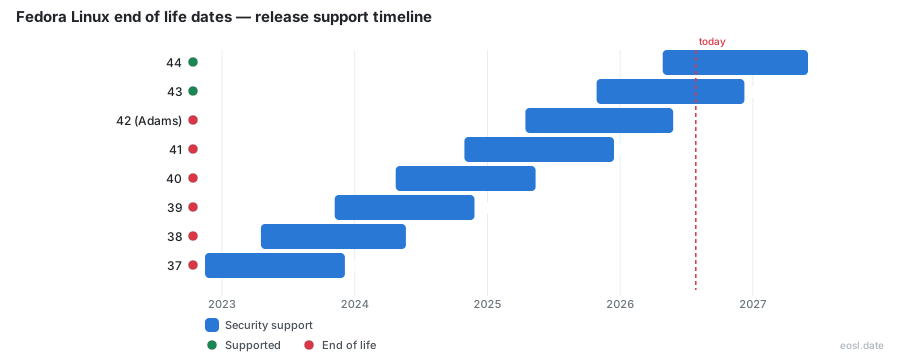
Currently Supported Fedora Linux Releases - Active EOS/EOSL Support (2)
| Release | Released | Security Support |
|---|---|---|
| 44 | (6 months ago) | (in 6 months) |
| 43 | (1 year ago) | (in 1 month and 6 days) |
Fedora Linux End of Life (EOL) Releases - No Longer Supported (42)
| Release | Released | Security Support |
|---|---|---|
| 42 (Adams) | (1 year and 6 months ago) | (5 months ago) |
| 41 | (2 years ago) | (10 months ago) |
| 40 | (2 years and 6 months ago) | (1 year and 5 months ago) |
| 39 | (2 years and 11 months ago) | (1 year and 11 months ago) |
| 38 | (3 years and 6 months ago) | (2 years and 5 months ago) |
| 37 | (3 years and 11 months ago) | (2 years and 10 months ago) |
| 36 | (4 years and 5 months ago) | (3 years and 5 months ago) |
| 35 | (5 years ago) | (3 years and 10 months ago) |
| 34 | (5 years and 6 months ago) | (4 years and 4 months ago) |
| 33 | (6 years ago) | (4 years and 11 months ago) |
| 32 | (6 years and 6 months ago) | (5 years and 5 months ago) |
| 31 | (7 years ago) | (5 years and 11 months ago) |
| 30 | (7 years and 6 months ago) | (6 years and 5 months ago) |
| 29 | (8 years ago) | (6 years and 11 months ago) |
| 28 | (8 years and 6 months ago) | (7 years and 5 months ago) |
| 27 | (8 years and 11 months ago) | (7 years and 11 months ago) |
| 26 | (9 years and 3 months ago) | (8 years and 5 months ago) |
| 25 | (9 years and 11 months ago) | (8 years and 10 months ago) |
| 24 | (10 years and 4 months ago) | (9 years and 2 months ago) |
| 23 | (11 years ago) | (9 years and 10 months ago) |
| 22 | (11 years and 5 months ago) | (10 years and 3 months ago) |
| 21 | (11 years and 10 months ago) | (10 years and 11 months ago) |
| 20 (Heisenbug) | (12 years and 10 months ago) | (11 years and 4 months ago) |
| 19 (Schrödinger's Cat) | (13 years and 4 months ago) | (11 years and 9 months ago) |
| 18 (Spherical Cow) | (13 years and 9 months ago) | (12 years and 9 months ago) |
| 17 (Beefy Miracle) | (14 years and 5 months ago) | (13 years and 3 months ago) |
| 16 (Verne) | (14 years and 11 months ago) | (13 years and 8 months ago) |
| 15 (Lovelock) | (15 years and 5 months ago) | (14 years and 4 months ago) |
| 14 (Laughlin) | (16 years ago) | (14 years and 10 months ago) |
| 13 (Goddard) | (16 years and 5 months ago) | (15 years and 4 months ago) |
| 12 (Constantine) | (16 years and 11 months ago) | (15 years and 11 months ago) |
| 11 (Leonidas) | (17 years and 4 months ago) | (16 years and 4 months ago) |
| 10 (Cambridge) | (17 years and 11 months ago) | (16 years and 10 months ago) |
| 9 (Sulphur) | (18 years and 5 months ago) | (17 years and 3 months ago) |
| 8 (Werewolf) | (18 years and 11 months ago) | (17 years and 9 months ago) |
| 7 (Moonshine) | (19 years and 5 months ago) | (18 years and 4 months ago) |
| 6 (Zod) | (20 years ago) | (18 years and 10 months ago) |
| 5 (Bordeaux) | (20 years and 7 months ago) | (19 years and 4 months ago) |
| 4 (Stentz) | (21 years and 4 months ago) | (20 years and 2 months ago) |
| 3 (Heidelberg) | (21 years and 11 months ago) | (20 years and 9 months ago) |
| 2 (Tettnang) | (22 years and 5 months ago) | (21 years and 6 months ago) |
| 1 (Yarrow) | (22 years and 11 months ago) | (22 years and 1 month ago) |
Your Fedora Linux End of Life date decides how long your system keeps getting fixes, so knowing it early spares you a rushed weekend upgrade. The Fedora Project builds this fast-moving Linux distribution on a short schedule and keeps each supported release alive for roughly 13 months, which means Fedora 43 is covered until 9 December 2026 and Fedora 44 until 2 June 2027. This guide lists every current date, explains the end of support rules and shows how to move before your release runs out.
Fedora Linux End of Life Dates and Schedule
The table shows each release the Fedora Project has released recently and when its support ends. Entries for versions not yet released are tentative dates and can move by a few days or weeks.
| Version | Released | Support ends | Status |
|---|---|---|---|
| 45 | 3 Nov 2026 (planned) | 8 Dec 2027 (planned) | Preview version |
| 44 | 28 Apr 2026 | 2 Jun 2027 | Latest version |
| 43 | 28 Oct 2025 | 9 Dec 2026 | Supported |
| 42 | 15 Apr 2025 | 27 May 2026 | Unsupported |
| 41 | 29 Oct 2024 | 15 Dec 2025 | Unsupported |
| 40 | 23 Apr 2024 | 13 May 2025 | Unsupported |
Fedora Linux Version 43 End of Life: 9 December 2026
Fedora 43 was released on 28 October 2025 and will reach its end of life on 9 December 2026, about six weeks from now. After that day the release loses all security support, so mark the EOL date in your calendar and plan your move to version 44 this month. Fedora Linux EOL arrives on the same pattern every cycle, which the formula below explains.
Latest Version: Fedora 44 Support Window
Fedora 44 was released on 28 April 2026 and runs until 2 June 2027. Each new version brings new features: a refreshed GNOME desktop, a newer Linux kernel and revised default settings. GNOME stays the default, and spins such as KDE Plasma follow the same dates, so picking a desktop does not change your deadline.
Fedora Release Schedule for 45 and Beyond
The Fedora Project targets a preview version of 45, to be released on 3 November 2026, and Fedora 46, to be released on 20 April 2027. Rawhide, the development branch, feeds every release, so anything planned before branching is provisional.
How the Fedora Lifecycle Works
Fedora has a short life cycle next to enterprise systems. A new release cycle begins about every six months, a pace the Fedora Project calls its six-month release schedule. The community distribution is sponsored by Red Hat and serves as the upstream source for Red Hat Enterprise Linux (RHEL), so it adopts new open source technology first and trades long support for speed. Developers and enthusiasts gain from that speed, but you must keep moving.
The rule behind every date is simple:
$$\text{Support ends}_{X} \approx \text{Release date}_{X+2} + 4\ \text{weeks}$$
The Support Period: About 13 Months
Version X is supported until one month after version X+2 appears, so the support period lasts about 13 months. Check it with Fedora 42: version 44 was released on 28 April 2026, add 4 weeks and you reach late May, and the real date was 27 May 2026. Slips happen, as Fedora 41 ran to 15 December 2025.
Fedora Linux Version Numbering and Editions
Every number covers several editions of the Linux operating system: Fedora Workstation, which ships the GNOME desktop by default, plus Server, Fedora CoreOS, Fedora IoT, Cloud and the KDE Plasma Desktop spin that replaces GNOME. Any other spin works the same way. All editions on one number share one end date, because the Fedora Project and Red Hat engineers ship them together.
What End of Support Means for Your System
Once the end-of-life date passes, the repositories stop receiving bugfix and enhancement updates, and maintenance of the release ends. Packages stay downloadable, but nobody builds new ones. Treat the release as abandoned.
Security Updates and Bugfix Updates Stop
To keep receiving support and updates, you need a supported release. After the cutoff, newly found vulnerabilities in the kernel, browsers and libraries get patches only on newer releases, leaving your machine exposed.
Fedora Project Policy on Unsupported Systems
The Fedora Project does not backport patches to unsupported systems, and Red Hat engineers focus on current code. Linux users running old installations can still ask the community for help, but maintainers answer with the same advice: move forward.
Upgrade Your Fedora Version Before Support Ends
You have two paths. A fresh install gives a clean base, while an in-place upgrade keeps your settings. On Qubes OS, a virtualization-focused system, the recommended route is a new template, since customizations are not carried over, and you then move your Qubes templates and standalones across one at a time. Advanced users can run an in-place upgrade of an existing template to keep them. Step-by-step upgrades between consecutive versions are the safest route.
Upgrading Fedora Workstation with DNF
GNOME Software shows a prompt when a new version of Fedora is ready, and Fedora Project docs recommend the terminal for control. Back up your data, then use DNF, the Linux package management tool, from a terminal:
sudo dnf upgrade --refresh
sudo dnf system-upgrade download --releasever=44
sudo dnf offline reboot
The system restarts, applies the new packages and boots into the new release, with default settings preserved and new features available. Anaconda, systemd and Secure Boot components update along the way, and optional services such as PostgreSQL keep their data directories but may need a manual migration.
Tracking End-of-Life Dates Across Your Devices
With many machines, an audit report from an inventory tool lists each device, its Fedora version and the days remaining. That makes it easy to find software and systems that sit closest to the end-of-life date.
Fedora Release History: Unsupported Versions
The first Fedora Core was released in November 2003, built on Red Hat Linux 9 with a 2.4 kernel and GNOME 2.4. Every release since has an unsupported status, and each entry in the release history carries its own end date.
Older Fedora Versions Already Retired
Fedora 40 stopped on 13 May 2025, Fedora 41 on 15 December 2025 and Fedora 42 on 27 May 2026. Anything older is unsupported too, and all of those Linux versions are released builds you should leave behind. The Fedora Project keeps their packages for historians only.
Fedora Magazine and the Fedora 26 Retirement Notice
Fedora Magazine posted a notice that Fedora 26 end of life would fall on 29 May 2018, less than 11 months after launch, because Fedora 28 shipped early. That shows why checking the current schedule beats counting months.