Erlang End of Life (EOL) Dates and End of Support (EOS) Dates
Erlang end of life (EOL) and end of support (EOS) dates: 10 Erlang versions have reached EOL, including Erlang 26 (EOL date: May 26, 2026) — no longer receiving security updates or patches. Erlang 29.1.2 is the current supported release, with support through May 11, 2029 — 3 versions in active support. Also see Bellsoft Liberica JDK end of support dates for related end-of-life information.
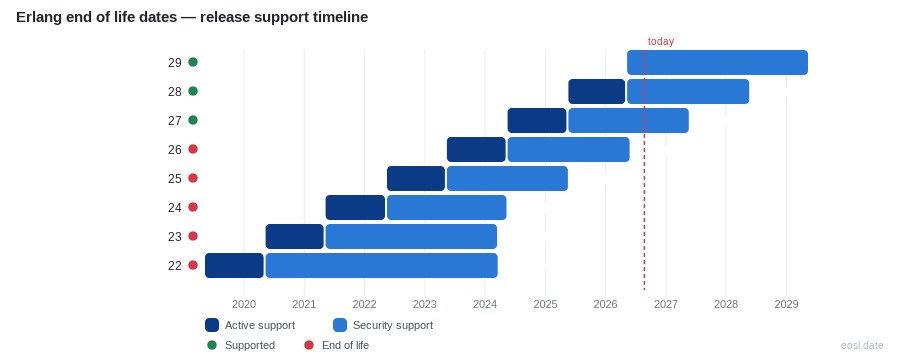
Currently Supported Erlang Releases - Active EOS/EOSL Support (3)
| Release | Released | Security Support | Active Support | Latest |
|---|---|---|---|---|
| 29 | (6 months ago) | (in 2 years and 5 months) | Active | 29.1.2 (1 month and 3 days ago) |
| 28 | (1 year and 5 months ago) | (in 1 year and 6 months) | (6 months ago) | 28.5.0.8 (1 month and 3 days ago) |
| 27 | (2 years and 6 months ago) | (in 6 months) | (1 year and 5 months ago) | 27.3.4.19 (1 month and 3 days ago) |
Erlang End of Life (EOL) Releases - No Longer Supported (10)
| Release | Released | Security Support | Active Support | Latest |
|---|---|---|---|---|
| 26 | (3 years and 6 months ago) | (5 months ago) | (2 years and 6 months ago) | 26.2.5.21 (5 months ago) |
| 25 | (4 years and 6 months ago) | (1 year and 6 months ago) | (3 years and 6 months ago) | 25.3.2.21 (1 year and 6 months ago) |
| 24 | (5 years and 6 months ago) | (2 years and 6 months ago) | (4 years and 6 months ago) | 24.3.4.17 (2 years and 7 months ago) |
| 23 | (6 years and 6 months ago) | (2 years and 8 months ago) | (5 years and 6 months ago) | 23.3.4.20 (2 years and 8 months ago) |
| 22 | (7 years and 6 months ago) | (2 years and 7 months ago) | (6 years and 6 months ago) | 22.3.4.27 (2 years and 7 months ago) |
| 21 | (8 years and 4 months ago) | (5 years and 4 months ago) | (7 years and 6 months ago) | 21.3.8.24 (5 years and 5 months ago) |
| 20 | (9 years and 4 months ago) | (6 years and 4 months ago) | (8 years and 4 months ago) | 20.3.8.26 (6 years and 8 months ago) |
| 19 | (10 years and 4 months ago) | (7 years and 4 months ago) | (9 years and 4 months ago) | 19.3.6.13 (7 years and 10 months ago) |
| 18 | (11 years and 4 months ago) | (8 years ago) | (10 years and 4 months ago) | 18.3.4.11 (8 years ago) |
| 17 | (12 years and 7 months ago) | (8 years and 1 month ago) | (11 years and 4 months ago) | 17.5.6.10 (8 years and 1 month ago) |
If you run Erlang in production, your Erlang end of life date decides how long you keep receiving security patches. Erlang/OTP, short for Open Telecom Platform, is a functional, concurrent programming language with a garbage-collected runtime system, and each release is maintained for roughly three years. You will see which releases are covered today and when yours stops.
Erlang End of Life Dates for Every OTP Release
A new major release lands every May. Each one gets active support for about a year, then security support for roughly two more, before the line is end of life. Engineering teams, brokers and any cluster pinned to an old runtime should check the table below.
Release Table With Support Status
| Release | Released | Active support ends | Security support ends | Latest | Status |
|---|---|---|---|---|---|
| OTP 29 | 11 May 2026 | 11 May 2029 (current) | 11 May 2029 | 29.1.2 | Supported |
| OTP 28 | 20 May 2025 | 11 May 2026 | 20 May 2028 | 28.5.0.8 | Supported |
| OTP 27 | 17 May 2024 | 20 May 2025 | 20 May 2027 | 27.3.4.19 | Approaching end of life |
| OTP 26 | 15 May 2023 | 17 May 2024 | 26 May 2026 | 26.2.5.21 | End of life |
| OTP 25 | 17 May 2022 | 15 May 2023 | 17 May 2025 | 25.3.2.21 | End of life |
Supported Releases Today
As of late October 2026, OTP 29, 28 and 27 are the supported versions. OTP 27 reaches its final release stream on 20 May 2027, and OTP 28 or OTP 29 is its natural successor. Aim for the latest release, which gets the broadest fixes.
Erlang Support Policy and Fix Branches
Under the Erlang/OTP support policy, bugs are generally fixed only on the latest release, while new features go into the upcoming one. The project does list supported releases, and major security fixes and bug fixes are backported to the supported previous releases. When older lines get a fix, it ships as a patch package and is announced. Upstream security patches for vulnerabilities stop once a line reaches the end of its support window, so a scanner will keep flagging unpatched findings.
Bug Fixes and Security Fixes by Branch
Pull requests go to the maint branch for the next maintenance patch on the latest release, or to master for the upcoming OTP release, in the public git repository.
Release Policy and Version Numbers
The release policy is not formally published, but the pattern is steady. Erlang/OTP does not follow semantic versioning strictly, yet it borrows from it: the major version changes on incompatible work, the minor on new features, and an optional patch number for pure fixes. The documentation describes the scheme in full.
How Version Numbers Work
An Erlang/OTP number like 27.3.4.19 reads as major, minor, patch and a fourth part for partially ordered builds. Always check the release notes for the exact line you run.
Compatibility Across Supported Releases
Erlang aims for broad compatibility between releases, though it gives no hard promise everywhere. Treat any compatibility matrix from your own vendors as the final word, and keep testing in staging before you move a production system.
Distribution and Compiled Code
- Erlang nodes can talk across at least two earlier and two later releases over the distribution protocol.
- Compiled BEAM code loads on at least two later releases, and compiling on the deployed release gives the best performance.
- Compiler warnings, command line arguments and build procedures may change between releases.
Incompatible Changes in Patches
Security issues and bug fixes can bring incompatible changes even inside a patch. Severe design problems are only fixed in the following release.
Deprecated and Removed Features Before Security Support Ends
Anything deprecated has a newer alternative, and deprecations flag it; removal happens only after at least one release of warning. Features marked as scheduled for removal give you a fixed window to migrate away from legacy parts of the system.
Legacy TLS and SSH Deprecated in OTP 29
OTP 29 formally deprecates TLS 1.0, TLS 1.1 and DTLS 1.0, plus zlib compression in SSH, which is scheduled for removal in OTP 30.
Archives and Flags Deprecated in OTP 27
OTP 27 deprecated packaging applications as archives and the -epmd_module flag, in favour of kernel application parameters.
Older Deprecated Functions and Protocols
Earlier releases deprecated slave and retired it in favour of peer, and replaced the old link protocol in OTP 26.
Auditor Expectations Around End-of-Life Dates
An auditor checks whether known flaws in your Erlang/OTP runtime can still be fixed. PCI DSS Requirement 6 and SOC 2 controls expect timely security patches, so running a release past its end of life is a compliance gap even when vendors offer paid cover.
Upgrade Planning After Active Support Ends
Once active support ends, treat the upgrade as scheduled work. Before OTP end of life arrives, pick the destination release and move your nodes in one planned change. Teams that ignore Erlang/OTP end of life often discover a dependency pinned them to an old runtime. Plan your Erlang end of life migration early, and consider extended support only as a bridge.
Which RabbitMQ Versions Depend on OTP 27
Many 4.x RabbitMQ releases cap their supported Erlang/OTP at 27.x, so check the compatibility matrix before May 2027.
Plan the Broker and Runtime Together
Confirm which broker release you will run in mid-2027, confirm it supports OTP 28 or 29, then schedule both together.