Discourse End of Life (EOL) Dates and End of Support (EOS) Dates
Discourse end of life (EOL) and end of support (EOS) dates: 11 Discourse versions have reached EOL, including Discourse 2026.8 (EOL date: Oct 27, 2026) — no longer receiving security updates or patches. Discourse 2026.9 reaches its End of Support date on Nov 24, 2026 — plan your upgrade path now. Also see AdonisJS lifecycle dates for related end-of-life information.
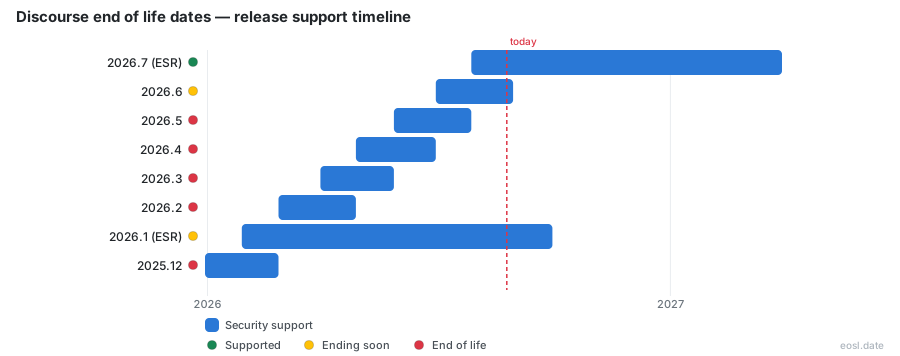
Discourse Releases Nearing End of Life - Support Ending Soon (3)
Discourse End of Life (EOL) Releases - No Longer Supported (11)
| Release | Released | Support | Latest | LTS |
|---|---|---|---|---|
| 2026.8 | (2 months ago) | (3 weeks ago) | 2026.8.2 (3 weeks and 4 days ago) | - |
| 2026.6 | (4 months ago) | (2 months ago) | 2026.6.3 (2 months ago) | - |
| 2026.5 | (5 months ago) | (3 months ago) | 2026.5.2 (3 months ago) | - |
| 2026.4 | (6 months ago) | (4 months ago) | 2026.4.2 (4 months ago) | - |
| 2026.3 | (7 months ago) | (5 months ago) | 2026.3.1 (5 months ago) | - |
| 2026.2 | (8 months ago) | (6 months ago) | 2026.2.2 (7 months ago) | - |
| 2026.1 (ESR) | (9 months ago) | (1 month and 3 weeks ago) | 2026.1.9 (1 month and 3 weeks ago) | LTS |
| 2025.12 | (10 months ago) | (8 months ago) | 2025.12.2 (8 months ago) | - |
| 2025.11 | (11 months ago) | (9 months ago) | 2025.11.2 (9 months ago) | - |
| 3.5 (ESR) | (1 year and 2 months ago) | (9 months ago) | 3.5.4 (9 months ago) | LTS |
| 3.4 (ESR) | (1 year and 9 months ago) | (1 year and 2 months ago) | 3.4.7 (1 year and 3 months ago) | LTS |
If you run an online forum on open source forum software, Discourse End of Life is the date after which your community stops receiving fixes for the release you are on. Discourse ships a new version every month, so the useful question is not whether a release will expire but which date applies to your installation and how soon you need to move your users to a newer one.
Discourse End of Life: How the Support Schedule Works
Every release follows the same pattern: it is developed, published, supported for a short window, then retired. The window is deliberately short, which keeps the project focused on new features and bug fixes in the current code rather than maintaining a long tail of old versions.
Calendar versioning and monthly releases
Discourse uses calendar versioning, so version 2026.9 is the build first published in September 2026. A new monthly release arrives about every four weeks, and each one stays a supported release for approximately two months before it is retired.
From semver to calendar versions
Before November 2025 the project numbered builds with semver (3.4, 3.5 and so on). That is why older entries on release trackers look different from the newer ones, even though the monthly cadence is the same.
Latest channel and security updates
Most installations follow the latest channel, which delivers continuous updates and always points at the newest latest version. Retired releases stop receiving security updates, and without security patches any newly found hole stays open. The developers run a public vulnerability disclosure program, so fixes for reported issues land in supported builds first.
ESR Builds and Their Longer Support Window
Not everyone can upgrade every month. Every 6 months one monthly build is designated an Extended Support Release (ESR), and it keeps receiving fixes for approximately 8 months. If you prefer a slower stable release that changes less often, an ESR is the one to track. You can also follow release dates through an RSS feed instead of checking a page by hand.
Supported Releases and ESR End of Life Dates
This table reflects the schedule as of 27 October 2026.
| Release | Released | End of life | Status |
|---|---|---|---|
| 2026.10 | 27 Oct 2026 | 29 Dec 2026 | Latest, in development |
| 2026.9 | 22 Sep 2026 | 24 Nov 2026 | Supported |
| 2026.8 | 25 Aug 2026 | 27 Oct 2026 | Ends today |
| 2026.7 (ESR) | 28 Jul 2026 | 30 Mar 2027 | Supported |
| 2026.1 (ESR) | 28 Jan 2026 | 22 Sep 2026 | Ended |
What End of Life Means for Self-Hosted Installations
On a self-hosted setup your administrators own every update, so a retired release simply stays frozen. Hosted software as a service customers have their server upgraded for them, while admins running their own hosting do not. Ask for help on the official support forum and the first answer will almost always be to upgrade.
The technology stack behind your install
Each release is tested against a specific stack: Ruby on Ruby on Rails with a JavaScript front end, PostgreSQL and Redis, usually run in Docker on Linux. Once your release is retired, those components stop being upgraded alongside it, and outdated software like this also leaves plugins, themes and any API integrations pinned to old code. The GitHub source stays under the GNU General Public License, so you can inspect what changed before you move to a newer build.
Upgrading Before a Supported Release or ESR Expires
Treat the date in the table as a deadline for your users' safety, not a suggestion. The project developers publish upgrade notes in their documentation, and the calendar feed is handy for reminders.
Moving to the latest version
- Back up your database and uploads.
- Check your plugins against the target build.
- Rebuild the app from the
latestchannel.
Choosing a stable release or ESR
If monthly changes disrupt your community, stay on an ESR so your users see fewer surprises, and upgrade the software when it nears its end. If you want features quickly, stay on the latest channel and accept the faster pace, since your users will notice changes sooner.