Hashicorp Consul End of Life (EOL) Dates and End of Support (EOS) Dates
Hashicorp Consul end of life (EOL) and end of support (EOS) dates: 16 Hashicorp Consul versions have reached EOL, including Hashicorp Consul 1.22 (EOL date: Oct 31, 2026) — no longer receiving security updates or patches. Hashicorp Consul 2.1.0 is the current supported release — 3 versions in active support. Also see Hashicorp Boundary EOSL dates for related end-of-life information.
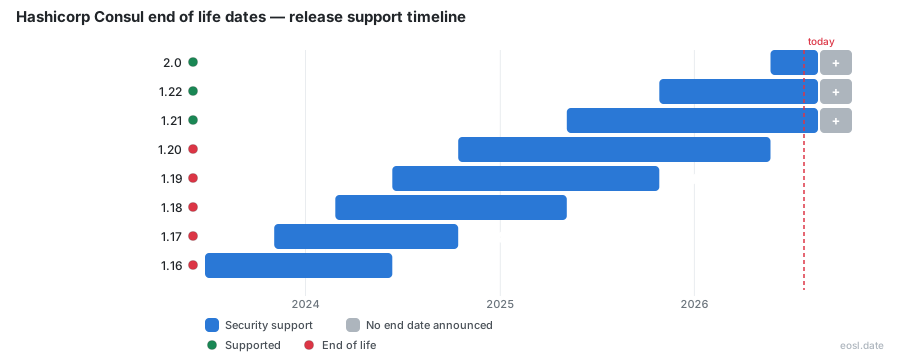
Currently Supported Hashicorp Consul Releases - Active EOS/EOSL Support (3)
Hashicorp Consul End of Life (EOL) Releases - No Longer Supported (16)
| Release | Released | Security Support | Latest | LTS |
|---|---|---|---|---|
| 1.22 | (1 year ago) | (3 weeks and 1 day ago) | 1.22.7 (7 months ago) | - |
| 1.20 | (2 years and 1 month ago) | (5 months ago) | 1.20.6 (1 year and 6 months ago) | - |
| 1.19 | (2 years and 5 months ago) | (1 year ago) | 1.19.2 (2 years and 2 months ago) | - |
| 1.18 (LTS) | (2 years and 8 months ago) | (6 months ago) | 1.18.2 (2 years and 6 months ago) | LTS |
| 1.17 | (3 years ago) | (2 years and 1 month ago) | 1.17.4 (2 years and 7 months ago) | - |
| 1.16 | (3 years and 4 months ago) | (2 years and 5 months ago) | 1.16.7 (2 years and 7 months ago) | - |
| 1.15 (LTS) | (3 years and 8 months ago) | (1 year and 6 months ago) | 1.15.11 (2 years and 7 months ago) | LTS |
| 1.14 | (4 years ago) | (3 years ago) | 1.14.11 (3 years ago) | - |
| 1.13 | (4 years and 3 months ago) | (3 years and 4 months ago) | 1.13.9 (3 years and 4 months ago) | - |
| 1.12 | (4 years and 7 months ago) | (3 years and 8 months ago) | 1.12.9 (3 years and 9 months ago) | - |
| 1.11 | (4 years and 11 months ago) | (4 years ago) | 1.11.11 (4 years and 1 month ago) | - |
| 1.10 | (5 years and 5 months ago) | (4 years and 3 months ago) | 1.10.12 (4 years and 4 months ago) | - |
| 1.9 | (5 years and 11 months ago) | (4 years and 7 months ago) | 1.9.17 (4 years and 7 months ago) | - |
| 1.8 | (6 years and 5 months ago) | (4 years and 11 months ago) | 1.8.19 (4 years and 11 months ago) | - |
| 1.7 | (6 years and 9 months ago) | (5 years and 5 months ago) | 1.7.14 (5 years and 7 months ago) | - |
| 1.6 | (7 years and 2 months ago) | (5 years and 11 months ago) | 1.6.10 (6 years ago) | - |
Before you schedule your next maintenance window, you need to know which Consul version still gets fixes. This guide lays out Hashicorp Consul End of Life dates for every release line as of 27 October 2026: 1.22 loses support on 31 October 2026, 1.21 follows on 30 April 2027, and 2.0 runs until 30 April 2028. Use the release table below to see where your own version sits.
Hashicorp Consul End of Life: Where Every Release Stands Today
HashiCorp currently ships Consul 2.1.0, published on 21 October 2026, and four release lines still receive fixes: 2.1, 2.0, 1.22 and 1.21. Every older minor line has retired. The product follows one vendor-wide policy that HashiCorp applies to all of its products, so the same rules govern each date below. Retirement mostly means the end of security fixes.
- 1.22 has 4 days left, until 31 October 2026.
- 1.21 has 185 days left, until 30 April 2027.
- 2.0 has 551 days left, until 30 April 2028.
What Consul Does and Why Its Lifecycle Matters
Consul is HashiCorp's service networking tool. It provides service discovery, health checking and a key/value store, and its service mesh features secure traffic between workloads across a datacenter, a public cloud or any other infrastructure network. Teams run it on virtual machines, Kubernetes, Docker and Nomad, so a retired release can sit underneath any production deployment, and your applications call its API to register services.
The code ships as an open-source Community Edition under the Business Source License, and as a commercial Enterprise Edition. Service discovery and health checking keep working after a release retires, but the fixes, including security fixes, stop, which is why the dates matter more than the feature list.
Consul EOL Dates for Every Release Line
| Release | Released | Support ends | Status |
|---|---|---|---|
| 2.1 | 21 Oct 2026 | Not yet published | Supported (newest) |
| 2.0 | 24 May 2026 | 30 Apr 2028 | Supported |
| 1.22 | 27 Oct 2025 | 31 Oct 2026 | Supported, ends in 4 days |
| 1.21 (LTS) | 6 May 2025 | 30 Apr 2027 | Supported |
| 1.20 | 14 Oct 2024 | 24 May 2026 | Ended |
| 1.19 | 12 Jun 2024 | 27 Oct 2025 | Ended |
| 1.18 (LTS) | 26 Feb 2024 | 30 Apr 2026 | Ended |
| 1.17 | 3 Nov 2023 | 14 Oct 2024 | Ended |
| 1.16 | 26 Jun 2023 | 12 Jun 2024 | Ended |
| 1.15 (LTS) | 23 Feb 2023 | 30 Apr 2025 | Ended |
Read the table from the bottom and a pattern appears: a standard line lost its fix coverage on the day the third release after it arrived. 1.20 retired when 2.0 shipped on 24 May 2026, and 1.19 retired when 1.22 shipped.
Which Consul Versions Are Still Supported
HashiCorp treats a major release as any change in the first or second digit of the X.Y.Z number, so 1.22 and 2.0 are both major lines. Fixes arrive as a new patch version on top of the newest line, and only the most recent lines get them. HashiCorp expects customers to stay current within two releases of the latest line.
Applied to today's calendar, that leaves 2.1, 2.0, 1.22 and 1.21 as the supported Consul versions. Anything on 1.20 or older no longer receives code-fixes or hot-fixes, and no new minor release will be cut for it.
Consul End of Support Dates for LTS Releases
Three 1.x lines carried a long-term label: 1.15, 1.18 and 1.21. Each ran for roughly two years, and 1.21 is the last line to receive that label.
Long-Term Support Releases in the 1.x Line
Under the pre-2026 policy, Consul 1.15 through 1.21 received long-term support on the Enterprise side, with longer fix eligibility than standard lines. Existing lines of that kind keep their stated periods: 1.15 closed on 30 April 2025, 1.18 on 30 April 2026. Third-party databases do not agree on this label, since Versio.io flags none of these lines, so confirm against HashiCorp's own published schedule.
Consul Enterprise Support Windows
The Consul Enterprise 1.21 line carries a planned end of support of 30 April 2027. If your cluster runs that line, you have until then to move to 2.x.
How the Release Strategy Defines End-of-Life
HashiCorp's release strategy is simple to state: Generally Available (GA) releases of active products are supported for up to two years. Support comes through new minor releases on the most current major line, and the vendor expects customers to run within two releases of the newest one. Because the same versioning scheme and end-of-life rules apply to every HashiCorp product, a Consul date can be predicted from the date of any GA releases that followed it.
Consul End of Standard Support Under the Pre-2026 Policy
Before the 2.x line, each Consul Enterprise major branch was maintained until three releases after it, while long-lived branches were maintained until six releases after. The end of standard support therefore moved every time HashiCorp shipped a new line.
Standard Term Support for GA Releases
GA lines received standard coverage for approximately one year, and the longer-lived lines roughly double that. That is why 1.19 and 1.20, which never earned the long-term label, retired so much earlier than 1.18 and 1.21.
Consul Support Lifecycle Under IBM Support Cycle-2
From the April 2026 releases, self-managed Enterprise products follow IBM Support Cycle-2 (SC2). Consul 2.0 is the first line governed by it, with planned support ending on 30 April 2028. IBM's SC2 model replaces the older version-count rule with fixed calendar periods, so the dates are known on the day a line ships.
Base, Extended and Sustained Support Phases
- Base support: 2 years of regular fixes.
- Critical extended support: 1 more year, limited to critical fixes (until 30 April 2029 for 2.0).
- Sustained support: 3 years without new fixes. An optional paid ongoing extended coverage runs to 30 April 2032, and that schedule treats it as a separate purchase.
Consul Releases: Version History and Latest Version
Versio.io counts 34 release lines and 304 versions since 0.1.0 in April 2014. The latest version, 2.1.0, followed a first candidate on 28 September and a second on 12 October 2026. The 2.0 line moved faster than usual: patches 2.0.1 to 2.0.4 landed roughly monthly between June and September 2026. When you need a release date for audit paperwork, the GitHub releases page and the official release notes are the primary sources, and Consul releases tagged as candidates should never count as supported.
Consul Compatibility and Requirements Across the Lifecycle
Treat the following as a checklist for leaving a retired line. Consul 1.22.x is compatible with Consul K8s 1.9.x, so a Kubernetes upgrade often forces a chart change too. Server agents form the control plane and use Raft consensus, so they want multi-core CPUs, SSD storage and 8 GB or more of RAM on larger clusters. A client agent runs on every application host, performs health checking and relays proxy traffic, which keeps its footprint small. Production servers run on systemd-based Linux, while Windows is mainly for development and testing. Nomad clusters follow the same agent rules. Every agent exposes the same HTTP API, so scripts that call the API break first when a release changes it, and each Envoy sidecar proxy should match its agent. Match the agent version across the cluster before you touch the server.
Ports and Operating System Support
Before you move off a retired line, confirm these ports are open between every server and client agent on the new build:
- 8300 for server RPC and Raft traffic.
- 8301 and 8302 for gossip on the LAN and WAN.
- 8500 for the HTTP API, CLI and web UI, and 8501 for the HTTPS API.
- 8600 for the DNS interface, plus gRPC for gateways and the Envoy proxy.
Security Status and CVE Exposure Before EOL
Retirement matters mainly for security. Versio.io lists 231 of the 304 versions as affected by at least one CVE, and a retired line no longer gets security support. Recent release notes show the pattern: 2.1.0 upgrades Go to 1.26.10 for vulnerabilities in the toolchain and cites CVE-2026-15972 in its test modules. Running a retired line means every new CVE stays open on your cluster, and a patched dependency such as the Envoy proxy will not reach you. The same notes tighten API permission checks, so a retired line also leaves a security gap in access control.
Planning a Consul Upgrade Before EOL
Check your running build with consul version in the CLI or the API at /v1/agent/self, compare it with the table above and confirm the support period for that line. Then choose the target: 2.0 buys the longest runway, while 1.21 is the fastest hop for a 1.2x cluster. Upgrade each server agent first and each client agent after it, put security-sensitive hosts at the front of the queue, and read the release notes for every line you cross.
Notice Period for HCP Consul Dedicated
HashiCorp commits to at least twelve months of prior written notice before it discontinues a product. The cloud offering HCP Consul Dedicated reached its own end of life on 12 November 2025, so any migration off it should already be complete.
Breaking Changes in the 2.1.0 Release Notes
These are the changes to test before you leave a retired 1.x line. The newest release changes behaviour you may rely on. The consul connect redirect-traffic command now uses nftables instead of iptables, official Docker images ship nftables, and the Enterprise HTTP API limits request bodies to 512 KiB, returning HTTP 413 above it. The Resource API follows the same limit, and API Gateway route composition now sits behind the experimental api-gateway-upstream-routing flag. Transparent proxy hosts need the nft binary, and Envoy-based gateways keep working unchanged. Run the CLI command on a test host first. Enterprise leaf certificate requests now need service:write on the service. Test each API caller in staging before you upgrade production.