Hashicorp Vault End of Life (EOL) Dates and End of Support (EOS) Dates
Hashicorp Vault end of life (EOL) and end of support (EOS) dates: 15 Hashicorp Vault versions have reached EOL, including Hashicorp Vault 2.1 (EOL date: Oct 14, 2026) — no longer receiving security updates or patches. Hashicorp Vault 2.2.2 is the current supported release. Also see Hashicorp Boundary end of support life for related end-of-life information.
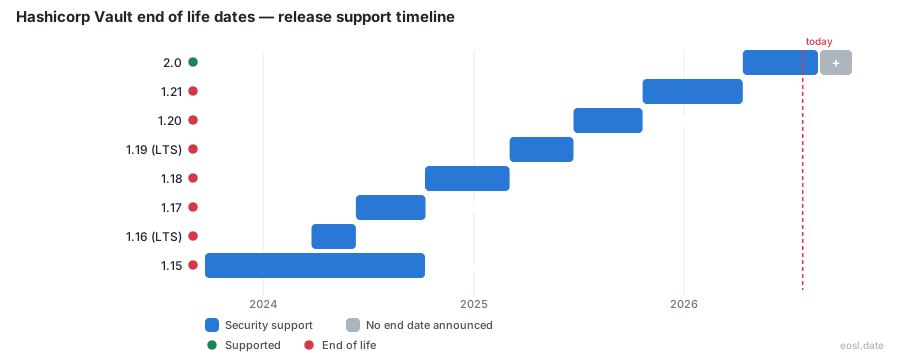
Currently Supported Hashicorp Vault Releases - Active EOS/EOSL Support (1)
| Release | Released | Standard Maintenance | Extended Maintenance | Latest | LTS |
|---|---|---|---|---|---|
| 2.2 | (1 month and 1 week ago) | Active | Active | 2.2.2 (1 week and 3 days ago) | - |
Hashicorp Vault End of Life (EOL) Releases - No Longer Supported (15)
| Release | Released | Standard Maintenance | Extended Maintenance | Latest | LTS |
|---|---|---|---|---|---|
| 2.1 | (2 months ago) | (1 month and 1 week ago) | Active | 2.1.2 (1 month and 2 weeks ago) | - |
| 2.0 | (7 months ago) | (2 months ago) | Active | 2.0.4 (3 months ago) | - |
| 1.21 | (1 year and 1 month ago) | (7 months ago) | Active | 1.21.4 (8 months ago) | - |
| 1.20 | (1 year and 4 months ago) | (1 year and 1 month ago) | Active | 1.20.4 (1 year and 1 month ago) | - |
| 1.19 (LTS) | (1 year and 8 months ago) | (1 year and 4 months ago) | Active | 1.19.5 (1 year and 5 months ago) | LTS |
| 1.18 | (2 years and 1 month ago) | (1 year and 8 months ago) | Active | 1.18.5 (1 year and 8 months ago) | - |
| 1.17 | (2 years and 5 months ago) | (2 years and 1 month ago) | Active | 1.17.6 (2 years and 1 month ago) | - |
| 1.16 (LTS) | (2 years and 7 months ago) | (2 years and 5 months ago) | Active | 1.16.3 (2 years and 5 months ago) | LTS |
| 1.15 | (3 years and 1 month ago) | (2 years and 1 month ago) | Active | 1.15.6 (2 years and 8 months ago) | - |
| 1.14 | (3 years and 5 months ago) | (2 years and 5 months ago) | Active | 1.14.10 (2 years and 8 months ago) | - |
| 1.13 | (3 years and 8 months ago) | (2 years and 7 months ago) | Active | 1.13.13 (2 years and 9 months ago) | - |
| 1.12 | (4 years and 1 month ago) | (3 years and 1 month ago) | Active | 1.12.11 (3 years and 2 months ago) | - |
| 1.11 | (4 years and 5 months ago) | (3 years and 5 months ago) | Active | 1.11.12 (3 years and 5 months ago) | - |
| 1.10 | (4 years and 8 months ago) | (3 years and 8 months ago) | Active | 1.10.11 (3 years and 8 months ago) | - |
| 1.9 | (5 years ago) | (4 years and 1 month ago) | Active | 1.9.10 (4 years and 2 months ago) | - |
Running secrets management on a schedule you can plan around starts with one question about HashiCorp Vault End of Life: when does your version stop getting fixes? The honest answer is that Vault has no fixed EOL calendar, only a rolling support window that moves forward with every release. Here is which Vault versions are still supported, how Long-Term Support works for Enterprise customers, and what to do before your release is superseded.
HashiCorp Vault End of Life: The Short Answer
Vault follows a latest-version model: only the newest minor release is current, and every older line is superseded the moment the next one ships. As of 27 October 2026, that makes Vault 2.2 the one line in standard maintenance, with 2.2.1 as its newest patch. Vault 2.1, 2.0, 1.21 and everything before them no longer receive routine fixes in the community edition. HashiCorp publishes no calendar date for any of them, so your job is to stay current rather than wait for a countdown. The sections below show the dates each line actually left standard coverage, which is the practical EOL signal for planning.
Latest Version and Vault Releases on GitHub
The authoritative record of Vault releases is the Vault releases page on GitHub. Version 2.2.0 appeared on 15 October 2026 and 2.2.1 followed on 22 October, so the latest version to run today is 2.2.1 unless a newer patch has landed since. Read the GitHub changelog before each upgrade, because every entry separates security fixes from breaking changes and Enterprise-only fixes.
Vault Support Lifecycle and Maintenance Levels
HashiCorp supports Generally Available releases of active products for up to two years, but what you get depends on the edition you run. Community versions lose standard coverage when the next release occurs, while Enterprise customers on select releases keep a second, narrower phase of coverage. Under the N-1 policy, HashiCorp expects you to stay within two releases of the newest major release to receive optimal support. Fixes land as a new minor release on top of the newest branch, not as patches back-ported to every old line, and a patch tag such as 2.2.1 is only built on the current line.
Standard Maintenance for Community Releases
Standard maintenance covers the latest minor release only. It delivers new features, bug fixes and security patches, and it ends for a community line as soon as the next minor release ships. That is why the 1.20 line stopped receiving fixes on 21 October 2025, the day 1.21 arrived.
Extended Maintenance for Enterprise Customers
Extended maintenance exists only for LTS releases of Vault Enterprise. It is deliberately narrower: it ships fixes for bugs that can cause outages and for critical vulnerabilities, including CVE-tracked flaws, and nothing else. No new features arrive during it.
- Standard phase: features, bug fixes and security fixes for the newest minor release.
- Extended phase: outage-causing bugs and critical vulnerabilities for Enterprise LTS releases only.
- Community versions: no extended phase, so support ends when the next release occurs.
Release Cadence and Versioning: When Vault End of Support Arrives
Vault typically ships three major releases a year, and the release cadence is what sets your clock. A major release is any change to the first or second digit of the version number X.Y.Z, so 1.21 to 2.0 and 2.0 to 2.1 both count. The third digit is a patch version used for hot-fixes on the current line. The practical result of that versioning scheme: end of support for a community line arrives between four and six months after it launches, as the 2.0 line showed. It opened in April 2026 and left standard coverage on 31 August 2026, when 2.1 shipped. Running the version command, vault version, tells you immediately which line you sit on, and the release strategy HashiCorp documents is simple: upgrade time is built into the cadence, so plan one upgrade window every few months.
Vault Version History: Release Dates and End-of-Life Status
This table gathers the recent Vault version history using the release dates and maintenance dates tracked by endoflife.date, with status as of 27 October 2026. The dates are facts about each line, and the status column applies the next-release rule described above.
| Vault version | Released | Standard maintenance ended | Status |
|---|---|---|---|
| 2.2 | 15 Oct 2026 | Current | Supported, latest 2.2.1 |
| 2.1 | 31 Aug 2026 | Superseded by 2.2 | Upgrade to 2.2 |
| 2.0 | 13 Apr 2026 | 31 Aug 2026 | Ended |
| 1.21 | 21 Oct 2025 | 13 Apr 2026 | Ended |
| 1.20 | 23 Jun 2025 | 21 Oct 2025 | Ended |
| 1.19 (LTS) | 4 Mar 2025 | 23 Jun 2025 | Extended maintenance for Enterprise until April 2027 |
| 1.18 | 8 Oct 2024 | 4 Mar 2025 | Ended |
| 1.17 | 10 Jun 2024 | 9 Oct 2024 | Ended |
Read it from the bottom up and the pattern is clear: every community line ends the day its successor arrives, except the one LTS line, 1.19, which stays covered for Enterprise customers long after.
Long-Term Support: End of LTS Support for Vault Enterprise
Long-term support stretches HashiCorp's support window to two years for designated Enterprise releases, with critical fixes, security patches and hardened upgrade paths to newer releases. The LTS program applies to the Enterprise products only. The upgrade path lets you skip intermediate major releases, so you can batch upgrades into fewer steps, though moving from one LTS to the next may still require transitional upgrades through intermediate versions. Each LTS product has its own end date.
- Vault Enterprise: last LTS version 1.19, end of LTS support in April 2027.
- Consul Enterprise: version 1.21, April 2027.
- Nomad Enterprise: version 1.10.x, April 2027.
- Boundary Enterprise: version 0.21, December 2027.
- Terraform Enterprise: version 1.2, November 2027.
Vault Enterprise LTS Dates
For Vault Enterprise, 1.19 is the release to watch: its end of LTS comes in April 2027, and it is the last one covered by the original LTS rules. The HashiCorp long-term support page lists the dates for every product in the program, so check it for Terraform, Consul, Nomad and Boundary before you schedule a migration.
IBM Support Cycle 2 and the New Vault Support Window
HashiCorp now belongs to IBM, and its self-managed products are adopting the IBM Support Cycle 2, known as SC2. Releases made before March 2025 follow LTS, releases between March 2025 and April 2026 follow a fixes-and-security-patches addendum, and anything released after April 2026 follows the IBM support cycle. That reshapes the support window for every new Vault line, so read the IBM lifecycle documentation alongside the older LTS policy before you commit to a version, because the acquisition changed more than branding.
What the Vault 2.0 Shift Changes
Vault 2.0 was the first major line under the new model, and HashiCorp positioned it as the point where the old LTS pattern gave way to IBM's lifecycle. If you plan on a 2.x release, assume the SC2 rules and not the LTS table above.
Discontinuing a HashiCorp Product: Notice and Sunsets
When HashiCorp starts discontinuing a product, it gives customers at least twelve months of prior written notice, according to the ITDB record. That is the closest thing to a formal end-of-life notice. The practical lesson of HCP Vault Secrets shows its limits: that cloud service was shut down on 30 June 2025, and users had to move to alternatives such as Vault itself, HCP Vault Dedicated, or a third-party tool, which means migrating every stored secret. The open-source server is different: since August 2023 it ships under the Business Source License, which allows internal and personal use, so an open source fork is a licensing question, and a fork gets no HashiCorp support. The same twelve-month courtesy does not apply to a community release line, which simply loses fixes when the next one ships.
Upgrade Planning Across the Vault Lifecycle
Treat every move off a superseded line as a scheduled change on your production calendar, started well before the line's support ends. Vault needs persistent stateful storage, runs commonly on Linux, and is deployed on Kubernetes or virtual machines, so each upgrade touches storage, containers and cloud identity at once. The security case for moving is concrete: 252 of the 306 Vault versions tracked by Versio.io are affected by a published CVE, and recent patches show why. Version 2.2.1 fixed a policy cache collision where alias names such as "./root" could resolve to the root policy, and version 2.2.0 closed an ACL bypass that used mixed-case policy names.
- Secrets and identity: policy, entity, group and token handling for every identity changes between releases, so test access control on a copy first.
- Audit: confirm the audit log still records every request after the upgrade, since compliance teams rely on it.
- Encryption and vulnerabilities: check the GitHub notes for fixed vulnerabilities in the Go runtime and in dependencies.
- Cloud and Enterprise: Enterprise-only fixes (identity, SCIM, managed keys, transit) are labelled in the release notes.
Security Fixes in Recent Patch Releases
Vault is a secrets management platform built around identity, tokens and policy, so its GitHub release notes double as a security bulletin. Once a line is out of support, none of these fixes reach it, which is the real cost of running a superseded line. Recent entries in the GitHub changelog include:
- Security fix in 2.2.1: a policy cache-key collision let a policy-name alias resolve to the immutable root policy, and Vault now rejects root-equivalent aliases wherever an identity, group, token or agent receives a policy.
- Security fix in 2.2.1: container images distrust the eMudhra intermediate chains in the CA trust store, which protects secrets in transit to any service that relied on them.
- Security fix in 2.2.0: a denied_parameters constraint on the policies field could be bypassed with a mixed-case policy name, a privilege-escalation path for any identity with write access.
- Dependency updates: several 2.2.0 and 2.2.1 changes upgrade Go libraries to resolve a CVE, and the Go version itself was bumped to close another CVE.
- Enterprise fixes in 2.2.1: identity and SCIM user adoption, group membership updates and managed-key handling for transit secrets.
Read the security section of the GitHub notes first, then run a quick audit of your own policies: list the identity aliases in use, confirm which secrets engines each token can reach, and keep every CVE-affected node behind the upgrade queue until it is patched. This matters most for compliance teams, who need audit evidence that no secrets were exposed during the gap.
Breaking Changes to Check Before You Upgrade
Release 2.2.0 carried several breaking changes. Container images no longer set the cap_ipc_lock capability, so set disable_mlock = true in the configuration and disable swapping on the host. UBI-based images dropped gnupg, openssl and procps. PostgreSQL storage now prefers Azure Workload Identity over Managed Identity. ACME finalization with the default directory policy now rejects CSRs that contain URI, email or other SANs. Staying on a superseded line to avoid them means no fixes at all, so test each one in staging so your secrets stay readable after the switch, then upgrade to the newest patch so you stay inside the supported releases. Keep the GitHub release page bookmarked, and watch the GitHub issues for your storage backend before you roll the change out, because dynamic secrets and static secrets both depend on it. A rollback plan for the secrets engines you rely on costs little and is worth writing down.