ROS 2 End of Life (EOL) Dates and End of Support (EOS) Dates
ROS 2 end of life (EOL) and end of support (EOS) dates: 8 ROS 2 versions have reached EOL, including ROS 2 Iron Irwini (EOL date: Dec 04, 2024) — no longer receiving security updates or patches. ROS 2 Lyrical Luth is the current supported release, with support through May 31, 2031 — 4 versions in active support. Also see Bootstrap lifecycle dates for related end-of-life information.
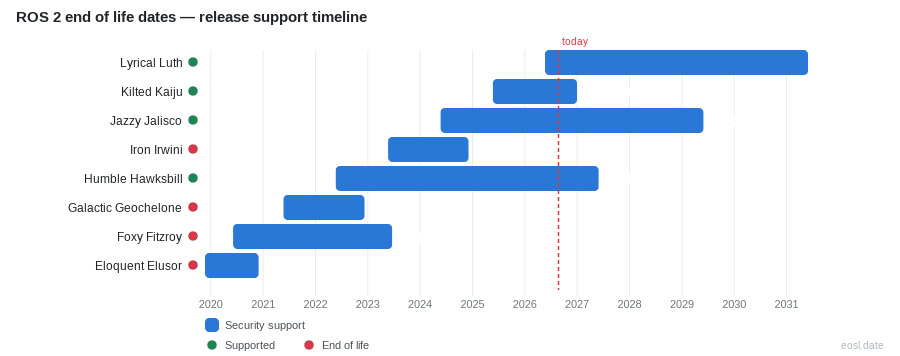
Currently Supported ROS 2 Releases - Active EOS/EOSL Support (4)
| Release | Released | End Of Life |
|---|---|---|
| Lyrical Luth | (5 months ago) | (in 4 years and 6 months) |
| Kilted Kaiju | (1 year and 5 months ago) | (in 1 month and 2 weeks) |
| Jazzy Jalisco | (2 years and 5 months ago) | (in 2 years and 6 months) |
| Humble Hawksbill | (4 years and 5 months ago) | (in 6 months) |
ROS 2 End of Life (EOL) Releases - No Longer Supported (8)
| Release | Released | End Of Life |
|---|---|---|
| Iron Irwini | (3 years and 5 months ago) | (1 year and 11 months ago) |
| Galactic Geochelone | (5 years and 5 months ago) | (3 years and 11 months ago) |
| Foxy Fitzroy | (6 years and 5 months ago) | (3 years and 4 months ago) |
| Eloquent Elusor | (6 years and 11 months ago) | (5 years and 11 months ago) |
| Dashing Diademata | (7 years and 5 months ago) | (5 years and 5 months ago) |
| Crystal Clemmys | (7 years and 10 months ago) | (6 years and 10 months ago) |
| Bouncy Bolson | (8 years and 4 months ago) | (7 years and 3 months ago) |
| Ardent Apalone | (8 years and 11 months ago) | (7 years and 10 months ago) |
Use this guide to find ROS 2 End of Life dates before you commit to a distribution. The Robot Operating System is an open-source robotics framework of libraries and tools that helps software developers build robotic applications, from lab prototypes to embedded hardware, and every release gets a fixed end date on a published schedule.
ROS 2 End of Life Dates and Supported Distributions
A ROS distribution is a versioned set of packages, much like a Linux distribution, and each one stays currently supported only until its end date. As of 27 October 2026, four ROS 2 distributions are still maintained, each led by a named ROS Boss and its maintainers.
| Distribution | Release date | End date | Status |
|---|---|---|---|
| Lyrical Luth | 22 May 2026 | 31 May 2031 | Supported |
| Kilted Kaiju | 23 May 2025 | 31 Dec 2026 | Supported |
| Jazzy Jalisco | 23 May 2024 | 31 May 2029 | Supported |
| Humble Hawksbill | 23 May 2022 | 31 May 2027 | Supported |
| Iron Irwini | 23 May 2023 | 4 Dec 2024 | Ended |
| Galactic Geochelone | 23 May 2021 | 9 Dec 2022 | Ended |
| Foxy Fitzroy | 5 Jun 2020 | 20 Jun 2023 | Ended |
Humble Hawksbill, Jazzy Jalisco, Kilted Kaiju and Lyrical Luth
Kilted is the shortest runway: it ends on 31 December 2026, about two months away, so plan its replacement now. Humble follows in May 2027, Jazzy in May 2029, and the newest release, Lyrical, runs to May 2031.
Iron Irwini and Foxy Fitzroy After Their EOL Date
Both are past support: Iron ended on 4 December 2024 and Foxy on 20 June 2023, so neither receives new work. If you still run either, treat a move to a supported release as overdue.
How the Release Policy Sets Each LTS Release
The release cadence is fixed: a new distribution ships every year on 23 May, World Turtle Day. Support length then follows from the release year:
- Every ROS 2 release in an even-numbered year gets five years of support; odd-numbered years get 1.5 years.
- Each distribution targets exactly one Ubuntu LTS, so it drops support when that Ubuntu version ends.
Under REP 2000, each distribution's target operating system, architecture and middleware are listed, so Linux users should check it before choosing among ROS 2 releases.
What Changes When a Distribution Is No Longer Supported
Once a distribution has reached end-of-life, maintainers stop shipping bug fixes, security updates, patches and updated binaries for it. Existing robotics stacks keep running, but lifecycle maintenance of dependencies and any security exposure become your job, with only community help.
Galactic Geochelone and Other End-of-Life Distributions
Galactic is one of several historic releases whose support has stopped:
- Eloquent Elusor: November 2020
- Dashing Diademata: May 2021
- Crystal Clemmys: December 2019
- Bouncy Bolson: July 2019
- Ardent Apalone: December 2018
Rolling Ridley and Future ROS 2 Distributions
Rolling Ridley, described in REP 2002, is the development distribution and a staging area for the next stable distribution. It can ship breaking changes at any time, so don't build a long-lived product architecture on it. Future distributions arrive each May; the next is due in May 2027 and is listed to end in December 2028. Follow the roadmap, and when each new ROS 2 distribution lands, schedule an upgrade before your current one expires.
ROS 1 Noetic Is Sunsetted: Migration to ROS 2
ROS 1 is sunsetted: Noetic, its final distribution, ended on 31 May 2025, and ROS 2 is its successor. Existing ROS 1 systems still run, but no new fixes arrive, which matters for commercial robotics products in production. Plan the transition in stages: inventory your packages, port those with the fewest dependencies first, and link both sides with ros1_bridge meanwhile. Migrating only restarts the support clock, so target a release with a long runway, such as Jazzy (May 2029) or Lyrical (May 2031). Teams building safety-critical autonomous vehicles or industrial automation may add Apex.OS for real-time work, while research groups can usually switch directly.
ROS 1 vs ROS 2 Differences That Affect Migration
| Area | ROS 1 | ROS 2 |
|---|---|---|
| Discovery | ROS Master | Automatic node discovery |
| Build tools | catkin | ament and colcon |
| Transport | TCPROS | DDS middleware with configurable QoS |
These differences are the price of leaving ROS 1 after its final end date. Because nodes talk through DDS middleware, with QoS policies set per data stream and DDS-Security available, expect real-time and latency tuning, a new middleware layer and an architecture to review, not just a recompile.
Planning Before Your ROS 2 Release Reaches Its EOL
Put your distribution's end date on the calendar a year ahead, check compatibility for every dependent package, and rehearse each deployment, including safety checks, on the next release. Nodes built against one distribution are not guaranteed to communicate with another, so upgrade whole robotics fleets together and watch community announcements for shifted dates.