Apache Lucene End of Life (EOL) Dates and End of Support (EOS) Dates
Apache Lucene end of life (EOL) and end of support (EOS) dates: 2 Apache Lucene versions have reached EOL, including Apache Lucene 8 (EOL date: Oct 14, 2024) — no longer receiving security updates or patches. Apache Lucene 10.6.0 is the current supported release — 2 versions in active support. Also see Apache Airflow end of life dates for related end-of-life information.
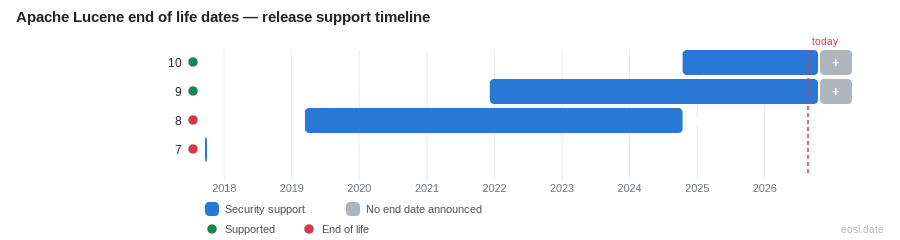
Currently Supported Apache Lucene Releases - Active EOS/EOSL Support (2)
Apache Lucene End of Life (EOL) Releases - No Longer Supported (2)
Wondering whether Apache Lucene end of life affects you? It depends on your version: the project is healthy, but older lines are EOL. Releases 7 and 8 are end-of-life and get no further security fixes, which matters for any legacy search stack, while 9 and 10 still receive support.
Is Apache Lucene End of Life? Current Status
No, the project is not dead. The Apache Software Foundation keeps the project active and maintained, and version 10.5.2 was released on 4 October 2026. Lucene 10 added support for Java 21, and in 2024 the community pushed roughly 2,000 commits from nearly 100 contributors. Questions go through the project's mailing lists. Only specific Apache Lucene lines have ended, and Lucene Core is the part you embed in your own code.
Solr, Elasticsearch and OpenSearch Build on Lucene
Lucene is a Java search library for full-text search and indexing. Apache Solr, Elasticsearch and OpenSearch each wrap it as a search engine, and PyLucene exposes it to Python. Most developers meet this open-source software library through one of those tools, so their release schedule decides which Lucene you actually run in production.
Lucene Lifecycle and Release Policy by Major Version
The Apache Lucene lifecycle follows no calendar. Under the release policy, the two newest major version lines get security support; once a third ships, the oldest ended its cover. Version 10 shipped in October 2024, so 8 dropped out that same day. These are the four versions tracked:
| Version | Released | Security support | Latest |
|---|---|---|---|
| 10 | 14 Oct 2024 | Active | 10.5.2 |
| 9 | 7 Dec 2021 | Active | 9.12.3 |
| 8 | 13 Mar 2019 | Ended 14 Oct 2024 | 8.11.4 |
| 7 | 19 Sep 2017 | Ended 7 Dec 2021 | 7.7.3 |
A supported release today means 9.12.3 or 10.5.2. Anything on 7 or 8 has no project support left, so any new vulnerability stays unfixed upstream.
Security Fixes and CVE Risk After EOL
Once a line is EOL, a new CVE published to the NVD gets no upstream security patches. The previous major version may still receive occasional critical security fixes, but nothing older does. Running that Apache Lucene code in production adds compliance risk and fails many security reviews. The same applies to Solr 8.11, which bundles Lucene 8. Patches only reach you if someone chooses to backport them.
Migrate or Choose Never-Ending Support for Legacy Lucene
You have two routes. The first is to migrate to 9.12.3 or 10.5.2 and plan the upgrade around your Java version. The second is vendor never-ending support, also sold as endless lifecycle support, where an enterprise provider will backport fixes to your old release. That keeps compatibility with your code and CI/CD pipeline while you schedule a rewrite.
Transitive Dependencies Hide the Risk
A vulnerable library buried in your supply chain forces every downstream component to be rebuilt. Lucene 7 or 8 can hide inside Solr 8.11 or another bundled product, so audit your dependency tree, including transitive dependencies, to see which Lucene version it resolves to before choosing either route.