Deno End of Life (EOL) Dates and End of Support (EOS) Dates
Deno end of life (EOL) and end of support (EOS) dates: 10 Deno versions have reached EOL, including Deno 2.8 (EOL date: Jun 25, 2026) — no longer receiving security updates or patches. Deno 2.9.8 is the current supported release. Also see Next.js EOSL dates for related end-of-life information.
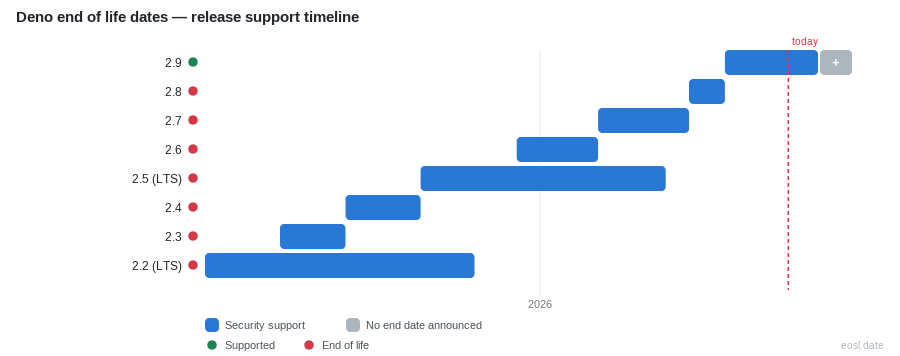
Currently Supported Deno Releases - Active EOS/EOSL Support (1)
| Release | Released | Security Support | Latest | LTS |
|---|---|---|---|---|
| 2.9 | (4 months ago) | Active | 2.9.8 (3 weeks and 1 day ago) | - |
Deno End of Life (EOL) Releases - No Longer Supported (10)
| Release | Released | Security Support | Latest | LTS |
|---|---|---|---|---|
| 2.8 | (5 months ago) | (4 months ago) | 2.8.3 (5 months ago) | - |
| 2.7 | (8 months ago) | (5 months ago) | 2.7.14 (6 months ago) | - |
| 2.6 | (11 months ago) | (8 months ago) | 2.6.10 (8 months ago) | - |
| 2.5 (LTS) | (1 year and 2 months ago) | (6 months ago) | 2.5.7 (9 months ago) | LTS |
| 2.4 | (1 year and 4 months ago) | (1 year and 2 months ago) | 2.4.5 (1 year and 2 months ago) | - |
| 2.3 | (1 year and 6 months ago) | (1 year and 4 months ago) | 2.3.7 (1 year and 4 months ago) | - |
| 2.2 (LTS) | (1 year and 8 months ago) | (1 year ago) | 2.2.15 (1 year and 1 month ago) | LTS |
| 2.1 (LTS) | (1 year and 11 months ago) | (1 year and 6 months ago) | 2.1.14 (1 year and 1 month ago) | LTS |
| 2.0 | (2 years and 1 month ago) | (1 year and 11 months ago) | 2.0.6 (2 years ago) | - |
| 1 | (6 years and 6 months ago) | (2 years and 1 month ago) | 1.46.3 (2 years and 2 months ago) | - |
Deno end of life now runs on two clocks. On 9 October 2026 the Deno team made an announcement: it is joining Cloudflare, Deno Deploy shuts down after six months, and the Deno runtime keeps receiving security updates for one more year before development ends. Below you'll find every date, what the announcement leaves unsaid, and which versions are still supported, so you can plan your migration.
Deno End of Life: What the Cloudflare Announcement Changes
The announcement carries two dated commitments instead of one cut-off. Deno says the Deno runtime stays supported for another year, then its own team stops working on it. The hosted side winds down much sooner. Cloudflare's half of the deal centres on workerd, its open JavaScript runtime: the two companies are merging workerd with a sister project, and Ryan Dahl, who created both Node.js and Deno, will lead an effort to make self-hosting workerd a first-class way to run apps. That effort doesn't extend support for the existing runtime, so it doesn't move any of the dates below.
No vendor has promised the existing runtime a permanent home. It remains open source, and the maintainers say outside contributors are welcome to carry it on, but nobody has volunteered yet, and the wider community hasn't answered.
For teams writing server-side JavaScript or TypeScript, the practical question is which of your services depend on Deno Deploy, which depend only on the runtime, and which npm packages and JSR modules they pull in. Everything below is organised around those three questions.
Timeline of the Deno announcement
Neither post gives calendar dates, so this timeline counts from 9 October 2026, the day of the announcement. The April and October 2027 dates are our reading, not Deno's.
| When | What happens | What nobody has stated |
|---|---|---|
| 9 October 2026 | Deno announces it is joining Cloudflare | Deal terms |
| Around 9 April 2027 | Deno Deploy shuts down (six months) | The exact day |
| The next twelve months | Monthly releases with fixes and security updates | Anything beyond fixes |
| Around 9 October 2027 | Deno stops developing the runtime | Who, if anyone, continues it |
| Ongoing | JSR keeps operating on Cloudflare infrastructure | Long-term JSR terms |
Is Deno dead? What the announcement says
Not yet. Fixes are still shipping: Deno 2.9.8 landed on 21 October 2026, twelve days after the announcement. After the one-year window, though, development stops and no person or company has committed to pick it up. Treat the runtime as a project with a known end date rather than a dead one.
Deno Deploy Shuts Down in Six Months
Deno Deploy is the hosted platform where Deno code runs on someone else's cloud, and it is the urgent clock. Deno says it will keep operating for six months and then close. Deno Deploy only reached general availability on 3 February 2026, so this is a short life for the product. Every service hosted on Deno Deploy, including edge functions and internal tools nobody has touched since launch, has to move before the shutdown. Deno also offers migration support to paying customers moving to Cloudflare Workers, though it hasn't defined what that covers, so don't count it as spare capacity in your schedule. JavaScript and TypeScript teams building for the edge on Deno Deploy have the least time of anyone.
When exactly does Deno Deploy close?
No calendar date is given. Counting from the announcement lands on about 9 April 2027, but plan to be off Deno Deploy several weeks earlier and stop shipping new work to it well before then. A hosting deadline with no stated day is a risk: you'd rather finish early than negotiate over a missing date. If your Deno Deploy projects pull npm packages, test those dependencies against Node.js now.
Deno Deploy edge functions and Subhosting questions
If you resell or embed Deno through Subhosting, the posts say nothing about its fate. Get answers in writing before you commit to a destination:
- Does Subhosting close on the same day as Deno Deploy, or follow a different timetable?
- What does migration support include for Subhosting customers, if anything?
- Will JSR, which keeps running on Cloudflare, stay available to publish to and install from throughout the wind-down?
- Can existing Subhosting deployments keep running until the Deno Deploy closing date?
- Is billing for your existing Deno Deploy projects unchanged until it closes?
Keep the replies with your inventory of services; they become the paper trail for any contract or compliance review later.
Deno Runtime End-of-Life: The One-Year Window
Anything running the runtime on your own servers, containers, CI jobs or scripts sits on the slower year clock. Deno promises monthly releases with bug fixes and security patches until that year ends, so nothing breaks on day one. Once Deno Deploy is gone, a self-hosted Deno service is simply a JavaScript process you operate, with a TypeScript toolchain and npm packages you now maintain. The risk grows afterwards: a runtime with no upstream development accumulates unpatched vulnerabilities, and the longer a service stays on it, the more you inherit that exposure yourself. Don't leave self-hosted services to drift once the support window closes.
Will Deno stay open source?
Yes, Deno says it will stay open source and invites others to continue it. A fork could keep an open-source runtime alive, but a fork needs funded maintainers, and none are named. That's acceptable for internal tooling and a poor bet for revenue-bearing production services.
Unstable APIs and the standard library after support ends
Unstable APIs sit behind --unstable-* flags and may change at any time, so they are the first things to avoid in long-lived code. The standard library on JSR is mostly stable: modules at 1.0.0 or higher count as stable, while 0.x modules don't. Once development stops, nobody will fix a breaking change in either. Unstable flags and 0.x standard library modules get no fixes after the window closes, so avoid them in anything meant to outlive it. Deno 2.7 stabilized the Temporal API, but new JavaScript standards like it only arrive while releases continue.
Deno LTS Maintenance End Dates by Version
Deno ships a new stable minor version on a 12 week schedule and releases patch releases as needed in between. It follows SemVer, and each minor release gets bug and security fixes until the next minor release arrives. That makes the release schedule your calendar: the current line is Deno 2.9, published on 25 June 2026. Each new line also adds JavaScript standards and npm compatibility work, such as the faster cold npm installs in Deno 2.8.
Release channels and the LTS channel
Deno ships four release channels: the default stable channel, an lts line, an rc (release candidate) and canary builds that change several times a day. The binary you installed remembers its channel, which decides what deno upgrade treats as latest and what the update notice tells you. Check your channel before reading any support cutoff, because a stable build and an LTS build of the same number follow different support windows. A bare version number always selects the stable build, so you switch channels by name:
| Command | What you get | Channel |
|---|---|---|
| deno upgrade | Latest stable release | stable |
| deno upgrade lts | Latest LTS release | lts |
| deno upgrade rc | Latest release candidate | rc |
| deno upgrade canary | Latest canary build | canary |
Stable builds are a download from GitHub releases, while every other channel comes from Deno's own download server. A version such as 2.9.3 exists as both a stable and an LTS build, so an LTS user who runs a plain version upgrade silently moves to stable. To stay put, upgrade with the channel name.
Long term support dates in a table
The LTS channel is a single stable minor line that receives only backwards-compatible fixes, which suits enterprise users who dislike frequent upgrades. A LTS release gets security patches and critical bug fixes, with critical performance work backported by severity; API changes and large new features are not. Here is the published maintenance start and maintenance end for each LTS release:
| LTS release | Maintenance start | Maintenance end |
|---|---|---|
| 2.1 | 1 February 2025 | 30 April 2025 |
| 2.2 | 1 May 2025 | 31 October 2025 |
| 2.5 | 1 November 2025 | 30 April 2026 |
| 2.9 | 1 July 2026 | 31 January 2027 |
One thing to check: the LTS page was last updated on 16 July 2026, before the announcement, and its 2.9 date falls about nine months before the runtime's year-long window closes. Confirm whether Deno revises it.
Which Deno versions still get security updates?
Only the current line does. Per endoflife.date, security support for each older minor ended when its successor shipped, and the LTS line followed its own table:
| Release | Released | Security support ended | Last patch |
|---|---|---|---|
| 2.9 | 25 Jun 2026 | Still supported | 2.9.8 |
| 2.8 | 22 May 2026 | 25 Jun 2026 | 2.8.3 |
| 2.7 | 25 Feb 2026 | 22 May 2026 | 2.7.14 |
| 2.5 (LTS) | 10 Sep 2025 | 30 Apr 2026 | 2.5.7 |
| 2.2 (LTS) | 18 Feb 2025 | 31 Oct 2025 | 2.2.15 |
| 2.1 (LTS) | 21 Nov 2024 | 30 Apr 2025 | 2.1.14 |
| 1.x | 13 Apr 2020 | 9 Oct 2024 | 1.46.3 |
If deno --version prints anything other than a supported release from that table, upgrading is your first task, whatever you decide about the platform. Deno 2.8 and Deno 2.7 lost security support as soon as their successors shipped, while Deno 2.5, Deno 2.2 and Deno 2.1, the older LTS lines, reached the end of their windows. Deno 1.0 stabilized the core namespace APIs, but its line has been unsupported for over two years.
Deno Shutdown Planning: Which Parts of Your Estate Are Exposed
Sort what you run into three buckets before debating destinations. Services on Deno Deploy sit on the six-month clock, and they are often the smallest bucket and the easiest to miss. Workloads running the runtime elsewhere sit on the year clock. The third bucket holds Deno-specific dependencies such as JSR packages and Subhosting. Ask each owning team for a list, and don't trust a repository search alone: the runtime choice often hides in a Dockerfile or a CI config. Start with a written inventory and name one owner this week.
The three exits for Deno workloads
| Exit | What is stated | What drives effort | Main risk |
|---|---|---|---|
| Cloudflare Workers | Migration support for paying customers | Deno-specific APIs, service count | Terms and pricing unpublished |
| Node.js on your hosting | No vendor commitment | Same drivers plus running your own platform | You own work Deno Deploy did for you |
| Stay on open-source Deno | Open source, contributors welcome | Almost nothing now | No named maintainer after a year |
Workers is the only exit with a stated vendor commitment, but migration support is still undefined. This table reflects our judgment, not measured effort.
Sizing the staffing decision for a Deno migration
Count services per bucket, check who owns each one, and look at its test coverage: a well-tested service with a single owner moves far faster than a large untested one nobody remembers writing. A workable plan for one quarter is an inventory in two weeks, an exit chosen per bucket by week four, low-risk services first to learn the real cost, and a freeze on new Deno Deploy work well ahead of the April 2027 closing. Anything self-hosted can follow later, but should still be off Deno before the October 2027 cutoff. If nobody has capacity, make that staffing call now.
Node.js Migration After the Deno End-of-Life Date
For most JavaScript developers, moving back to Node.js is often the smoothest migration, because Deno's compatibility work runs the other way too: it reads package.json, understands npm lockfiles and uses the same ECMAScript modules. Most developers find the hard part isn't the framework but the Deno-specific code, such as permission flags, JSR imports and platform helpers built for Deno Deploy.
That Node.js compatibility is why most JavaScript and TypeScript code needs few changes. Your npm lockfile, your node: imports and your ECMAScript modules keep working, and the compatibility gap mostly lives in Deno namespace calls and permission flags. Check each npm package against the Node.js version you plan to run, then test the TypeScript build.
Do I have to move to Cloudflare Workers?
No. Workers is the destination Deno names and the only one with a stated vendor commitment, but a Node.js server, a container platform or another cloud works if your code is portable. Compare effort and pricing once Cloudflare publishes terms, and aim to finish before Deploy closes and well before the runtime's year ends.
Moving TypeScript and npm projects to Node.js
The move is time-bound, so rehearse it early. TypeScript projects need a build step or Node's own type-stripping, and Deno's built-in tools such as the formatter and test runner need replacements. Packages from npm mostly carry over unchanged, and pnpm and Yarn can install JSR packages, so you rarely lose a dependency. Run npm install against your existing package.json and compare the npm lockfile with what Deno resolved, since a TypeScript project often pulls npm and JSR packages side by side. Rehearse the move on one low-risk JavaScript service in staging before you touch production, and keep the other JavaScript services running unchanged until it passes.