Vinyl Cache End of Life (EOL) Dates and End of Support (EOS) Dates
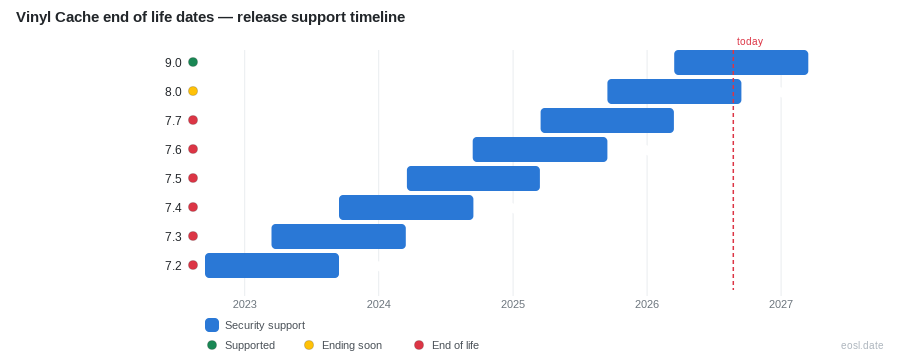
Vinyl Cache end of life (EOL) and end of support (EOS) dates: 9 Vinyl Cache versions have reached EOL, including Vinyl Cache 8.0 (EOL date: Sep 15, 2026) — no longer receiving security updates or patches. Vinyl Cache 9.0 reaches its End of Support date on Mar 16, 2027 — plan your upgrade path now. Vinyl Cache 9.1.0 is the current supported release, with support through Sep 16, 2027. Also see Caddy EOSL dates for related end-of-life information.
Currently Supported Vinyl Cache Releases - Active EOS/EOSL Support (1)
| Release | Released | Security Support | Latest | LTS |
|---|---|---|---|---|
| 9.1 | (2 months ago) | (in 9 months) | 9.1.0 (2 months ago) | - |
Vinyl Cache Releases Nearing End of Life - Support Ending Soon (2)
Vinyl Cache End of Life (EOL) Releases - No Longer Supported (9)
| Release | Released | Security Support | Latest | LTS |
|---|---|---|---|---|
| 8.0 | (1 year and 2 months ago) | (2 months ago) | 8.0.2 (6 months ago) | - |
| 7.7 | (1 year and 8 months ago) | (8 months ago) | 7.7.3 (1 year and 3 months ago) | - |
| 7.6 | (2 years and 2 months ago) | (1 year and 2 months ago) | 7.6.5 (1 year and 3 months ago) | - |
| 7.5 | (2 years and 8 months ago) | (1 year and 8 months ago) | 7.5.0 (2 years and 8 months ago) | - |
| 7.4 | (3 years and 2 months ago) | (2 years and 2 months ago) | 7.4.3 (2 years and 8 months ago) | - |
| 7.3 | (3 years and 8 months ago) | (2 years and 8 months ago) | 7.3.2 (2 years and 8 months ago) | - |
| 7.2 | (4 years and 2 months ago) | (3 years and 2 months ago) | 7.2.1 (4 years and 1 month ago) | - |
| 7.1 | (4 years and 8 months ago) | (3 years and 8 months ago) | 7.1.2 (4 years and 1 month ago) | - |
| 7.0 | (5 years and 2 months ago) | (4 years and 2 months ago) | 7.0.3 (4 years and 3 months ago) | - |
If you run an HTTP accelerator in production, Vinyl Cache end of life dates decide when your Varnish Cache setup stops receiving fixes. Below you can see which releases still get security support, which are done, and what the release status means for your upgrade plan.
Vinyl Cache End of Life Dates by Release
Each Vinyl Cache version is supported for a fixed window, and the end-of-life date is the day security fixes stop. A new minor version arrives every six months, in March and September. Here is the picture from endoflife.date as of 17 September 2026:
| Release | Released | Fixed until | Newest build |
|---|---|---|---|
| 9.1 | 16 Sep 2026 | Until 16 Sep 2027 | 9.1.0 |
| 9.0 | 16 Mar 2026 | Until 16 Mar 2027 | 9.0.2 |
| 8.0 | 15 Sep 2025 | Ended 15 Sep 2026 | 8.0.2 |
| 7.7 | 17 Mar 2025 | Ended 15 Mar 2026 | 7.7.3 |
| 6.0 (LTS) | 15 Mar 2018 | No end date listed | 6.0.18 |
The project's own policy is blunt: every release not listed as supported is end of life and unsupported. Today that means every 7.x line is gone.
Security support and supported release numbers
Pick a supported release from the table and check your release number against it: a 9.x or the 6.0 line is safe for now, while anything on 8.0 or older is running without security support. These supported release numbers cover only the project's own security vulnerabilities fixes, not your plugins.
Release status and the latest patch
Run varnishd -V to see your build, then compare it with the official release status page. A patch inside your line, such as 9.0.2, is a drop-in update, so apply the latest patch first. You can also follow the announce mailing list so new security notices reach you the day they ship.
Varnish Cache vs Vinyl Cache: the rename and your support options
In late 2025 the open source project began renaming itself, and by its 20th anniversary in early 2026 it was Vinyl Cache. The rename followed a trademark dispute with Varnish Software, the commercial company behind the original Varnish. The community still ships the same engine: the binary is still called varnishd and still prints a Varnish banner.
That leaves two names to watch. Vinyl Cache is the community, open-source upstream. Varnish Cache is now a downstream distribution that Varnish Software maintains for containerized and enterprise users, and it keeps collaborating with the Vinyl project on every release and security fix. Support dates can therefore differ slightly depending on which distribution you installed, so confirm which one you run before relying on any Varnish date.
Varnish long-term support: 6.0 LTS end-of-life and the LTS roadmap
The 6.0 LTS line dates back to 2018 and is still maintained; its latest patch, 6.0.18, shipped in May 2026. Vinyl's pages list no EOL for it, but Varnish Software has announced that it is retiring 6.0 and will support it until March 2027. Under its LTS roadmap, the next long-term support release builds on the first Vinyl-based line, so treat March 2027 as your deadline if you use that distribution.
Planning a migration window
That date gives you a full year of migration time before 6.0 reaches end of life. Stay on 6.0 only if backwards compatibility matters more than new features; otherwise schedule your migration window now.
What end-of-life means for a Varnish reverse proxy and caching proxy
Every release is the same kind of tool: a reverse proxy that sits in front of your web server and decides per request whether to serve a stored copy or fetch a fresh one from the backend. As a caching proxy built only for HTTP, and a web application accelerator by design, Varnish serves a cache hit straight from memory, which is why it can speed up delivery by a large factor.
Its behavior is written in VCL, a small language compiled into the running cache, so you can change caching rules without a restart. Your VCL must still load on the newer version: syntax from 3.x to 5.x will not compile, which is one more reason to upgrade early. Client-side TLS is arriving in the core of the newer lines, so an end-of-life release misses it.
An unsupported Varnish Cache release keeps serving your backend and every HTTP response from the cache, but it no longer receives fixes, so the risk grows quietly.
Upgrading before a Varnish release reaches end-of-life
Upgrading is easier when you do it before the deadline, not after. A short checklist:
- Find your release with
varnishd -Vand match it to the table above. - Validate your VCL on the target version, and test the new Varnish build against a staging backend with replayed HTTP traffic, comparing the cache hit ratio before and after.
- Move to 9.x for new work; it is the current line and the one under active development.
- Plan your upgrade for the quiet week after a March or September release.
The project is also building for cloud-native setups (Docker images, Helm charts, Rust bindings and a Kubernetes Gateway API), and those cloud and enterprise features land on supported 9.x software, not on old lines.