Varnish End of Life (EOL) Dates and End of Support (EOS) Dates
Varnish end of life (EOL) and end of support (EOS) dates: 8 Varnish versions have reached EOL, including Varnish 7.7 (EOL date: Mar 15, 2026) — no longer receiving security updates or patches. Varnish 8.0.0 is the current supported release, with support through Sep 15, 2026 — 2 versions in active support. Also see Caddy lifecycle dates for related end-of-life information.
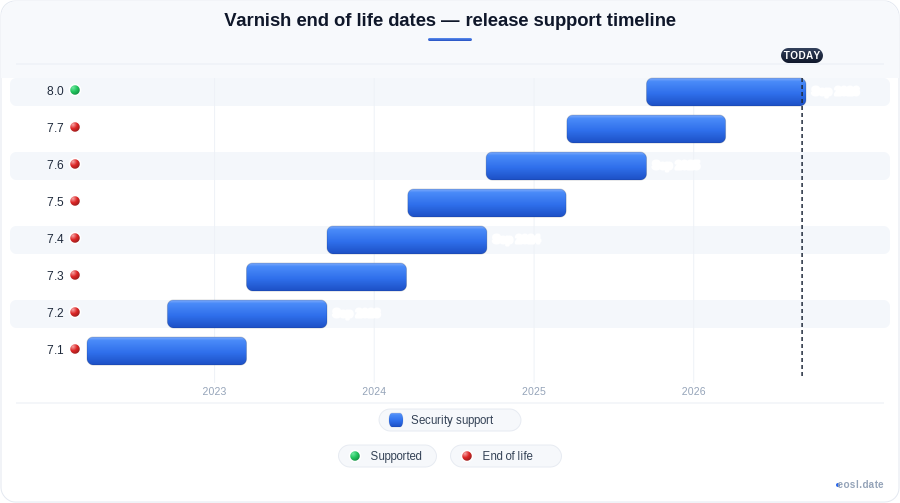
Currently Supported Varnish Releases - Active EOS/EOSL Support (2)
Varnish End of Life (EOL) Releases - No Longer Supported (8)
| Release | Released | Security Support | Latest | LTS |
|---|---|---|---|---|
| 7.7 | (1 year and 8 months ago) | (8 months ago) | 7.7.3 (1 year and 3 months ago) | - |
| 7.6 | (2 years and 2 months ago) | (1 year and 2 months ago) | 7.6.5 (1 year and 3 months ago) | - |
| 7.5 | (2 years and 8 months ago) | (1 year and 8 months ago) | 7.5.0 (2 years and 8 months ago) | - |
| 7.4 | (3 years and 2 months ago) | (2 years and 2 months ago) | 7.4.3 (2 years and 8 months ago) | - |
| 7.3 | (3 years and 8 months ago) | (2 years and 8 months ago) | 7.3.2 (2 years and 8 months ago) | - |
| 7.2 | (4 years and 2 months ago) | (3 years and 2 months ago) | 7.2.1 (4 years and 1 month ago) | - |
| 7.1 | (4 years and 8 months ago) | (3 years and 8 months ago) | 7.1.2 (4 years and 1 month ago) | - |
| 7.0 | (5 years and 2 months ago) | (4 years and 2 months ago) | 7.0.3 (4 years and 3 months ago) | - |
Your Varnish end of life check starts with one question: does the version you run still get fixes? Varnish is a web application accelerator, a caching HTTP reverse proxy that keeps traffic off your origin by answering from its cache. Every open source release reaches end-of-life sooner or later, and the project now goes by Vinyl Cache, so this guide lists which lines are supported and which are unsupported.
Varnish End of Life Dates for Every Release
The table shows each release line, when it shipped and when fixes stop, based on endoflife.date data from September 2026. The release date tells you how old a line is, and the EOL date tells you whether your cache still gets fixes. You can download a supported build from the official releases page.
| Release | Released | Security support ends | Status |
|---|---|---|---|
| 9.1 | 16 Sep 2026 | 16 Sep 2027 | Supported |
| 9.0 | 16 Mar 2026 | 16 Mar 2027 | Supported |
| 8.0 | 15 Sep 2025 | 15 Sep 2026 | Ended |
| 7.7 | 17 Mar 2025 | 15 Mar 2026 | Ended |
| 7.6 | 13 Sep 2024 | 15 Sep 2025 | Ended |
| 6.0 LTS | 15 Mar 2018 | None announced | Supported |
Varnish 9.0 and Varnish 8.0 release dates
Varnish 9.0 shipped in March 2026 and 9.1 followed in September. A new minor version arrives every 6 months, and each gets a year of security support. That is why 8.0 ended on 15 September 2026, with 8.0.2 as its latest patch. Always pair a supported line with its newest patch level.
Varnish Cache 6.0 LTS stays supported
Varnish Cache 6.0 is the long-term line: released in 2018, with 6.0.18 as its latest patch from May 2026 and no end date listed. Choose it when backwards compatibility matters more than new features, and schedule its maintenance like any dependency of your cache layer. Treat this supported release as the safe fallback.
Vinyl Cache: The New Name for Varnish Cache
The Varnish Cache community went through a rename after a trademark dispute with Varnish Software, the company that sells the paid distribution. Names changed, binaries did not: the command is still varnishd, and the version banner still shows a varnish-9.x number. Release notices and the documentation now come from the community, so check them there before trusting any cache date you find elsewhere.
End of Support for Varnish Cache 4.1
The open source Varnish Cache 4.1 line no longer receives fixes, so keeping that cache in service means going it alone. Varnish Enterprise 4.1.x was marked end of life on 1 August 2022, which tells you how long ago that line left its retirement window. Treat any 4.x or 5.x install as past its retirement date, especially when it sits in core infrastructure.
Security vulnerabilities in unsupported software
Old releases fail in three predictable ways:
- Security: nobody patches critical bugs or newly found security vulnerabilities in the Varnish Cache install sitting in front of your backend.
- Compliance: out-of-date releases can break regulatory requirements and carry legal cost.
- Incompatibility: obsolete software drifts away from new operating systems, and the cache cannot scale.
Upgrade Path: Which Varnish Release to Choose
Moving from Varnish Cache 4.1 to a current line is an upgrade of your whole config, because VCL syntax changed along the way. Pick 9.x for new work, or Varnish Cache 6.0 if you value stability. Test the new cache beside the old cache while your backend keeps serving production traffic, then compare cache hit rates and performance before you cut over.
Checking your VCL before you switch
Before moving off an unsupported 4.x or 5.x line, run varnishd -C against your VCL to confirm it compiles on the target release, then confirm cache invalidation through PURGE and bans and grace mode still behave and your cache still serves hits.
Varnish Enterprise Support Options
Varnish Enterprise is the paid build from Varnish Software. Customers on a subscription get backported security updates, long-term software lifecycles and 24x7x365 support, which suits streaming and CDN workloads and teams that cannot upgrade before a line reaches its end-of-life. It adds cache persistence and extra Varnish modules through a private package repository, so weigh Varnish Enterprise against moving to a free supported release.
Staying on Supported Releases as New Ones Ship
Join the mailing list named varnish-announce so each cache release and EOL notice reaches you. Before your line's date, install the next supported release on Linux (Ubuntu or Redhat packages) or as a Docker image, and test the cache first.