Valkey End of Life (EOL) Dates and End of Support (EOS) Dates
Valkey 9.1.3 is the current supported release, with support through May 19, 2031 — 5 versions currently in active support. Track Valkey end of life dates — EOL, EOS and EOSL dates — across all 5 releases. Also see containerd end of life dates for related end-of-life information.
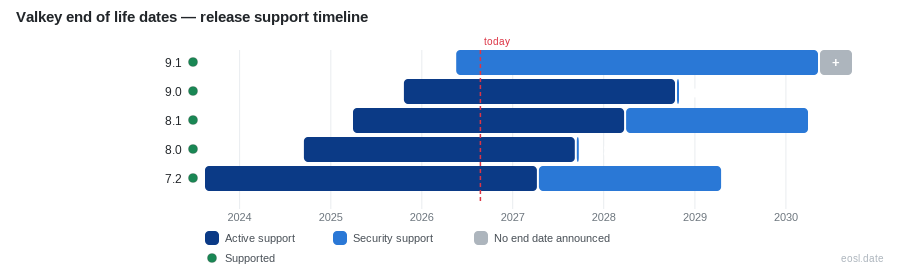
Currently Supported Valkey Releases - Active EOS/EOSL Support (5)
| Release | Released | Extended Security Support | Maintenance Support | Latest |
|---|---|---|---|---|
| 9.1 | (5 months ago) | (in 4 years and 6 months) | (in 2 years and 6 months) | 9.1.3 (2 weeks and 3 days ago) |
| 9.0 | (1 year ago) | (in 1 year and 11 months) | (in 1 year and 11 months) | 9.0.7 (2 weeks and 3 days ago) |
| 8.1 | (1 year and 7 months ago) | (in 3 years and 4 months) | (in 1 year and 4 months) | 8.1.11 (2 weeks and 3 days ago) |
| 8.0 | (2 years and 1 month ago) | (in 10 months) | (in 10 months) | 8.0.12 (2 weeks and 3 days ago) |
| 7.2 | (2 years and 6 months ago) | (in 2 years and 5 months) | (in 5 months) | 7.2.15 (2 weeks and 3 days ago) |
Valkey end of life is the date a release line stops receiving fixes from the open source community behind this BSD-licensed key/value datastore. This guide lays out every supported release, the maintenance and security dates attached to it, and the lifecycle rules behind them, so you know how long your Valkey support lasts before you plan an upgrade.
Valkey End of Life Dates for Every Supported Version
Each release line gets a fixed support window counted from its initial release. The table lists the supported versions, with the day each one first shipped and the day each kind of support stops. Run valkey-server --version on your host, then find the matching row. The latest version listed is 9.1, and the schedule is published on GitHub alongside the source.
| Version | Initial release | Maintenance support end | Security support end |
|---|---|---|---|
| 9.1 | 2026-05-19 | 2029-05-19 | 2031-05-19 |
| 9.0 | 2025-10-21 | 2028-10-21 | 2028-10-21 |
| 8.1 | 2025-03-31 | 2028-03-31 | 2030-03-31 |
| 8.0 | 2024-09-15 | 2027-09-15 | 2027-09-15 |
| 7.2 | 2024-04-16 | 2027-04-16 | 2029-04-16 |
Any supported release in this table is a version your workloads can run today; anything older has no support window left. Treat each date like a deadline for any other critical software, because the versions past it lose fixes, and a fleet running mixed versions makes the risk worse.
When Is Valkey EOL? Reading Each Release Line
The first date to watch is 16 April 2027, when the three-year maintenance window for 7.2 closes. Its extended window carries on to 2029, because that line is the one chosen for the longer window. Lines 8.0 and 9.0 have no such extension, so their EOL date is the same day maintenance stops: 15 September 2027 for 8.0 and 21 October 2028 for 9.0. Patch releases keep arriving on every supported line until that point, and the community also publishes updated EOL dates whenever a new major release changes the picture.
Maintenance Support End and Security Support End Dates
Two different promises sit behind the two date columns. Maintenance support means bug fixes and security fixes for three years from the first release of a minor line. Security support runs up to five years, but only for the newest minor line of each major release, and only for flaws the technical steering committee (TSC) judges exploitable. When both columns show the same day, the line has no extension beyond three years.
Valkey Version Support: Maintenance and Extended Security Support
The newest stable release is always fully supported and maintained. The maintainers ship a patch for each reported vulnerability they consider possible to exploit, and bug fixes follow while the maintenance window lasts. Once that closes, only extended security support remains, and it is narrower on purpose.
Extended Support for the Latest Minor Release Line
Extended support covers just one minor line per major release. Maintainers pick that line after the next major release launches, which is why 7.2 gained its longer window while 8.0 has not. If you depend on that longer window, plan around the pick rather than assuming your line qualifies; the yearly cadence means the decision comes regularly.
What End-of-Life Means for Security Patches
An end-of-life release gets no new fixes from upstream, and the formal name for that moment is end of support. A flaw found tomorrow stays open on your host, and anyone scanning for it will find an unpatched server. Software past its final support date is not broken the day after, but each month adds exposure that you cannot remove by configuration alone.
Valkey Release Schedule and Versioning Schema
The release schedule is predictable: one stable major version a year, with minor releases whenever needed and at least one per year. Version numbers follow semantic versioning, a major.minor.patch versioning schema, so the digit that changes tells you what to expect. Releases begin in the unstable branch, which is not meant for production and is useful for development only.
Patch Version, Minor Version and Major Version Changes
A patch version carries backward compatible corrections and is safe to apply. A minor version adds commands, info fields or configuration parameters, and the rules ask you to avoid new features until every server in a cluster is upgraded. A major version may bring breaking changes, such as removing a deprecated command or changing a default, so read the release notes first.
Release Candidate and Stable Release Stages
A new line starts as an early build named like 7.2.0-rc1, issued every couple of weeks for testing and feedback. When feedback slows, the release is marked stable with 0 as its last digit. A release candidate carries no support promise: the Valkey support clock starts when the stable version ships, so wait for the stable tag and its first patches before pointing a production cluster at it.
Managed Service Support and EOL Policy: ElastiCache and Aiven
If a cloud provider runs your database, its schedule matters as much as the project's own. Managed services follow upstream, but their own dates differ, so check your cloud account for the versions in use. Amazon ElastiCache documents Valkey engines 9.1, 9.0, 8.2, 8.1, 8.0 and 7.2, and Aiven publishes its own table: 9.0.x service creation is supported until 2026-08-31, while 8.1.x and 9.1.x dates are still to be announced. Best practices are the same on any provider:
- Track both the upstream date and your provider's date.
- Move on your own schedule, before the earlier of the two.
- Keep a fork or copy of the service to test the move.
Notifications and Automatic Upgrades on Managed Services
Aiven sends EOL notifications by email when it sets a date, monthly reminders after that, and weekly ones in the final month. After the date, a powered-on service upgrades automatically when possible, and a service that cannot be upgraded is powered off and eventually deleted. One notification gives you time to avoid unplanned downtime, and clusters with high availability can roll through the change more gently.
Redis Compatibility and ElastiCache Engine Versions
ElastiCache lists its Valkey engine versions beside Redis OSS, and its retired engine lines show how old versions fade out, so match your engine version to the Valkey dates above. Valkey keeps protocol-level compatibility for caching workloads, but check that your Linux image, clients and modules support the engine line you pick.
Running Unsupported Valkey Software: Risks and Extended Support
A Valkey end-of-life release is a risk decision, not a legal one. Teams that cannot move yet can buy paid coverage from third parties, which adds fixes upstream will no longer ship. It buys time, never a permanent home, and the open source licence does not change either way.
End-of-Life Software and Unpatched Vulnerabilities
Every vulnerability published after the date applies to your Valkey server with no official fix, so a 7.2 server still running after 2029 and exposed on a network port is the case to avoid. Rate each one of these software flaws by whether the vulnerable feature is reachable in your environment, and fix the reachable ones first. Closing network access to the port reduces exposure but does not replace patching.
Backported CVE Patches for Valkey and Evidence for Auditors
Some vendors backport fixes and offer backported CVE patches for Valkey, taking a fix from a newer release and applying it to the old line so nothing else changes. For compliance, SOC 2 or PCI DSS reviews usually want the patch source and a dated migration schedule, so keep that record.
Valkey Upgrade Plan: Moving Before the EOL Date
Start the upgrade about a year before the end-of-life date, not a month. A written upgrade plan names the target version, the owner and the date the old line leaves service. Working from a plan makes the migration a routine task instead of an emergency.
Testing the Upgrade Path Before End of Life
Pick the Valkey upgrade path with the fewest jumps, such as 7.2 straight to 9.1, and rehearse it on a copy of your data before the line's end date. Check commands, configuration defaults and client behaviour, and keep a rollback ready: a snapshot taken just before the cutover. Schedule the change in a window that tolerates a short period of downtime, and measure latency before and after.
Upgrading Replicas Before Primaries
In a Valkey cluster, upgrade replicas first, verify replication is healthy, then promote one and upgrade the former primaries. Older primaries stream data in a format newer replicas accept, so this order protects consistency. Read the release notes for the target line before you begin, then go node by node; finishing before then avoids running primaries without fixes.