TLS End of Life (EOL) Dates and End of Support (EOS) Dates
TLS end of life (EOL) and end of support (EOS) dates: 2 TLS versions have reached EOL, including TLS TLS 1.1 (EOL date: Mar 23, 2021) — no longer receiving security updates or patches. TLS TLS 1.3 is the current supported release — 2 versions in active support. Also see PCI-DSS EOSL dates for related end-of-life information.
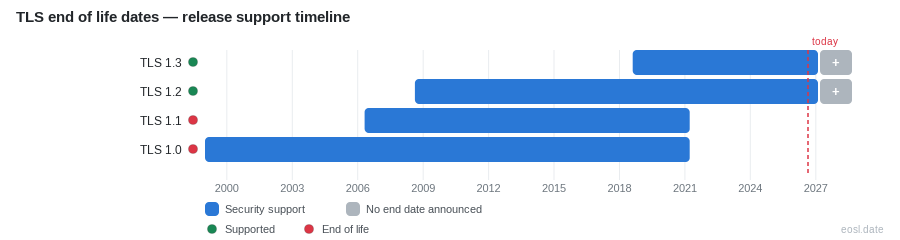
Currently Supported TLS Releases - Active EOS/EOSL Support (2)
| Release | Released | Security Support |
|---|---|---|
| TLS 1.3 | (8 years and 3 months ago) | Active |
| TLS 1.2 | (18 years and 2 months ago) | Active |
TLS End of Life (EOL) Releases - No Longer Supported (2)
| Release | Released | Security Support |
|---|---|---|
| TLS 1.1 | (20 years and 6 months ago) | (5 years and 7 months ago) |
| TLS 1.0 | (27 years and 10 months ago) | (5 years and 7 months ago) |
If a vendor notice or audit finding sent you searching for TLS end of life, the short answer is that TLS 1.0 and 1.1 are retired, TLS 1.2 is still allowed but frozen, and TLS 1.3 is the version to aim for. This guide shows where each version stands, what changed, and how to plan your upgrade without dropping a single client connection.
TLS End of Life Timeline: Where TLS 1.3 and TLS 1.2 Stand
Transport Layer Security replaced the older SSL protocol in 1999 (people still say SSL for what is now TLS), and every release since has been published by the IETF as a numbered standard. Transport Layer Security secures HTTPS, email, and voice traffic, so its release history doubles as a support calendar for the internet.
| Version | Standard | Released | Status today |
|---|---|---|---|
| TLS 1.0 | RFC 2246 | 1999 | Deprecated, Historic status |
| TLS 1.1 | RFC 4346 | 2006 | Deprecated, Historic status |
| TLS 1.2 | RFC 5246 | 2008 | Supported, feature freeze |
| TLS 1.3 | RFC 8446 | 2018 | Current, recommended |
Only the first two rows are truly end-of-life. The third is under pressure but has no fixed sunset date, while the last gets all new work, including post quantum cryptography.
Why TLS 1.0 and 1.1 Were Deprecated by RFC 8996
In March 2021 the IETF published RFC 8996, which deprecated both early versions and moved them to Historic status. Browsers, cloud vendors, and standards bodies had already spent years removing them, yet the retirement still dragged on, because many old systems depended on them.
Weak Ciphers and Missing Forward Secrecy
TLS 1.0 and 1.1 allow weak ciphers and known vulnerabilities, and they lack modern cryptography. A downgrade attack can push a client onto the weakest option both sides share. Ciphers using forward secrecy protect past sessions even if a long-term key leaks later, and the old versions cannot guarantee it. They also cannot carry post-quantum algorithms, which matters for long-term security. The same lesson applies to SSL 2.0 and SSL 3.0, which were abandoned long before: an SSL-era protocol that lingers becomes the easiest target in your stack.
Legacy TLS in Browsers and Cloud Platforms
Support for the old versions has been dropped almost everywhere, and current browsers no longer negotiate legacy TLS by default. In the cloud, Microsoft Azure extended its cutoff for TLS 1.0 and 1.1 to August 31, 2025, after which TLS 1.2 or later is required for connections to its services, unless a service's documentation says otherwise. A delay like that shows how slowly the internet moves its foundations, and why you should not wait for a final enforcement date before you act.
Is TLS 1.2 Deprecated? PCI-DSS and the Feature Freeze
No. TLS 1.2 end of life is a common misreading: the IETF has not set a retirement date for it, and PCI-DSS still accepts it as the minimum. What changed is that RFC 9851 put it in a feature freeze, so it only receives urgent security fixes, new exporter labels, and new ALPN identifiers. Everything else, including all post-quantum work, goes to TLS 1.3 and later, so plan on TLS 1.2 as a bridge, not a destination: the TLS 1.2 protocol stays secure when configured well, and it gets support from every major platform.
Key Exchange Methods Now Marked Obsolete
The second change is RFC 10015, which says clients must not offer the RSA key exchange and servers must not select it. The reason is that the key travels over the network encrypted only with the server's public key, so a later leak unlocks every recorded session. Bleichenbacher found a practical attack in 1998, and the ROBOT attack showed it still worked years later. Most Diffie-Hellman groups are also now obsolete. The list of allowed cipher suites shrinks, but nothing breaks overnight; note that this concerns the key exchange, not the RSA certificate, which stays fine.
How to Check Whether Retired Versions Like TLS 1.0 Are Still in Use
Open your browser's connection details to see which version a site negotiated, and scan your own servers with a TLS testing tool, or try openssl s_client -tls1_1 against a host: if the handshake succeeds, that server still accepts a retired version. The deprecation matters most where a single vulnerability could expose customer data, so check public endpoints first, then internal ones. Anything still answering with TLS 1.0 and 1.1 is your first upgrade candidate.
Retirement Dates for Cloud, Servers and SIP: Minimum Version Rules
When a carrier or cloud peer raises its minimum version, your side must keep up or the connection fails at the handshake. Watch for these triggers:
- A vendor notice announcing a new minimum accepted version for API or partner traffic.
- Default settings in Nginx, Apache, and Windows Server that still enable retired protocols or obsolete suites.
- Telephony links where SIP signalling runs over TLS on
port 5061, such as a session border controller facing a carrier: once a carrier requires TLS 1.2 or later, every SIP trunk and SIP phone behind it must support that version.
Dates are concrete: Azure moved its cutoff for TLS 1.0 and 1.1 to August 31, 2025, and the IETF moved both versions to Historic status in 2021. Telephony needs the same attention as a cloud-hosted website, because a failed handshake silently stops calls. Ask each vendor for written support terms, and check each endpoint on its own.
How to Plan a Migration Away from Retired TLS Versions
A calm migration beats a flag-day cutover. Follow this order:
- Inventory every server, client, and appliance that terminates TLS, and record the versions each one negotiates.
- Run an audit of connection logs to find peers still using TLS 1.0 or TLS 1.1.
- Raise the protocol minimum to TLS 1.2 first, then enable TLS 1.3 alongside it.
- Remove RSA key exchange and weak Diffie-Hellman suites during a scheduled change window.
- Record the new baseline for compliance reviews.
Cipher Suites to Keep and Remove
Prefer a modern cipher suite built on authenticated encryption, such as AES-GCM or ChaCha20-Poly1305, with forward secrecy through ephemeral keys, which is known as perfect forward secrecy. TLS 1.3 only offers suites like these. Keep an older protocol fallback only for a named client you cannot yet upgrade.
Handshake Testing Before the Cutover
Test the handshake against each partner in staging after TLS 1.0 and 1.1 are disabled, and confirm every connection now negotiates TLS 1.2 or 1.3. A version or cipher mismatch fails there, before any application data flows. Confirm the authentication step still passes with your certificates, then check that HTTPS pages and API calls work and note the risk of any peer that fails.