PCI-DSS End of Life (EOL) Dates and End of Support (EOS) Dates
PCI-DSS end of life (EOL) and end of support (EOS) dates: 4 PCI-DSS versions have reached EOL, including PCI-DSS 4.0 (EOL date: Dec 31, 2024) — no longer receiving security updates or patches. PCI-DSS 4.0.1 is the current supported release. Also see TLS lifecycle dates for related end-of-life information.
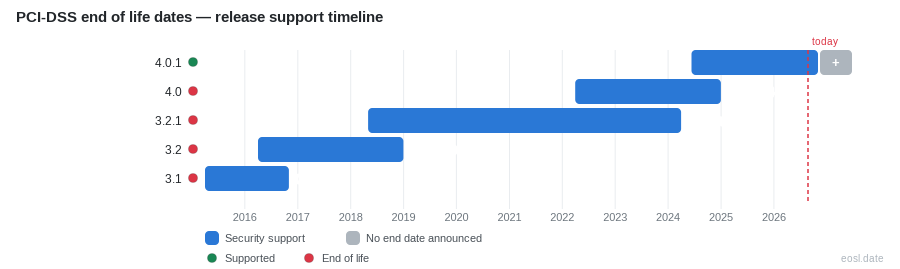
Currently Supported PCI-DSS Releases - Active EOS/EOSL Support (1)
| Release | Released | Acceptance |
|---|---|---|
| 4.0.1 | (2 years and 5 months ago) | Active |
PCI-DSS End of Life (EOL) Releases - No Longer Supported (4)
| Release | Released | Acceptance |
|---|---|---|
| 4.0 | (4 years and 7 months ago) | (1 year and 10 months ago) |
| 3.2.1 | (8 years and 6 months ago) | (2 years and 7 months ago) |
| 3.2 | (10 years and 7 months ago) | (7 years and 10 months ago) |
| 3.1 | (11 years and 7 months ago) | (10 years ago) |
Your PCI-DSS end of life checklist has two parts: knowing which versions of this security standard are withdrawn, and keeping unsupported systems away from payment account data. The card schemes enforce it for credit cards, so PCI DSS 4.0.1 is the version your cardholder environment is judged against today.
Retired PCI DSS Versions and Sunset Dates
The PCI Security Standards Council publishes each standard and announces when an older release stops counting. During a sunset period you may still be assessed against the old text, but once it closes, the newer requirements govern every cardholder data and payment card system you run. An assessment result stays valid for its own period even after the release it used is withdrawn, and the Summary of Changes documents what moved between releases.
| Version | Released | Acceptance |
|---|---|---|
| 4.0.1 | 11 June 2024 | Yes |
| 4.0 | 31 March 2022 | Ended 31 December 2024 |
| 3.2.1 | 1 May 2018 | Retired on 31 March 2024 |
| 3.2 | 1 April 2016 | Expired 31 December 2018 |
PCI DSS v3.2.1 and Older Releases
Release 3.2.1 stopped being accepted on 31 March 2024, while PCI DSS v3.2 ran out on 31 December 2018. Its future-dated items had long since arrived, much as v3.2's own additions became effective on 1 February 2018 after a stretch as guidance only.
PCI DSS 4.0 and the Current Release
Release 4.0 came out in 2022 and its acceptance ended on 31 December 2024, which leaves 4.0.1 as the only release you can validate against. Its new requirements are all in force, so assessors expect them across the full payment lifecycle, and you should track which of your systems still depend on older components.
EOL Software, Security and PCI DSS Compliance
EOL software is a product whose manufacturer has stopped selling, updating or fixing it. That reaches operating systems, databases, libraries and hardware alike, and each unpatched component stays vulnerable to attack, which makes it a compliance matter as much as a technical debt matter. Under PCI DSS compliance, assessors look at those gaps because the standard's requirements cover supported components, and every EOL date on your list is a future finding. An unsupported product is a security weakness that grows with each month.
Control 12.3.4 and the 31 March 2025 Date
Requirement 12.3.4 makes you check, at least yearly, that every technology you use still has vendor support, then document what you will do about anything that does not. It stayed a best practice until the compliance deadline in the heading above, and since then assessors treat it as mandatory. Pair the check with owners and dates, and track each item until it is closed.
Security Patches and Control 6.2
When support ends, security patches stop. Software that falls behind on patching accumulates vulnerabilities, and your remediation options shrink to replacement or isolation. That is why EOL tracking and patch management are examined side by side, since an unsupported system breaks the standard's patching requirements even when the yearly check is documented.
Managing End-of-Life Software Before an Audit
Organizations that cope well treat end-of-life software as a standing work item rather than a pre-audit scramble. Merchants, service providers and financial institutions all face the same inspection, and an upgrade queue started months ahead is cheaper than an emergency swap. Each organization should also decide what counts as acceptable compensating protection while a replacement is pending.
Software Inventories and High-Risk Systems
Start with accurate inventories of servers, endpoints and network devices, and mark each entry with its end date. Feed it into your risk management process so replacements are ranked by exposure, and let the security team own it. Continuous scanning keeps the list honest as new workloads appear. Systems that store, process or transmit payment data, or that terminate encryption, go to the front of the queue because a failure there exposes the most sensitive information. A single merchant with one forgotten terminal image can fail an otherwise clean review.
Lifecycle Management Plan for Compliance Teams
A sound lifecycle management routine starts with a calendar listing the date each product reaches its end, and tie that calendar to the annual review your PCI DSS assessor expects. Build the software lifecycle into procurement so new purchases arrive with a known horizon, and use vendor management reviews to ask suppliers for dates early. Stakeholders from security, operations and compliance should sign off on every replacement date together, which keeps the requirements visible to the people who fund the work.
Obsolete Software Beyond PCI-DSS End of Life
Obsolete software also worries regulators outside the PCI DSS assessment, and organizations in healthcare and finance feel the same pressure. PCI DSS is the regime that names the check outright, which makes its rules the reference point for the rest. Frameworks such as SOC 2, ISO 27001 and HIPAA never name end dates explicitly, but their safeguards imply that unsupported software is a finding, so good security habits from one regime carry over to the next. Following best practices here means the effort pays off well beyond card data.
NIST, CISA and OWASP Expectations
NIST's Secure Software Development Framework expects organizations to manage end dates, and CISA's secure-software attestation form asks vendors to show they do. OWASP ranks vulnerable and outdated components among the top web application weaknesses, Unlike PCI DSS, which ties the question to card environments, these ask it of software suppliers in general, so an unsupported library is a security problem long before it is a compliance one.