Svelte End of Life (EOL) Dates and End of Support (EOS) Dates
Svelte end of life (EOL) and end of support (EOS) dates: 4 Svelte versions have reached EOL, including Svelte 4 (EOL date: Oct 19, 2024) — no longer receiving security updates or patches. Svelte 5.59.1 is the current supported release. Also see Bun end of support dates for related end-of-life information.
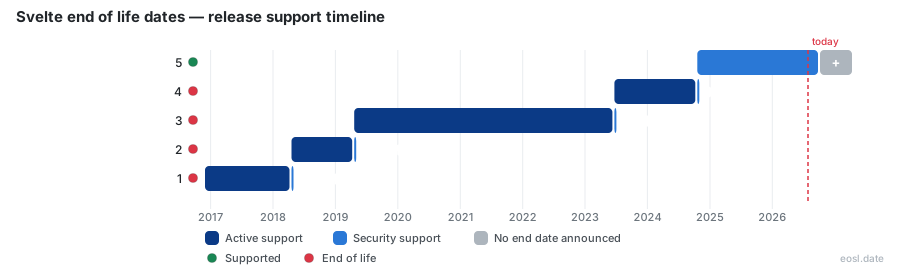
Currently Supported Svelte Releases - Active EOS/EOSL Support (1)
| Release | Released | Security Support | Active Support | Latest |
|---|---|---|---|---|
| 5 | (2 years and 1 month ago) | Active | Active | 5.59.1 (1 day ago) |
Svelte End of Life (EOL) Releases - No Longer Supported (4)
| Release | Released | Security Support | Active Support | Latest |
|---|---|---|---|---|
| 4 | (3 years and 4 months ago) | (2 years and 1 month ago) | (2 years and 1 month ago) | 4.2.20 (1 year and 6 months ago) |
| 3 | (7 years and 7 months ago) | (3 years and 4 months ago) | (3 years and 4 months ago) | 3.59.2 (3 years and 5 months ago) |
| 2 | (8 years and 7 months ago) | (7 years and 7 months ago) | (7 years and 7 months ago) | 2.16.1 (7 years and 9 months ago) |
| 1 | (9 years and 11 months ago) | (8 years and 7 months ago) | (8 years and 7 months ago) | 1.64.1 (8 years and 7 months ago) |
If your app still runs on an old release, Svelte End of Life decides how long you can count on fixes. Svelte is a UI framework whose compiler turns HTML, CSS and JavaScript components into small browser code, and right now only Svelte 5 is current: the previous major version hit EOL when its successor became stable, so this guide shows what that means for you.
Svelte End of Life: Which Versions Are Still Supported
The project publishes no formal schedule, so the clearest record is the community-maintained endoflife.date table, last updated in October 2026. It shows one supported release line and four that have ended. Treat any older install as unsupported software, and keep the maintenance cost of that choice in mind.
| Svelte version | Released | Support ended | Last release |
|---|---|---|---|
| 5 | 19 Oct 2024 | Still supported | 5.57.2 (6 Oct 2026) |
| 4 | 22 Jun 2023 | 19 Oct 2024 | 4.2.20 (20 May 2025) |
| 3 | 21 Apr 2019 | 22 Jun 2023 | 3.59.2 (20 Jun 2023) |
| 2 | 19 Apr 2018 | 21 Apr 2019 | 2.16.1 (8 Feb 2019) |
| 1 | 29 Nov 2016 | 19 Apr 2018 | 1.64.1 (18 Apr 2018) |
Svelte 5 and the Latest Release
The table lists the newest line as the one major version under both active support and security support. Its latest release was 5.57.2, so pin your dependency to the 5.x line to stay inside the supported window.
Svelte 4, Svelte 3 and Older Lines
The 4.x series lived for 485 days between 22 June 2023 and 19 October 2024, while the 3.x series lasted just over four years. Every older line reached end-of-life when the next major arrived, and a late maintenance release or minor release here and there does not change that. Legacy codebases on 3.x or earlier are the most exposed.
Svelte Support Policy and Release Schedule
Unlike a vendor such as Elastic, which defines a maintenance term and a support term in months, the Svelte open source project has no written support policy and no fixed release schedule. There is no published end of life policy and no version policy to quote in an audit. Past behavior is the only guide: after general availability of a new major release, fixes go to the newest line only. Because there is no predictable schedule, you cannot plan around a calendar the way a support matrix allows. Watch the GitHub repository for announcements and treat each new major release as the start of the old one's retirement.
Why Svelte EOL Dates Are Inferred
The EOL dates in the table are inferred, not promised. They mark the day a successor shipped, yet the 4.x series still received 4.2.20 about 213 days later, so the support window is looser than a vendor calendar. Plan for the earlier EOL date, and use a Vite and Svelte plugin update as your cue to review.
Svelte Has No LTS Line
Svelte has no LTS track and makes no promise to backport bug fixes to an older stable release, unlike Node.js, which gives even-numbered majors long-term support (LTS) for roughly three years. Plan as if only the current Svelte line is fixed, since no LTS safety net exists, and remember that the Node.js runtime under your build has its own EOL clock.
What End of Support Means for Svelte 4 and Svelte 3
Running retired software is a business risk, not a crash waiting to happen. Your production apps keep working on the web; what you lose is the safety net behind them.
Security Patches and Vulnerabilities Stop
Once a line is retired, new security patches go only to the current release. Any vulnerability or CVE disclosed later stays unpatched on the old line, and a security scan that flags it has no fix to point to. When a CVE affects both lines, only the current one gets the fix, and security fixes will not be backported.
Compliance, Tool-Chain and Ecosystem Drift
Many audits flag unmaintained dependencies, which counts as a compliance problem. Compatibility also erodes: plugins, TypeScript definitions and the tool-chain move on, and an old Svelte line is the first to stop working with them. Your Node.js build image matters too, because SvelteKit's server output and every CI job rely on Node.js. An end-of-life Node.js release, such as Node.js 20 (EOL on 30 April 2026), is the unsupported runtime problem in miniature.
Upgrade and Migration Path From Unsupported Versions
The good news is that the current major version is almost completely backwards-compatible with the previous one, so for most teams the first upgrade is a version bump. Pick an upgrade strategy that moves one step at a time and keeps the test suite green between steps.
Runes, SvelteKit and Other Major Release Changes
Svelte 5 is a rewrite built around runes, which bring fine-grained reactivity based on signals. They replace the older $: statement, and you can adopt them component by component. If you use SvelteKit for routing and server-side rendering, upgrade it alongside the core package, since the frontend performance gains come from both.
Steps to Move Off an Unsupported Svelte Release
- Run
npm list svelteto find your current version. - Bump
svelteto^5and the Vite plugin to^4.0.0. - Rebuild, fix warnings, then schedule maintenance to adopt the new syntax.
Options for EOL Versions: Commercial Support
If you cannot upgrade yet, note that none of the pages reviewed lists a Svelte extended-support program. Node.js shows what such a service looks like: its documentation names vendors offering Never-Ending Support and Endless Lifecycle Support for EOL versions, with backported security fixes. Treat any such service as a temporary bridge for legacy codebases, because open source software still needs fixes from a supported release, and any bridge is an EOL workaround rather than a plan.
Lifecycle Checklist for Your Svelte Project
- Check your version with
npm list svelteafter every dependency update. - Review Node.js: Node.js 22 reaches EOL on 30 April 2027 and Node.js 24 on 30 April 2028, and an end-of-life Node.js build image can block Svelte upgrades.
- Follow GitHub releases and plan an upgrade whenever a new major version ships.
Keep this routine as part of regular maintenance for your Node.js and Svelte software, and the next end-of-life date will not catch you off guard.