jQuery End of Life (EOL) Dates and End of Support (EOS) Dates
jQuery end of life (EOL) and end of support (EOS) dates: 2 jQuery versions have reached EOL, including jQuery 2 — no longer receiving security updates or patches. jQuery 4.1.0 is the current supported release — 2 versions in active support. Also see Bun end of life dates for related end-of-life information.
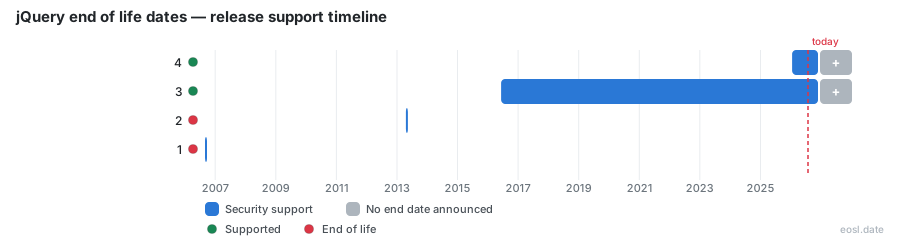
Currently Supported jQuery Releases - Active EOS/EOSL Support (2)
jQuery End of Life (EOL) Releases - No Longer Supported (2)
Wondering whether jQuery end of life applies to the code running on your websites? The 1.x and 2.x branches are EOL, jQuery 3 now receives only security patches, and jQuery 4 is the only fully maintained line of this JavaScript library. This guide shows which build you can still trust and what to do if you cannot move yet.
Is jQuery End of Life? Where Each Release Stands
Unlike frameworks that publish long-term support windows, this open source project runs an informal support model signalled through release activity rather than calendar dates. The OpenJS Foundation oversees it, and the position is plain: only the latest version gets active support, the previous line receives critical security patches, and the 1.x and 2.x branches have been closed since 2016. The security support column on endoflife.date tells the same story. The last build of the 3.x line, 3.7.1, shipped on 28 August 2023, while the latest release, 4.0.0, arrived on 17 January 2026. No official sunset notice exists for the older line, so watch the dates, because they are the signal.
jQuery Versions and Their Support Status
Here is how the four major branches compare, using the dates the project and endoflife.date publish.
| Branch | Last build | Status | Third-party coverage |
|---|---|---|---|
| jQuery 4.x | 4.0.0, 17 Jan 2026 | Current, fully maintained | Not needed |
| jQuery 3.x | 3.7.1, 28 Aug 2023 | Critical fixes only | Available |
| jQuery 2.x | 2.2.4, 20 May 2016 | Ended | Available |
| jQuery 1.x | 1.12.4, 20 May 2016 | Ended | Available |
Only the 4.x branch is fully maintained; the closed branches get no bug fixes. Every build above, plus jQuery Migrate 4.0.2, sits on the jQuery CDN, though its unstable git builds are not for production.
jQuery 1.x and 2.x Are No Longer Supported
Both branches stopped receiving fixes in 2016. A core team lead has said that serious security fixes were backported and might be again, but treat that as goodwill, not policy. Any site still loading them is running software that is no longer supported.
jQuery 3 Gets Only Critical Security Patches
Active support for 3.x ended on 17 January 2026 when the next major version arrived. It remains patched for serious problems, though nothing new will land.
jQuery 4 Breaking Changes and Browser Support
jQuery 4.0.0 is the first major version in almost 10 years and includes breaking changes, so test before swapping the file. Browser support follows a rolling rule: the latest two major releases of Chrome, Edge, Firefox and Safari, plus Internet Explorer 11 on the endoflife.date list.
Why jQuery Support Gaps Persist in Codebases
The gap persists because jQuery rarely arrives on purpose. It ships inside WordPress and Drupal, and it hides as a transitive dependency of Bootstrap 3 and 4, jQuery UI, DataTables and hundreds of other plugins and plug-ins written between 2010 and 2018. In an npm project it can sit four or five levels down the dependency tree. W3Techs data puts it on roughly 70% of all websites. Developers reached for this JavaScript library to smooth over browser quirks in DOM traversal, events and Ajax. Once native DOM APIs and Ajax-capable fetch matured in every JavaScript engine, and React, Angular and Vue took over the enterprise frontend, many teams stopped writing new jQuery without removing the old, and no framework switch ever forces a cleanup, which is why legacy copies linger. Because the library is free and bundled by default, a JavaScript file from 2014 can sit untouched, nobody receives a renewal notice either. The useful question is which copies your codebases hold, not whether you use any.
jQuery Supported Versions and End-of-Life Options
If you run anything other than the newest line, the project lists three choices. First, move to the current release; the jQuery Migrate plugin and the official upgrade guides exist for exactly that. Second, keep the old version and add paid security fixes, covered next. Third, change nothing, which leaves every known flaw open. Free community help exists, but it cannot patch anything. The OpenJS Foundation's Ecosystem Sustainability Program gives approved vendors a framework for offering compatibility support to end-of-life open source projects.
Never Ending Support and Other Commercial Support Options
Teams that cannot move yet can buy continuity from two vendors:
- HeroDevs sells Never Ending Support for older lines, delivering fixes and compatibility work.
- TuxCare offers Endless Lifecycle Support covering legacy releases and their dependencies.
endoflife.date marks commercial support as available for the 3.x, 2.x and 1.x branches and unavailable for 4.x, since the core team still maintains it.
CVEs and XSS: The Security Risk of jQuery EOL
The 2026 Black Duck OSSRA report found that four of the ten most common flaws in scanned applications trace back to this library, and that 25% to 28% of scanned applications carry at least one. Most of these vulnerabilities are cross-site scripting (XSS) flaws, where an attacker runs malicious scripts in a visitor's browser. The 1.x and 2.x branches will never receive a fix for any CVE listed against them. An unpatched library is a quiet route to cyberattacks and data breaches, and the exposure grows with every year a vulnerable file stays live. The real risk is not that jQuery is badly built; it is that old copies stay untouched.
Mitigation and Extended Lifecycle Maintenance for Outdated jQuery
Mitigation of unsupported jQuery starts with knowing which versions you run:
- Build an inventory of every jQuery copy, including closed 1.x and 2.x ones, by generating an SBOM (software bill of materials) for every application, then run
npm ls jqueryto expose buried copies. - Rank each outdated copy by version, internet exposure and how hard a change would be.
- Upgrade where feasible; where breaking code blocks you, buy extended lifecycle maintenance instead.
- Rehearse the change in staging before it reaches production.
Upgrade from Unsupported Versions with jQuery Migrate
Begin by loading jQuery Migrate beside your current library. It logs every deprecated call to the JavaScript console, so you see incompatibilities before users do. Fix those first, then step to the last 3.x release, then to 4.x, because small steps are the safest way off an outdated JavaScript copy. Because jQuery versions differ in removed APIs, check each of your plugins separately, along with any DOM code and Ajax calls that rely on old behaviour. When a plugin has no maintained successor, a native JavaScript rewrite is often the cleaner exit than carrying the library forever.