Strapi End of Life (EOL) Dates and End of Support (EOS) Dates
Strapi end of life (EOL) and end of support (EOS) dates: 2 Strapi versions have reached EOL, including Strapi 4 (EOL date: Jun 09, 2026) — no longer receiving security updates or patches. Strapi 5.61.1 LTS is the current supported release. Also see Bun EOSL dates for related end-of-life information.
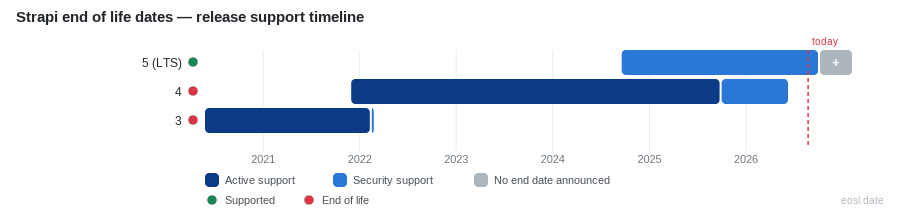
Currently Supported Strapi Releases - Active EOS/EOSL Support (1)
| Release | Released | Security Support | Active Support | Latest | LTS |
|---|---|---|---|---|---|
| 5 (LTS) | (2 years and 1 month ago) | Active | Active | 5.61.1 (3 days ago) | LTS |
Strapi End of Life (EOL) Releases - No Longer Supported (2)
If your project still runs on Strapi 4, the Strapi end of life date has already passed. This guide covers the support timeline, what it means for your open-source headless CMS, and how to reach Strapi 5 before an unpatched flaw lands in production. Every CMS release line ends eventually, and the Strapi 5 upgrade is the way forward. You get the exact dates, the risks and a practical upgrade path.
Strapi End of Life Timeline and Support Status
Strapi's security policy promises 12 months of bug fixes and 18 months of security fixes after a new major version ships. Strapi 5 arrived on 18 September 2024, which fixed the schedule for the older line. Bug fixes stopped at the end of October 2025, a security-only maintenance period followed, and the Strapi v4 EOL date of April 30, 2026 closed it. Release 4.26.2, published on June 9, 2026, is the final release; no further v4 updates are published.
| Version | Released | Active support ended | Security support ended | Latest release |
|---|---|---|---|---|
| Strapi 5 (LTS) | 18 Sep 2024 | Still supported | Still supported | Current |
| Strapi 4 | 30 Nov 2021 | 1 Oct 2025 | 9 Jun 2026 | 4.26.2 |
| Strapi 3 | 26 May 2020 | 16 Feb 2022 | 16 Feb 2022 | 3.6.11 |
Security Updates and Strapi v4 EOL Dates
Read the table as a support timeline: security updates were the last thing to stop. Strapi 5 is the long-term support line, and the team only starts a new major version when breaking changes cannot fit inside the current one, so no Strapi 6 roadmap exists yet. That makes the end of Strapi 4 final rather than a pause.
Risks of Staying on Strapi v4 After End of Support
Running an end-of-support version is a risk that grows every month. Newly discovered security vulnerabilities go unpatched, and exploits aimed at them can lead to breaches and compliance failures. Node.js and browser changes also create compatibility issues that nobody will fix, and limited support from the team and community means each bug takes longer to solve. Treat these as the main reasons to act:
- No patches: every vulnerability found after the cutoff stays open.
- Broken integrations: compatibility drifts as dependencies and hosting stacks move on.
- Stalled growth: your production site misses everything the framework adds from here.
Benefits of Moving to Strapi 5 Before the EOL
Strapi 5 gives developers more than a supported version. Its new features include conditional fields and live preview in the editor, plus content versioning that treats drafts, published entries and locales as one document through draft and publish. Internationalization is built into the core, so the CMS no longer needs an optional plugin for it. Switching to Strapi 5 also means the Content API returns a flattened format: attributes sit at the top level instead of inside a nested attributes wrapper, which makes every API response easier to parse.
These gains matter because the v4 line will not receive them. The stack is modern too. TypeScript covers almost the whole codebase, Vite replaces webpack for the admin panel, and better-sqlite3 backs the default database. Together they bring faster builds and better performance and scalability. New features for developers include the Plugin SDK for scaffolding plugins and the official Strapi client for calling the API from a frontend, and the plugins ecosystem has largely moved to v5.
Plugin Compatibility in Strapi v5
Most popular plugins already support v5, but custom code needs a check. Each plugin migration should cover third-party integrations and the deprecation of the helper-plugin, since plugins that import it must switch to the new admin APIs. Also confirm that any plugin touching your API responses handles the new shape, because performance gains mean little if a plugin breaks the response format.
How to Upgrade Before the End-of-Life Date
A migration to Strapi 5 follows the official step-by-step guide in the migration resources. Before you start, move to the latest Strapi 4 release, then follow this order:
- Take a database backup, because the data migration scripts run once on first startup and are not reversed.
- Rehearse the upgrade in staging environments, never first on production.
- Run the upgrade tool, which updates dependencies and applies codemods that rewrite code automatically.
- Review the breaking changes it could not fix, then deploy.
Strapi does not ship a downgrade path, so restoring that backup is your only way back. Strapi Cloud customers run the deploy command and the cloud platform performs the data migration. Anyone still waiting to upgrade should schedule the Strapi 5 move this quarter.
Strapi 4 Breaking Changes to Handle
These changes decide how much work the upgrade needs before the v4 cutoff. The biggest breaking changes are the Entity Service API giving way to the Document Service API and the new documentId identifier. REST clients can send the Strapi-Response-Format: v4 header while they refactor; GraphQL clients enable v4 compatibility mode and switch queries to documentId. The Entity Service is also marked for deprecation, so plan that refactor early.
Migration Challenges Before the Strapi EOL
With security fixes over, the deadline pressure is real. Expect codebase refactoring, because projects with heavy customization need real code edits to custom controllers, services and plugins. Plan for downtime during the cutover, since the data migration alters your schema on first start, and for a learning curve for editors and developers who meet the new content manager.
Where to Get Help When Support Coverage Ends
Community members can ask in the Strapi Discord. Enterprise and Growth customers can open a support ticket. Strapi, a JavaScript framework and content management system, now maintains its documentation for v5 only, while the archived v4 docs stay online. Community users can still find answers for edge cases in the release notes.
Strapi Cloud Projects After the EOL
Strapi Cloud can still run existing v4 projects, but that may change without warning. Upgrade first, since the end-of-life (EOL) status of v4 will not be reversed.