React Native End of Life (EOL) Dates and End of Support (EOS) Dates
React Native end of life (EOL) and end of support (EOS) dates: 26 React Native versions have reached EOL, including React Native 0.85 (EOL date: Oct 12, 2026) — no longer receiving security updates or patches. React Native 0.88.1 is the current supported release — 3 versions in active support. Also see Bun EOSL information for related end-of-life information.
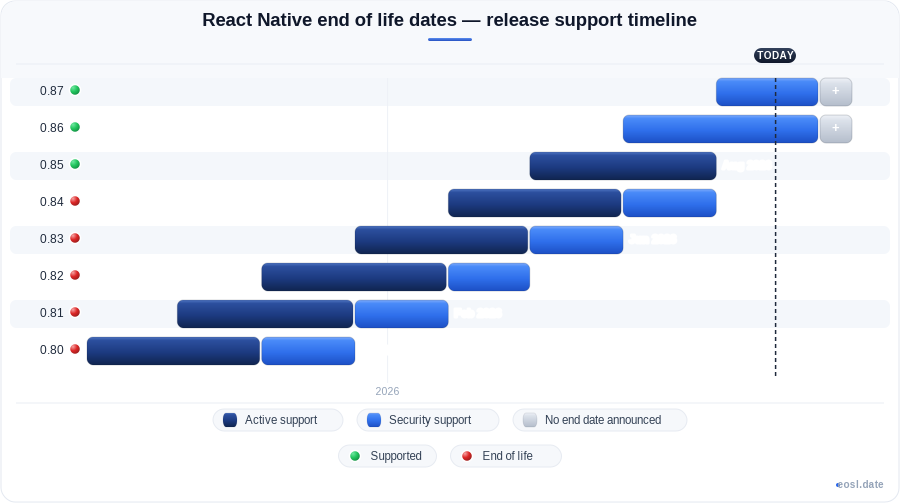
Currently Supported React Native Releases - Active EOS/EOSL Support (3)
React Native End of Life (EOL) Releases - No Longer Supported (26)
| Release | Released | Security Support | Active Support | Latest |
|---|---|---|---|---|
| 0.85 | (7 months ago) | (1 month and 1 week ago) | (3 months ago) | 0.85.3 (6 months ago) |
| 0.84 | (9 months ago) | (3 months ago) | (5 months ago) | 0.84.1 (8 months ago) |
| 0.83 | (11 months ago) | (5 months ago) | (7 months ago) | 0.83.10 (4 months ago) |
| 0.82 | (1 year and 1 month ago) | (7 months ago) | (9 months ago) | 0.82.1 (1 year and 1 month ago) |
| 0.81 | (1 year and 3 months ago) | (9 months ago) | (11 months ago) | 0.81.6 (9 months ago) |
| 0.80 | (1 year and 5 months ago) | (11 months ago) | (1 year and 1 month ago) | 0.80.3 (9 months ago) |
| 0.79 | (1 year and 7 months ago) | (1 year and 1 month ago) | (1 year and 3 months ago) | 0.79.7 (1 year and 1 month ago) |
| 0.78 | (1 year and 9 months ago) | (1 year and 3 months ago) | (1 year and 5 months ago) | 0.78.3 (1 year and 4 months ago) |
| 0.77 | (1 year and 10 months ago) | (1 year and 5 months ago) | (1 year and 7 months ago) | 0.77.3 (1 year and 4 months ago) |
| 0.76 | (2 years and 1 month ago) | (1 year and 7 months ago) | (1 year and 9 months ago) | 0.76.9 (1 year and 7 months ago) |
| 0.75 | (2 years and 3 months ago) | (1 year and 9 months ago) | (1 year and 10 months ago) | 0.75.5 (1 year and 9 months ago) |
| 0.74 | (2 years and 7 months ago) | (1 year and 9 months ago) | (2 years and 1 month ago) | 0.74.7 (1 year and 9 months ago) |
| 0.73 | (2 years and 11 months ago) | (2 years and 1 month ago) | (2 years and 3 months ago) | 0.73.11 (2 years ago) |
| 0.72 | (3 years and 5 months ago) | (2 years and 3 months ago) | (2 years and 7 months ago) | 0.72.17 (2 years and 3 months ago) |
| 0.71 | (3 years and 10 months ago) | (2 years and 7 months ago) | (2 years and 11 months ago) | 0.71.19 (2 years and 6 months ago) |
| 0.70 | (4 years and 2 months ago) | (2 years and 11 months ago) | (3 years and 5 months ago) | 0.70.15 (2 years and 10 months ago) |
| 0.69 | (4 years and 5 months ago) | (3 years and 5 months ago) | (3 years and 10 months ago) | 0.69.12 (3 years and 4 months ago) |
| 0.68 | (4 years and 7 months ago) | (3 years and 10 months ago) | (4 years ago) | 0.68.7 (3 years and 6 months ago) |
| 0.67 | (4 years and 10 months ago) | (4 years ago) | (4 years and 5 months ago) | 0.67.5 (4 years ago) |
| 0.66 | (5 years and 1 month ago) | (4 years and 5 months ago) | (4 years and 7 months ago) | 0.66.5 (4 years ago) |
| 0.65 | (5 years and 3 months ago) | (4 years and 7 months ago) | (4 years and 10 months ago) | 0.65.3 (4 years ago) |
| 0.64 | (5 years and 8 months ago) | (4 years and 10 months ago) | (5 years and 1 month ago) | 0.64.4 (4 years ago) |
| 0.63 | (6 years and 4 months ago) | (5 years and 1 month ago) | (5 years and 3 months ago) | 0.63.5 (4 years ago) |
| 0.62 | (6 years and 7 months ago) | (5 years and 3 months ago) | (5 years and 8 months ago) | 0.62.3 (5 years and 6 months ago) |
| 0.61 | (7 years and 2 months ago) | (5 years and 8 months ago) | (6 years and 4 months ago) | 0.61.5 (7 years ago) |
| 0.60 | (7 years and 4 months ago) | (6 years and 4 months ago) | (6 years and 7 months ago) | 0.60.6 (7 years and 2 months ago) |
Planning for React Native end of life starts with one question: does the version running in your production apps still get fixes? React Native is an open source framework from Meta that lets developers build iOS and Android apps in JavaScript, and its maintainers publish a calendar that answers the question in seconds.
React Native End of Life: How the Support Schedule Works
The official schedule lists every release with its branch cut date, its release date and a support level. The community-run React Native releases working group maintains that policy, so the dates are the same ones the people shipping patches work from.
Support Definitions: Active Support and End of Cycle
Each release moves through four stages, and the stage tells you how much help to expect:
- Future: release candidates are cut quickly so the community can test the next version.
- Active support: frequent patches, with extra bug fixes right after the
.0release to stabilize it. - End of cycle: fewer patches, apart from important regressions, plus one last patch before the release is dropped.
- Unsupported: no new releases are expected, so move off it.
Security Support, Supported Releases and the Versioning Policy
The maintainers commit to keeping the latest three minor series alive. A supported release is one of those three, and anything older gets no security support from the project. There is no long-term support line beyond that window, so the maintenance burden shifts to you quickly. Because React Native still uses 0.x numbers, the versioning policy treats a minor bump as the place where breaking changes can land, so it does not follow strict semantic versioning. Stability comes from staying inside the window, not from pinning an old number.
React Native Versions Still in Support Today
Here is the picture from the official schedule as of 27 October 2026, with 0.87 as the newest stable line:
| Version | Release date | Support level |
|---|---|---|
| 0.87 | 10 August 2026 | Active |
| 0.86 | 9 June 2026 | Active |
| 0.85 | 6 April 2026 | End of cycle |
| 0.84 | 9 February 2026 | Unsupported |
| 0.83 | 10 December 2025 | Unsupported |
Say your app still runs 0.82. The security window for that release closed on 7 April 2026 according to endoflife.date, so by today it has gone 203 days with no fixes, and it sits five minor series behind the newest line. Third-party trackers can differ from the official table by a few weeks on when security support ends, so read both before you set a deadline.
Latest Release and Stable Release Rules
The latest release gets top priority, with several quick patches after its .0 drop. Every stable release is published under the latest tag, which is why that tag is the right choice for production.
Release Channels, Release Candidates and Nightlies
The package is published to npm under three release channels, each tied to a dist-tag:
latest: stable builds for production apps.next: release candidates for testing an upcoming version.nightly: unstable nightlies built from the main branch.
Application developers rarely need anything beyond latest.
Upgrade Planning Before a Release Becomes Unsupported
Start the upgrade while your release still sits in the window, because every skipped minor adds risk. Read the release notes for each step, run the upgrade helper to diff your project against the target version, and check each third-party library and its native dependencies in your codebase against the documentation. Expo projects follow their own SDK cadence, so confirm which React Native line your SDK pins. Because the app logic is JavaScript, most breakage hides in native modules, so teams often migrate one or two minors at a time instead of jumping across a year of changes, since React 19 and React 18 era APIs behave differently.
Legacy Architecture, New Architecture and Breaking Changes
The New Architecture has been the default since 0.76. As of 0.80 the Legacy Architecture is frozen: no new bug fixes or features, and warnings appear for APIs that will stop working when it is sunset. Deep imports from the package are deprecated too, and an opt-in Strict TypeScript API previews the future public surface. Treat these as the breaking changes most likely to block you, and fix them while you still have supported patches to lean on.
End-of-Life Security Risk: Fixes, CVEs and Compliance
Once a release is unsupported, security fixes are no longer backported to it. A vulnerability published as a CVE stays unpatched in your build even though the app keeps running, and "it still works" is not the same as "it is secured." Auditors increasingly treat that as a compliance finding, which matters most for enterprise apps under SOC 2 or PCI DSS. Some vendors sell paid never-ending support for old React 17 and React 16 builds, but that bridges the gap rather than closing it. A practical order of work:
- Find your current version and compare it with the table above.
- If it is outside the three-release window, plan the upgrade now.
- Test on the
nexttag before each stable release lands.