Spring Cloud End of Life (EOL) Dates and End of Support (EOS) Dates
Spring Cloud end of life (EOL) and end of support (EOS) dates: 6 Spring Cloud versions have reached EOL, including Spring Cloud 2025.0 (Northfields) (EOL date: Jun 30, 2026) — no longer receiving security updates or patches. Spring Cloud 2025.1.5 is the current supported release, with support through Jul 31, 2027. Also see Apache Grails Framework lifecycle dates for related end-of-life information.
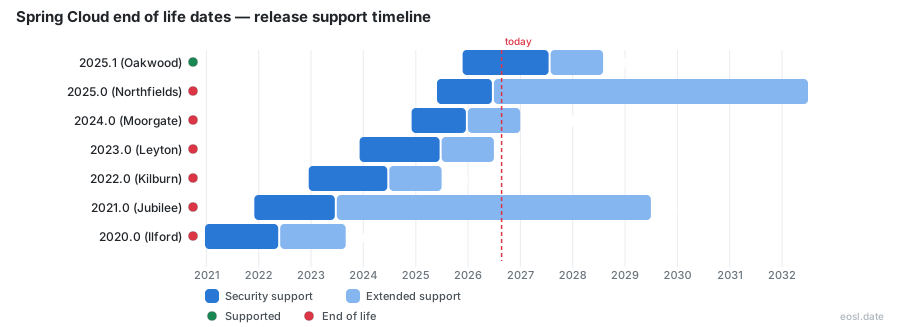
Currently Supported Spring Cloud Releases - Active EOS/EOSL Support (1)
| Release | Supported Spring Boot Versions | Released | OSS support | Commercial Support | Latest |
|---|---|---|---|---|---|
| 2025.1 (Oakwood) | 4.0.x | (11 months ago) | (in 8 months) | (in 1 year and 8 months) | 2025.1.5 (2 days ago) |
Spring Cloud End of Life (EOL) Releases - No Longer Supported (6)
| Release | Supported Spring Boot Versions | Released | OSS support | Commercial Support | Latest |
|---|---|---|---|---|---|
| 2025.0 (Northfields) | 3.5.x | (1 year and 5 months ago) | (4 months ago) | (in 5 years and 7 months) | 2025.0.3 (5 months ago) |
| 2024.0 (Moorgate) | 3.4.x | (1 year and 11 months ago) | (10 months ago) | (in 1 month and 1 week) | 2024.0.3 (11 months ago) |
| 2023.0 (Leyton) | 3.3.x, 3.2.x | (2 years and 11 months ago) | (1 year and 4 months ago) | (4 months ago) | 2023.0.6 (1 year and 4 months ago) |
| 2022.0 (Kilburn) | 3.1.x, 3.0.x | (3 years and 11 months ago) | (2 years and 4 months ago) | (1 year and 4 months ago) | 2022.0.5 (2 years and 9 months ago) |
| 2021.0 (Jubilee) | 2.7.x, 2.6.x | (4 years and 11 months ago) | (3 years and 4 months ago) | (in 2 years and 7 months) | 2021.0.9 (2 years and 11 months ago) |
| 2020.0 (Ilford) | 2.5.x, 2.4.x | (5 years and 10 months ago) | (4 years and 5 months ago) | (3 years and 2 months ago) | 2020.0.6 (4 years and 4 months ago) |
If you run Spring Cloud end of life checks before every upgrade, this page gives you the dates in one place. Spring Cloud ships as a bundle of release trains, and each one stops getting free fixes about three months after the Spring Boot line it rides on does, so the date that matters for your production services depends on the Boot version underneath them.
Spring Cloud End of Life Dates by Version
The table below lists every active and recently retired Spring Cloud release train with the Spring Boot line it targets, using the dates published by endoflife.date (last updated 23 October 2026). Only the newest Oakwood train is still inside its free window, while the Spring Boot 3.5 pairing has already reached the end of its free support.
| Release train | Spring Boot | OSS support ends | Commercial support ends |
|---|---|---|---|
| 2025.1 (Oakwood) | 4.0.x | 31 Jul 2027 | 31 Jul 2028 |
| 2025.0 (Northfields) | 3.5.x | 30 Jun 2026 (ended) | 30 Jun 2032 |
| 2024.0 (Moorgate) | 3.4.x | 31 Dec 2025 (ended) | 31 Dec 2026 |
| 2023.0 (Leyton) | 3.3.x, 3.2.x | 30 Jun 2025 (ended) | 30 Jun 2026 (ended) |
| 2022.0 (Kilburn) | 3.1.x, 3.0.x | 30 Jun 2024 (ended) | 30 Jun 2025 (ended) |
| 2021.0 (Jubilee) | 2.7.x, 2.6.x | 30 Jun 2023 (ended) | 30 Jun 2029 |
| 2020.0 (Ilford) | 2.5.x, 2.4.x | 31 May 2022 (ended) | 31 Aug 2023 (ended) |
The Oakwood row is worth double-checking on the project page: its date sits later than the 31 December 2026 close of Boot 4.0's own free window, so confirm which Spring Boot minor your build resolves before you plan around it.
Spring Cloud Support Policy Explained
The Spring Cloud support policy follows the VMware Tanzu open-source rules: a Spring Boot major version gets at least 3 years of fixes from its release date, and a minor version gets at least 12 months. Those fixes cover security fixes and bug fixes for critical issues, and every artifact is published on Maven Central, with no private repository held back for paying customers.
A release train has no support timeline of its own. It is a collection of projects, so a train counts as maintained while the newest Spring Boot line it supports is still maintained. Projects in that train usually fall out of the support window within 3 months after Spring Boot's own cutoff. The practical advice from the maintainers is to upgrade to the latest GA release, because the community stops looking at older lines.
Spring Cloud CalVer Codenames in Release Train Naming
Older trains used London tube-station names; since 2020 the CalVer scheme (year.minor) added a codename in parentheses, such as Oakwood. This release train naming is only a label, so match on the number and the Boot line when you read a compatibility table.
Spring Cloud Supported Release Rows and Historical Versions
The official wiki marks each supported release in a grid and crosses out retired trains with strikethrough, then keeps the historical versions below it. Treat a struck-through column as a signal to plan an exit, not as a delete-by-tomorrow deadline.
Spring Boot Support Timeline Behind Spring Cloud
Spring Boot follows a steady cadence: a new minor line roughly every six months, in May and November, with 12 months of free patches before it is marked end-of-life. Spring Boot 4.1 arrived on 10 June 2026, and Spring Boot 3.5 received its last open-source patch, 3.5.16, on 25 June 2026. That single release date is why the 2025.0 train dropped out of the free tier at the end of June. Spring Boot 4.0 is next, with its OSS window closing on 31 December 2026, and any Spring Framework upgrade underneath comes along with it.
Spring Boot 3.5 OSS Support Ended
With OSS support over for Spring Boot 3.5, the final public build is the only one you will pull from Maven Central or any Maven mirror. Stay on it and you accept every new vulnerabilities advisory published afterwards, so your risk grows each month.
Commercial Support Windows from VMware
Commercial support from VMware adds extended support on top of the open-source period, shown as a second column in the table above. Buying it moves the Spring Cloud cutoff to the table's last column: the 2025.0 train stays covered through 30 Jun 2032 under paid enterprise support, even though its free window has closed. That buys time for a controlled move rather than a rushed one.
Spring Cloud Release Train Compatibility Matrix
Every train is built against specific Boot lines, so a compatibility matrix tells you which pairings are valid. Spring Boot 4.0.x pairs with 2025.1, Spring Boot 3.5.x with 2025.0, Spring Boot 3.4.x with 2024.0, and Spring Boot 3.3.x or 3.2.x with 2023.0. The Java baseline matters too: Spring Boot 2.7 still runs on Java 8, while the 3.x and 4.x lines require a newer Java runtime, with Java 17 as the floor for Boot 3, on the Jakarta EE namespace. Every Java upgrade should be tested against the train you target, since the Java toolchain and the Spring Cloud BOM move together. Check this version pairing before you move a framework dependency, because a mismatched BOM fails at startup.
Third-party dependencies managed by the train, such as third-party dependencies pinned for Netty or Jackson in your Java and Maven builds, follow the same schedule. Projects covered include Gateway, Config, OpenFeign, Stream, Kubernetes and Bus, which handle microservices concerns like service discovery, configuration management and circuit breakers across distributed systems.
What Happens After EOL: Security Patches Stop
Once a Spring Cloud release train has reached end of life, the security patches stop, and its artifacts, such as Gateway or Config, get no more patch releases for that Spring Boot pairing. Scanners will flag the old artifacts, your compliance team may block the build, and the next lifecycle event, such as a new CVE, hits you with no upstream fix. The same EOL logic applies to the Spring Framework modules Boot brings in, so the exposure covers more than the cloud layer.
End-of-Life Options: Never-Ending Support and Migration
When a Spring Cloud train has hit its EOL date you have four routes, and the first usually costs least over time:
- Migrate to Spring Boot 4.x and the newest Spring Cloud train, then keep following the roadmap.
- Self-patch the Spring Cloud artifacts you use, which means owning every backport.
- Buy never-ending support from a vendor such as HeroDevs, which keeps old lines patched.
- Accept the risk on the retired train and document the decision.
Pick based on how many services you run and how fast a release can be validated.
Maven Central and Spring Framework Patches for Spring Cloud
Free patches for retired lines are no longer pushed to any Maven repository, and the Spring team does not backport to a closed Spring Framework branch. Cached copies of old jars will still resolve, which hides the problem until an audit.
Spring Boot Quick Reference: Is Your Version Past EOL?
- Spring Boot 4.1 and 4.0 (Spring Cloud 2025.1): supported by open-source patches today.
- Spring Boot 3.5, 3.4, 3.3 (trains 2025.0, 2024.0, 2023.0): past end of life for free support; only paid enterprise plans continue.
- Spring Boot 2.7 (train 2021.0): free support ended in 2023, paid support continues to 2029.
- Anything older: unsupported, upgrade first.
Run your dependency report, find the Spring Boot version that resolves, using your Java build's Maven or Gradle report, and match it against this list.