Samba End of Life (EOL) Dates and End of Support (EOS) Dates
Samba end of life (EOL) and end of support (EOS) dates: 29 Samba versions have reached EOL, including Samba 4.22 (EOL date: Sep 30, 2026) — no longer receiving security updates or patches. Samba 4.23 reaches its End of Support date on Mar 31, 2027 — plan your upgrade path now. Samba 4.25.1 is the current supported release, with support through Mar 31, 2028 — 2 versions in active support. Also see Chef Infra Server end of life dates for related end-of-life information.
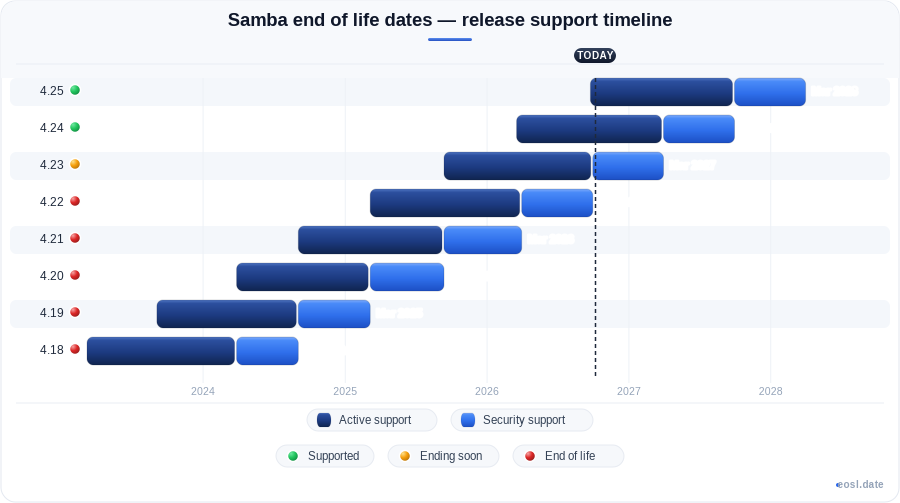
Currently Supported Samba Releases - Active EOS/EOSL Support (2)
Samba Releases Nearing End of Life - Support Ending Soon (1)
| Release | Released | Security Support | Active Support | Latest |
|---|---|---|---|---|
| 4.23 | (1 year and 2 months ago) | (in 4 months) | (1 month and 3 weeks ago) | 4.23.13 (1 month and 3 weeks ago) |
Samba End of Life (EOL) Releases - No Longer Supported (29)
| Release | Released | Security Support | Active Support | Latest |
|---|---|---|---|---|
| 4.22 | (1 year and 8 months ago) | (1 month and 3 weeks ago) | (7 months ago) | 4.22.11 (4 months ago) |
| 4.21 | (2 years and 2 months ago) | (7 months ago) | (1 year and 2 months ago) | 4.21.10 (1 year ago) |
| 4.20 | (2 years and 7 months ago) | (1 year and 2 months ago) | (1 year and 8 months ago) | 4.20.8 (1 year and 7 months ago) |
| 4.19 | (3 years and 2 months ago) | (1 year and 8 months ago) | (2 years and 2 months ago) | 4.19.9 (2 years and 1 month ago) |
| 4.18 | (3 years and 8 months ago) | (2 years and 2 months ago) | (2 years and 7 months ago) | 4.18.11 (2 years and 8 months ago) |
| 4.17 | (4 years and 2 months ago) | (2 years and 7 months ago) | (3 years and 2 months ago) | 4.17.12 (3 years and 1 month ago) |
| 4.16 | (4 years and 8 months ago) | (3 years and 2 months ago) | (3 years and 8 months ago) | 4.16.11 (3 years and 4 months ago) |
| 4.15 | (5 years and 2 months ago) | (3 years and 8 months ago) | (4 years and 2 months ago) | 4.15.13 (3 years and 11 months ago) |
| 4.14 | (5 years and 8 months ago) | (4 years and 2 months ago) | (4 years and 8 months ago) | 4.14.14 (4 years and 3 months ago) |
| 4.13 | (6 years and 2 months ago) | (4 years and 8 months ago) | (5 years and 2 months ago) | 4.13.17 (4 years and 9 months ago) |
| 4.12 | (6 years and 8 months ago) | (5 years and 2 months ago) | (5 years and 8 months ago) | 4.12.15 (5 years and 6 months ago) |
| 4.11 | (7 years and 2 months ago) | (5 years and 8 months ago) | (5 years and 11 months ago) | 4.11.17 (5 years and 11 months ago) |
| 4.10 | (7 years and 8 months ago) | (6 years and 2 months ago) | (6 years and 8 months ago) | 4.10.18 (6 years and 2 months ago) |
| 4.9 | (8 years and 2 months ago) | (6 years and 8 months ago) | (7 years and 2 months ago) | 4.9.18 (6 years and 10 months ago) |
| 4.8 | (8 years and 8 months ago) | (7 years and 2 months ago) | (7 years and 8 months ago) | 4.8.12 (7 years and 6 months ago) |
| 4.7 | (9 years and 2 months ago) | (7 years and 8 months ago) | (8 years and 2 months ago) | 4.7.12 (7 years and 11 months ago) |
| 4.6 | (9 years and 8 months ago) | (8 years and 2 months ago) | (8 years and 8 months ago) | 4.6.16 (8 years and 3 months ago) |
| 4.5 | (10 years and 2 months ago) | (8 years and 8 months ago) | (9 years and 2 months ago) | 4.5.16 (8 years and 8 months ago) |
| 4.4 | (10 years and 8 months ago) | (9 years and 2 months ago) | (9 years and 8 months ago) | 4.4.16 (9 years and 2 months ago) |
| 4.3 | (11 years and 2 months ago) | (9 years and 8 months ago) | (10 years and 2 months ago) | 4.3.13 (9 years and 11 months ago) |
| 4.2 | (11 years and 8 months ago) | (10 years and 2 months ago) | (10 years and 8 months ago) | 4.2.14 (10 years and 4 months ago) |
| 4.1 | (13 years and 1 month ago) | (10 years and 8 months ago) | (11 years and 2 months ago) | 4.1.23 (10 years and 9 months ago) |
| 4.0 | (13 years and 11 months ago) | (11 years and 2 months ago) | (11 years and 8 months ago) | 4.0.26 (11 years and 6 months ago) |
| 3.6 | (15 years and 3 months ago) | (11 years and 8 months ago) | (12 years and 11 months ago) | 3.6.25 (11 years and 9 months ago) |
| 3.5 | (16 years and 8 months ago) | (13 years and 1 month ago) | (13 years and 11 months ago) | 3.5.22 (13 years and 3 months ago) |
| 3.4 | (17 years and 4 months ago) | (13 years and 11 months ago) | (15 years and 3 months ago) | 3.4.17 (14 years and 6 months ago) |
| 3.3 | (17 years and 9 months ago) | (15 years and 3 months ago) | (16 years and 8 months ago) | 3.3.16 (15 years and 4 months ago) |
| 3.2 | (18 years and 4 months ago) | (16 years and 8 months ago) | (17 years and 3 months ago) | 3.2.15 (17 years and 1 month ago) |
| 3.0 | (23 years and 2 months ago) | (17 years and 3 months ago) | (17 years and 9 months ago) | 3.0.37 (17 years and 1 month ago) |
Planning around Samba end of life starts with one fact: only the three newest series of the Samba 4 family (4.25, 4.24 and 4.23) are supported today, and every older line has stopped receiving fixes. Samba is the free implementation of the SMB networking protocol that delivers file and print services to Windows clients from Linux and Unix machines, so a server stuck on an expired series carries real exposure. Use the dates below to see where your install sits and when to move.
Samba End of Life Policy and Release Strategy
The Samba Team does not run a long, multi-year track. Its release strategy is a steady, predictable lifecycle: a new series roughly every six months, and about 18 months of life for each one before it reaches end-of-life. Because Samba is open source and distributed as free software, that cadence is public, so you can work out any series' end of life well before the day arrives. Inside a series, minor releases arrive as patch version bumps (4.24.8 to 4.24.9, for example); the series number itself changes only when the next series starts the release cycle again.
Release Series and Maintenance Mode
Think of the 18 months as three six-month phases. A release series is fully supported while it is the newest. Once the next series appears it drops into maintenance mode, and the last maintenance period is reserved for urgent patches only. Lifecycle trackers describe the first two phases as standard maintenance and the final phase as extended maintenance, which is why one source may show a different "end" date than another. A stable release series moves down this ladder automatically; nobody has to announce it.
Security Fixes Only and Security Support
In the final phase a series gets security fixes only: no new features and no ordinary bug work. Security support is the date that matters most for planning, because after it passes a series will no longer receive fixes of any kind. Maintenance patches and security updates still arrive for the newer lines, so the cure is always the same: move to a supported series.
Samba Release History and Release Date Table
The version history stretches back to the early 1990s, and the full release history shows how many generations have already expired. Samba 3.0 appeared in September 2003; its 3.0.x line officially reached end-of-life on 5 August 2009, and 3.2.x followed on 1 March 2010. That 3.2 line, now long past its EOL, is also where the project moved from GPL version 2 to the GNU General Public License version 3. SMB2 support arrived experimentally in 3.5 and fully in 3.6, while SMB3 came with Samba 4.1. Samba 4.0 itself shipped in December 2012. Each series starts life as an unstable preview version, then a signed tarball and its release notes mark the first stable cut, and that release date starts the 18-month clock toward end-of-life. The release dates below come from the project's own record, and each row shows when its security coverage stops.
| Series | Release date | Security support ends | Latest version | Status |
|---|---|---|---|---|
| 4.25 | 24 Sep 2026 | 31 Mar 2028 | 4.25.1 | Supported |
| 4.24 | 18 Mar 2026 | 30 Sep 2027 | 4.24.8 | Supported |
| 4.23 | 12 Sep 2025 | 31 Mar 2027 | 4.23.13 | Supported |
| 4.22 | 6 Mar 2025 | 30 Sep 2026 | 4.22.11 | Unsupported |
| 4.21 | 2 Sep 2024 | 31 Mar 2026 | 4.21.10 | Unsupported |
| 4.20 | 27 Mar 2024 | 12 Sep 2025 | 4.20.8 | Unsupported |
| 3.6 | 9 Aug 2011 | 4 Mar 2015 | 3.6.25 | Unsupported |
| 3.0 | 24 Sep 2003 | 5 Aug 2009 | 3.0.37 | Unsupported |
Dates reflect the state on 27 October 2026. Hundreds of older point releases are affected by a published CVE, which is one more reason the table matters.
Which Samba Versions Are Supported Now?
Three series qualify: 4.25, 4.24 and 4.23. Active support for 4.23 ended on 30 September 2026, so it now receives security fixes only until 31 March 2027, when it too joins the unsupported list. The project's release planning page shows what is coming next, and because a new series appears about every six months, expect 4.26 around March 2027. Linux distributions often package an older series and backport patches themselves, so read your vendor's notice before assuming a package number tells the whole story.
Latest Version and Current Stable Release
The latest version is 4.25.1, published on 23 October 2026 as the first stable release of the 4.25 line. The 4.24 line's current stable release is 4.24.8 from 12 October 2026. To see what your server runs, execute smbd --version and compare the output with the table above. Read the release notes for 4.25.1 before you update.
Long-Term Support and LTS Status
Samba publishes no long-term support branch. There is no LTS series to park on, so every deployment must follow the 18-month rhythm, or rely on a distribution vendor whose own support contract outlasts the upstream dates.
Samba 3 EOL and the Move to Samba 4
Samba 3 EOL arrived years ago: the entire 3.x family has reached end of life, and its final point releases date from 2015 at the latest. Samba 3 could act as a file server for SMB shares and as a domain member, even joining Active Directory, and it could emulate an old Microsoft NT-style domain controller. Those features explain why many sites stayed on 3.x, yet none of it matters now that the line is unsupported and a migration is the only safe path. The 4.0 rewrite added the ability to be a full Active Directory domain controller, speaking LDAP and Kerberos natively, which is the reason most sites that wanted a Windows-free domain upgraded. If a legacy box still reports a 3.x number, treat it like any other protocol relic: plan a migration rather than a patch. The official end-of-life (EOL) dates in the table apply to the whole line.
The Risks of Running an Unsupported Samba
Samba runs on Linux, other Unix-like systems, macOS and many NAS appliances, so an expired SMB server can be hiding in places nobody checks. Once support ends, any newly discovered vulnerability stays unpatched upstream, and an exposed file server is a typical ransomware entry point. Compatibility erodes too: Microsoft has switched off the old SMB1 dialect in recent Windows releases, and SMB clients may simply refuse to talk to an ageing server. Run through this short checklist:
- Read your version with
smbd --version. - Match it against the status column above.
- Schedule an upgrade if the series is unsupported or enters security-only mode within a year.
Samba Releases and When to Upgrade Before EOL
In practice, Samba releases follow one rule, driven by the security-support end dates in the table: stay within the newest three series, and upgrade one series at a time rather than jumping several, reading each series' release notes for removed options. For a Samba 4 admin, moving from 4.23 to 4.25 before March 2027 keeps you inside the supported window with room to spare, and the Samba 4 line makes each hop routine.