OTOBO End of Life (EOL) Dates and End of Support (EOS) Dates
OTOBO end of life (EOL) and end of support (EOS) dates: 10.0 has reached EOL — EOL date: Jan 01, 2026. This version no longer receives security updates, patches, or support. OTOBO 10.1 reaches its End of Support date on May 01, 2027 — plan your upgrade path now. OTOBO 11.1.1 is the current supported release — 2 versions in active support. Also see Chef Infra Server end of support dates for related end-of-life information.
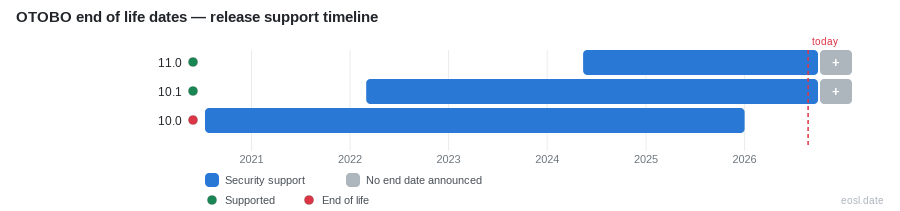
Currently Supported OTOBO Releases - Active EOS/EOSL Support (2)
OTOBO Releases Nearing End of Life - Support Ending Soon (1)
| Release | Released | Security Support | Latest |
|---|---|---|---|
| 10.1 | (4 years and 8 months ago) | (in 5 months) | 10.1.19 (2 months ago) |
OTOBO End of Life (EOL) Releases - No Longer Supported (1)
| Release | Released | Security Support | Latest |
|---|---|---|---|
| 10.0 | (6 years and 4 months ago) | (10 months ago) | 10.0.27 (1 year and 1 month ago) |
OTOBO end of life for the 10.0 line arrived on January 1, 2026, so if you still run OTOBO 10.0 you no longer receive fixes. This free and open-source, web-based ticketing system stays safe only while you track which lines are covered and where to move next.
OTOBO End of Life: Dates and Impact
The vendor announced on November 28, 2024 that every 10.0.x build released since July 2020 would stop at the turn of 2026. The final build is 10.0.27, published on October 23, 2025. Your ticketing data keeps flowing, yet the end of life for OTOBO milestone means the server now sits outside the maintenance window and should be treated as unpatched software.
Security Updates Stop After January 2026
Once a line is retired, security updates end for it. A flaw found in the runtime or the Debian base underneath stays open on your server, and any extension modules you installed inherit that exposure. The system looks healthy while the attack surface grows. Read the SECURITY.md file in the project repository for the policy, and check the tags on GitHub for the newest builds.
OTOBO Release Cycle and Lifecycle Dates
The project promises that every release gets a minimum of 36 months of security fixes, and at least six months after the next-but-one major or minor launch. That rule is the OTOBO release cycle in one sentence, and the table applies it to the lines on the market today.
| Line | Launched | Security fixes | Latest build |
|---|---|---|---|
| 11.0 | May 13, 2024 | Active | 11.0.18 (September 16, 2026) |
| 10.1 | March 2, 2022 | Active | 10.1.19 (September 16, 2026) |
| 10.0 | July 13, 2020 | Ended January 1, 2026 | 10.0.27 (October 23, 2025) |
The 11.0 line is the newest supported release, and a beta of OTOBO 11.1 is already available for testing, so review the notes before you plan a long-term move.
Three Years of Security Support
Three years is a floor, not a ceiling. Because the clock also depends on when the next-but-one line ships, a line often lives longer: 10.0 launched in July 2020 and lasted until January 2026, over five years. Plan around whatever the table shows today, and let the source code history in the repository confirm the pattern.
Upgrade Paths After EOL: OTOBO 10.1 or OTOBO 11
The vendor's advice is to jump to the 10.1 or 11 lines. Pick OTOBO 10.1 if your add-ons are not yet tested on 11.0, and pick 11.0 if you want the longest runway, since it launched in May 2024. Waiting longer only prolongs the EOL exposure.
Check Docker, Elasticsearch and Perl Before You Upgrade
Review the software requirements in the manuals first. A containerized setup uses a Docker image built on Perl 5.32 and Debian 10, with MariaDB as the database and Elasticsearch for search, so pull the newer image and confirm those parts still connect. A bare-metal installation needs the same checks done by hand.
Plan the Migration and Test the Update
To retire your 10.0 install cleanly, clone production into a staging copy, run the move there, and open a few real tickets before you touch live data. The migration is mostly mechanical, but custom packages can break, so test each one. Keep a database dump so you can roll back if a package fails. If you would rather skip the server work, a managed version hosted by the vendor removes it.
OTOBO 10.0 Documentation, Community and Professional Support
The central documentation hub covers the admin, installation, developer and user manuals, and it is where the steps for each line live. The project forum is the place to ask questions, and the maintainers posted the original notice there.
Open Source Roots as an OTRS Community Edition Fork
The project began in 2019 as a fork of the free edition of OTRS, aiming to stay 100% free and driven by its users. It ships under the GNU General Public License, so you can read, change and host the code yourself. The tool serves service organizations such as IT helpdesk teams, customer service desks and call centers, and it can automate processes, run a knowledgebase, and add an ITSM layer with a CMDB for assets. Teams in HR and facility management use it too.
Professional Services and Managed Hosting
Rother OSS GmbH, the owner of the source code, sells consulting, training and custom development, and its partners offer the same around the world. Ask them for a quote if your project is large.