Ruby End of Life (EOL) Dates and End of Support (EOS) Dates
Ruby end of life (EOL) and end of support (EOS) dates: 12 Ruby versions have reached EOL, including Ruby 3.2 (EOL date: Mar 31, 2026) — no longer receiving security updates or patches. Ruby 3.3 reaches its End of Support date on Mar 31, 2027 — plan your upgrade path now. Ruby 4.0.9 is the current supported release, with support through Mar 31, 2029 — 2 versions in active support. Also see Azul Zulu lifecycle dates for related end-of-life information.
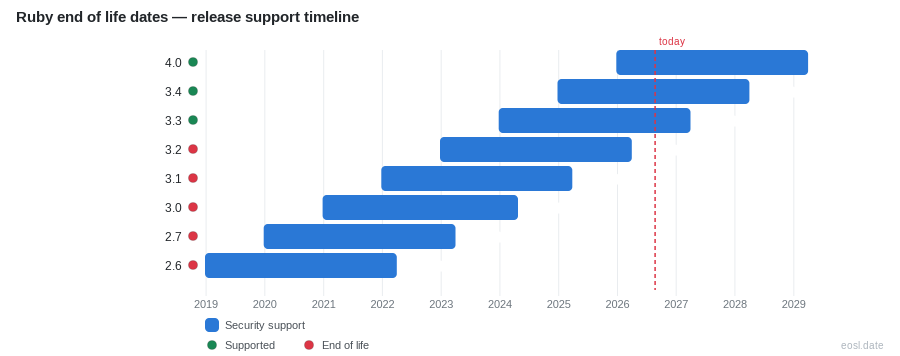
Currently Supported Ruby Releases - Active EOS/EOSL Support (2)
Ruby Releases Nearing End of Life - Support Ending Soon (1)
| Release | Released | Support Status | Latest |
|---|---|---|---|
| 3.3 | (2 years and 10 months ago) | (in 4 months) | 3.3.13 (3 weeks ago) |
Ruby End of Life (EOL) Releases - No Longer Supported (12)
| Release | Released | Support Status | Latest |
|---|---|---|---|
| 3.2 | (3 years and 10 months ago) | (7 months ago) | 3.2.11 (7 months ago) |
| 3.1 | (4 years and 10 months ago) | (1 year and 7 months ago) | 3.1.7 (1 year and 7 months ago) |
| 3.0 | (5 years and 10 months ago) | (2 years and 6 months ago) | 3.0.7 (2 years and 6 months ago) |
| 2.7 | (6 years and 10 months ago) | (3 years and 7 months ago) | 2.7.8 (3 years and 7 months ago) |
| 2.6 | (7 years and 10 months ago) | (4 years and 7 months ago) | 2.6.10 (4 years and 7 months ago) |
| 2.5 | (8 years and 10 months ago) | (5 years and 7 months ago) | 2.5.9 (5 years and 7 months ago) |
| 2.4 | (9 years and 10 months ago) | (6 years and 7 months ago) | 2.4.10 (6 years and 7 months ago) |
| 2.3 | (10 years and 10 months ago) | (7 years and 7 months ago) | 2.3.8 (8 years ago) |
| 2.2 | (11 years and 10 months ago) | (8 years and 7 months ago) | 2.2.10 (8 years and 7 months ago) |
| 2.1 | (12 years and 10 months ago) | (9 years and 7 months ago) | 2.1.10 (10 years and 7 months ago) |
| 2.0.0 | (13 years and 8 months ago) | (10 years and 8 months ago) | 2.0.0p648 (10 years and 10 months ago) |
| 1.9.3 | (15 years ago) | (11 years and 8 months ago) | 1.9.3p551 (12 years ago) |
A forgotten interpreter turns into a liability the day its patches stop, so every team running this open-source programming language should know the Ruby end of life dates for the version it runs. This guide lists each EOL date, explains what the support phases mean for developers, and shows how Rails apps are affected. Your upgrade path starts with the version you run today.
Ruby End of Life Dates by Version
The Ruby lifecycle is simple: a new release arrives every December 25, and the Ruby maintenance branches page tracks how long each one lives. The table shows where every EOL date stands in late October 2026.
| Release | Released | EOL date | Status |
|---|---|---|---|
| 4.0 | 25 Dec 2025 | 31 Mar 2029 | Normal maintenance |
| 3.4 | 24 Dec 2024 | 31 Mar 2028 | Normal maintenance |
| 3.3 | 25 Dec 2023 | 31 Mar 2027 | Security maintenance |
| 3.2 | 25 Dec 2022 | 31 Mar 2026 | EOL |
| 3.1 | 25 Dec 2021 | 26 Mar 2025 | EOL |
| 3.0 | 25 Dec 2020 | 23 Apr 2024 | EOL |
| 2.7 | 25 Dec 2019 | 31 Mar 2023 | EOL |
Release Date and Support Cycle Pattern
Because each release date lands on Christmas, you can predict an EOL date years ahead: add three years and three months and the end falls on March 31. That support cycle has held since Ruby 2.1, give or take a few days when the final patch release slips. Each December the newest line becomes the stable branch, and the previous ones age out as a release series.
Normal Maintenance and Security Maintenance
Every branch passes through three phases. During normal maintenance, also called active maintenance, it gets a bug fix backport and security fixes. In security maintenance only fixes for vulnerabilities ship. At end-of-life no patch release is published at all.
Unsupported Ruby Versions Right Now
Anything older than 3.3 is unsupported today. The maintenance branches page marks each of these releases as expired, meaning no fixes of any kind.
Ruby 3.2, Ruby 3.1, Ruby 3.0 and Ruby 2.7 Are EOL
Ruby 3.2 reached EOL on March 31, 2026, days after its final patch fixed CVE-2026-27820, a buffer overflow in Zlib::GzipReader. Ruby 3.1 closed in March 2025, Ruby 3.0 in April 2024 and Ruby 2.7 in March 2023. Support ends for good on those dates, so every new security vulnerability found since then stays unpatched, and the runtime will never receive a fix for the next batch of security vulnerabilities either.
Ruby 3.3, Ruby 3.4 and Ruby 4.0 Still Get Patches
Ruby 3.3 sits in security maintenance until March 31, 2027, roughly five months away. Its newer siblings run longer: the 3.4 line to March 2028 and the 4.0 line to March 2029. Check which Ruby versions your servers run with ruby --version and plan around the earliest date.
Dual EOL: Ruby on Rails Meets Unsupported Ruby
Ruby is only half of your stack. Rails keeps its own schedule, so a Rails app can reach EOL at the framework and at the runtime separately. When both Rails and Ruby are past support you face a double EOL: unpatched vulnerabilities in two layers, each with its own framework and runtime fixes missing, plus ecosystem pressure as gems stop testing against old Rails releases and you hit upgrade walls.
Critical Risk Combinations
- Ruby 3.1 with Rails 7.0: critical, because both are EOL and neither will be patched.
- Rails 7.1 on Ruby 3.2: high risk, since Rails 7.1 lost support in October 2025 and Ruby followed in March 2026.
- Rails 7.2 on a supported Ruby: moderate, because Rails 7.2 security support was scheduled to end in August 2026.
- Rails 8.0 or later on a current Ruby: low risk today, though Rails 8.0 has its own scheduled cutoff in November 2026.
Rails Maintenance Policy and Security Fixes
Since Rails 7.2, each minor release gets bug fixes for one year and security fixes for two. That maintenance policy is predictable but creates sharp cliffs. Rails 7.0 stopped receiving patches in April 2025 and Rails 7.1 in October 2025. When the Rails team fixed ten vulnerabilities in March 2026, only the supported branches received the update.
EOL Ruby Security Patches and Compliance Exposure
Once a release is EOL, security patches stop and each later CVE becomes permanent exposure. Recent examples include CVE-2025-27221, which leaks credentials through URI handling, plus DoS and XSS bugs in neighbouring libraries. Treat this as a production concern, not housekeeping, because attackers read the same advisories you do.
PCI DSS and HIPAA Obligations
PCI DSS requirement 12.3.4, mandatory since March 31, 2025, calls for a remediation plan approved by management, and an application still running an EOL Ruby release is exactly the software past EOL it describes. HIPAA's proposed rule would make patching mandatory, and GDPR, SOC2 and ISO 27001 auditors expect the same. Enterprises in regulated industries should treat technical debt like this as a finding waiting to happen. A commercial support contract can bridge the gap during the migration.
Ruby Upgrade Path From End-of-Life Releases
Move to Ruby 3.4 unless something blocks you: it has a year of production use, works with Rails 7.2 and Rails 8, brings YJIT improvements and stays supported through March 2028. Ruby 3.3 is the cautious stop for teams with thin test coverage, and Ruby 4.0 makes sense once you are on 3.4. Step through each intermediate release so deprecation warnings appear before they become errors, and upgrade Ruby before Rails because it is the lower-risk change.
Bundled Gems and Bundler Changes
The 3.4 release moved base64, csv and bigdecimal from default gems to bundled gems. They still ship with the interpreter, but under Bundler you must declare them in your Gemfile or require 'csv' can raise a LoadError. The previous release prints warnings about missing declarations, so it is worth stopping there first.
Bundle Audit and Brakeman Scanning
Run bundle audit weekly, not just in CI, so you hear about new CVEs even when you cannot patch yet, and let Brakeman flag vulnerable Rails code. The next_rails gem's compatibility report shows which dependencies block the move, and legacy code with no tests deserves attention first.
Staying Safe on an Expired Ruby Release
If the upgrade cannot happen this quarter, shrink the danger rather than ignore it:
- Write a dated plan with sign-off, even if the date is two months out.
- Upgrade customer-facing applications first; keep internal tools behind your VPN or cloud network controls.
- Subscribe to the Ruby and Rails security advisories, and review the cloud and infrastructure dependencies of every service for flaws that will never be fixed on an EOL line.
Whichever route you choose, name the actual EOL date in the ticket. A date is harder to defer than "outdated software".