rtpengine End of Life (EOL) Dates and End of Support (EOS) Dates
rtpengine end of life (EOL) and end of support (EOS) dates: 23 rtpengine versions have reached EOL, including rtpengine mr26.2 (EOL date: Oct 31, 2026) — no longer receiving security updates or patches. rtpengine mr26.3 reaches its End of Support date on Jan 30, 2027 — plan your upgrade path now. rtpengine 26.0.1.28 LTS is the current supported release, with support through May 01, 2029 — 3 versions in active support. Also see Calico end of support dates for related end-of-life information.
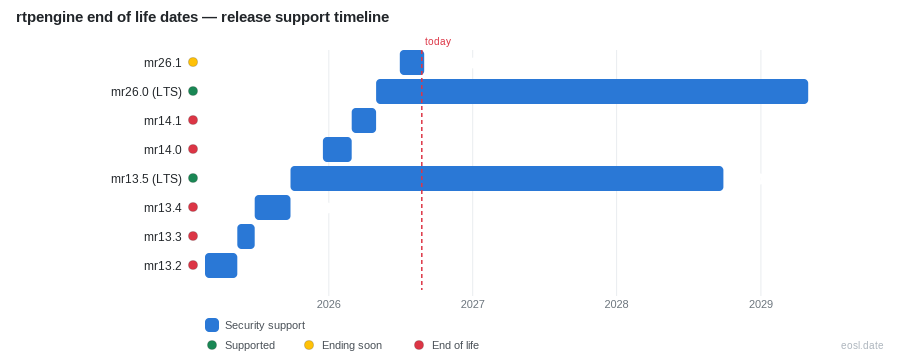
Currently Supported rtpengine Releases - Active EOS/EOSL Support (3)
| Release | Released | Security Support | Latest | LTS |
|---|---|---|---|---|
| mr26.0 (LTS) | (6 months ago) | (in 2 years and 5 months) | 26.0.1.28 (1 week and 6 days ago) | LTS |
| mr13.5 (LTS) | (1 year and 1 month ago) | (in 1 year and 10 months) | 13.5.1.31 (2 weeks and 1 day ago) | LTS |
| mr12.5 (LTS) | (2 years and 1 month ago) | (in 10 months) | 12.5.1.56 (1 month and 1 day ago) | LTS |
rtpengine Releases Nearing End of Life - Support Ending Soon (1)
| Release | Released | Security Support | Latest | LTS |
|---|---|---|---|---|
| mr26.3 | (2 weeks and 3 days ago) | (in 2 months) | 26.3.1.3 (1 week and 6 days ago) | - |
rtpengine End of Life (EOL) Releases - No Longer Supported (23)
| Release | Released | Security Support | Latest | LTS |
|---|---|---|---|---|
| mr26.2 | (2 months ago) | (2 weeks and 3 days ago) | 26.2.1.6 (2 weeks and 1 day ago) | - |
| mr26.1 | (4 months ago) | (2 months ago) | 26.1.1.11 (2 months ago) | - |
| mr14.1 | (8 months ago) | (6 months ago) | 14.1.1.21 (3 months ago) | - |
| mr14.0 | (11 months ago) | (8 months ago) | 14.0.1.11 (5 months ago) | - |
| mr13.4 | (1 year and 4 months ago) | (1 year and 1 month ago) | 13.4.1.10 (1 year ago) | - |
| mr13.3 | (1 year and 6 months ago) | (1 year and 4 months ago) | 13.3.1.16 (1 year ago) | - |
| mr13.2 | (1 year and 8 months ago) | (1 year and 6 months ago) | 13.2.1.16 (1 year and 4 months ago) | - |
| mr13.1 | (1 year and 10 months ago) | (1 year and 8 months ago) | 13.1.1.16 (1 year and 6 months ago) | - |
| mr13.0 | (2 years ago) | (1 year and 10 months ago) | 13.0.1.10 (1 year and 9 months ago) | - |
| mr12.4 | (2 years and 5 months ago) | (2 years and 1 month ago) | 12.4.1.11 (2 years ago) | - |
| mr12.3 | (2 years and 7 months ago) | (2 years and 5 months ago) | 12.3.1.6 (2 years ago) | - |
| mr12.2 | (2 years and 9 months ago) | (2 years and 7 months ago) | 12.2.1.5 (2 years and 7 months ago) | - |
| mr12.1 | (2 years and 10 months ago) | (2 years and 9 months ago) | 12.1.1.7 (2 years and 9 months ago) | - |
| mr12.0 | (3 years ago) | (2 years and 10 months ago) | 12.0.1.5 (2 years and 10 months ago) | - |
| mr11.5 (LTS) | (3 years and 1 month ago) | (2 months ago) | 11.5.1.53 (4 months ago) | LTS |
| mr11.4 | (3 years and 3 months ago) | (3 years and 2 months ago) | 11.4.1.8 (2 years and 9 months ago) | - |
| mr11.3 | (3 years and 7 months ago) | (3 years and 3 months ago) | 11.3.1.15 (2 years and 9 months ago) | - |
| mr11.2 | (3 years and 9 months ago) | (3 years and 7 months ago) | 11.2.1.12 (3 years and 6 months ago) | - |
| mr11.1 | (4 years ago) | (3 years and 9 months ago) | 11.1.1.12 (3 years and 6 months ago) | - |
| mr11.0 | (4 years and 2 months ago) | (4 years ago) | 11.0.1.7 (4 years and 1 month ago) | - |
| mr10.5 (LTS) | (4 years and 4 months ago) | (1 year and 2 months ago) | 10.5.9.1 (1 year and 3 months ago) | LTS |
| mr9.5 | (5 years and 4 months ago) | (2 years and 2 months ago) | 9.5.9.1 (2 years and 4 months ago) | - |
| mr8.5 | (6 years and 3 months ago) | (2 years and 11 months ago) | 8.5.12.2 (2 years and 11 months ago) | - |
Before your next maintenance window, check rtpengine end of life dates so you know which series still get fixes. This media processing component is a drop-in replacement for other RTP proxies, and each supported release below shows when LTS coverage ends, so a SIP proxy stack never runs unpatched by surprise.
rtpengine End of Life Dates and Branch Status
The table lists each major branch with its security cutoff, taken from the public support schedule as of 27 October 2026. Read it before you touch any production server or voice platform, since software on an expired line receives no further support.
| Series | Released | Security fixes end |
|---|---|---|
| mr26.2 | 31 Aug 2026 | 31 Oct 2026 |
| mr26.1 | 30 Jun 2026 | 31 Aug 2026 (ended) |
| mr26.0 | 1 May 2026 | 1 May 2029 |
| mr13.5 | 26 Sep 2025 | 28 Sep 2028 |
| mr12.5 | 20 Sep 2024 | 24 Sep 2027 |
| mr11.5 | 22 Sep 2023 | 11 Sep 2026 (ended) |
| mr10.5 | 8 Jul 2022 | 5 Sep 2025 (ended) |
| mr9.5 | 2 Jul 2021 | 6 Sep 2024 (ended) |
The mr26.0, mr13.5 and mr12.5 series are the long-term ones still covered. Plan an upgrade for anything older.
LTS Releases and Security Support Windows
The recent security support windows for the .5 series run about three years, while a regular series such as mr26.2 gets only two months. Production servers belong on a long-term line, because stability matters more than new features once calls carry revenue.
Checking Support Status with rtpengine -v
To confirm your support status, run rtpengine -v and compare the version it prints with the table. On Ubuntu, the package version from apt may lag the upstream version, and Debian stable pins an even older build. A systemd unit also keeps running the previous binary until you restart the service, so check the running version, not just the installed one. Any Linux host showing mr11.5 or older, such as an Ubuntu image from 2024, is already outside the window. An Ubuntu LTS point release does not change that, and each Ubuntu or Debian package still needs its own version check.
How the rtp proxy Release Cycle Is Tracked
The project does not document a formal policy, so community trackers fill the gap. The vendor release page is authoritative, and every rtpengine release is tagged on GitHub. Trackers also publish an RSS feed, a JSON API, a calendar file and a Repology entry, which lets you alert on an approaching cutoff without reading release notes. The project documentation covers features, not dates, so keep a tracker bookmarked.
Why the Kamailio Media Proxy Still Matters
An expired build exposes every call that Kamailio routes through it. Pairing Kamailio with this media proxy is the standard way to handle SIP signaling and relay media for VoIP and WebRTC platforms. The older rtpproxy module is supported too, so teams in telecommunications and real-time communication can migrate gradually while real-time media keeps flowing. Because every call crosses the proxy, a stale build becomes a risk for the whole platform, not one server.
Sipwise Origins and Open-Source Licensing
Sipwise sets the support dates in the table above, and its open-source license means anyone can audit and patch an expired line. Even as a drop-in replacement for older proxies, the vendor schedule decides how long your build gets fixes.
rtp engine Features to Re-Test After an Upgrade
Newer series change behavior, so retest call recording, media forking and publish/subscribe forwarding, plus the Janus interface and any MySQL-backed storage you rely on. Keep a MySQL credential rotation in the same window, since recordings need the database.
Transcoding, Codecs and DTMF
Check transcoding between Opus, G.711 and G.729, plus T.38 fax and DTMF conversion. After moving off an expired series, retest against a recorded baseline. Silence detection, comfort noise and announcements should still work on audio and video. Run a load test on GPU transcoding and FFmpeg builds, since a codec library change can alter results, and compare each codec against a recorded baseline. Transcoding costs CPU, so budget for it, and note that a missing codec shows up as one-way audio.
SRTP, ICE and NAT Traversal
After moving to a supported series, verify SRTP and DTLS-SRTP media encryption, ICE handling, SDP rewriting and NAT traversal behind a firewall. Bridging between IPv4 and IPv6 should follow each RFC your carriers require, such as RFC 3711 for SRTP, RFC 5764 for DTLS keying and RFC 4568 for SDES, as encryption mismatches are the first thing users hear.
rtpengine Daemon Performance and the Kernel Module
The multi-threaded daemon forwards each packet in-kernel after negotiation. This in-kernel packet forwarding relies on the kernel module and iptables for low latency and little jitter, and the daemon falls back to userspace if the module is missing. After each upgrade, rebuild the module for your Linux kernel, then reload the iptables rule, since the daemon cannot bypass userspace until it exists. Confirm port range settings, high availability and monitoring and statistics, and watch packet counters. Performance, reliability and network paths depend on it, and every daemon restart drops forwarding until rules return. An expired series gets none of the fixes for this code, so rebuild on a supported one.
WebSocket and UDP Control Problems
One GitHub bug report described the daemon ignoring WebSocket commands after days of uptime, on a series that has since expired, so upgrading, not waiting, is the fix. Maintainers asked for a newer build and a gdb backtrace, and the reporter later linked the hang to a port scanner. The ng control protocol also runs over UDP, which avoids that path, though UDP fragmentation can bite. The control protocol listener should never face the internet, and scanners will find any open UDP or TCP port.
Planning Media Streams and RTP Traffic
Estimate media streams and RTP traffic per host before cutover, so the replacement series is sized before cutover. Each call needs two media streams, and transcoded legs cost more.
Upgrade Plan for the Sipwise NGCP rtpengine
Move mr11.5 or older to mr12.5, mr13.5 or mr26.0, rehearse installation and compiling on a staging host, then roll out one node at a time. Read the official documentation first, and ask questions on the mailing list, not the issue tracker. Community contribution and sponsors fund the fixes each supported series receives.