YouTrack End of Life (EOL) Dates and End of Support (EOS) Dates
YouTrack end of life (EOL) and end of support (EOS) dates: 21 YouTrack versions have reached EOL, including YouTrack 2025.2 (EOL date: Jun 23, 2026) — no longer receiving security updates or patches. YouTrack 2026.2.19884 is the current supported release — 3 versions in active support. Also see Calico EOSL information for related end-of-life information.
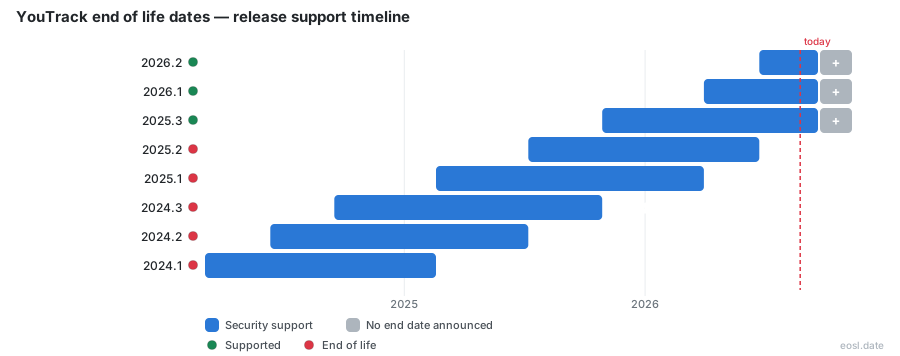
Currently Supported YouTrack Releases - Active EOS/EOSL Support (3)
| Release | Released | Security Support | Latest |
|---|---|---|---|
| 2026.2 | (4 months ago) | Active | 2026.2.19884 (1 day ago) |
| 2026.1 | (7 months ago) | Active | 2026.1.14193 (2 days ago) |
| 2025.3 | (1 year ago) | Active | 2025.3.178461 (2 days ago) |
YouTrack End of Life (EOL) Releases - No Longer Supported (21)
| Release | Released | Security Support | Latest |
|---|---|---|---|
| 2025.2 | (1 year and 4 months ago) | (4 months ago) | 2025.2.148048 (5 months ago) |
| 2025.1 | (1 year and 9 months ago) | (7 months ago) | 2025.1.148120 (5 months ago) |
| 2024.3 | (2 years and 2 months ago) | (1 year ago) | 2024.3.148430 (5 months ago) |
| 2024.2 | (2 years and 5 months ago) | (1 year and 4 months ago) | 2024.2.148429 (5 months ago) |
| 2024.1 | (2 years and 8 months ago) | (1 year and 9 months ago) | 2024.1.34109 (2 years and 5 months ago) |
| 2023.3 | (2 years and 11 months ago) | (2 years and 2 months ago) | 2023.3.26285 (2 years and 8 months ago) |
| 2023.2 | (3 years and 1 month ago) | (2 years and 5 months ago) | 2023.2.26286 (2 years and 8 months ago) |
| 2023.1 | (3 years and 5 months ago) | (2 years and 8 months ago) | 2023.1.22653 (2 years and 10 months ago) |
| 2022.3 | (4 years ago) | (2 years and 11 months ago) | 2022.3.65379 (3 years and 7 months ago) |
| 2022.2 | (4 years and 4 months ago) | (3 years and 1 month ago) | 2022.2.65377 (3 years and 7 months ago) |
| 2022.1 | (4 years and 9 months ago) | (3 years and 5 months ago) | 2022.1.65378 (3 years and 7 months ago) |
| 2021.4 | (5 years ago) | (4 years ago) | 2021.4.40676 (4 years and 9 months ago) |
| 2021.3 | (5 years and 4 months ago) | (4 years and 4 months ago) | 2021.3.30245 (5 years and 1 month ago) |
| 2021.2 | (5 years and 5 months ago) | (4 years and 9 months ago) | 2021.2.19690 (5 years and 4 months ago) |
| 2021.1 | (5 years and 7 months ago) | (5 years ago) | 2021.1.15276 (5 years and 6 months ago) |
| 2020.6 | (5 years and 11 months ago) | (5 years and 4 months ago) | 2020.6.8801 (5 years and 8 months ago) |
| 2020.5 | (6 years ago) | (5 years and 5 months ago) | 2020.5.3123 (5 years and 11 months ago) |
| 2020.4 | (6 years ago) | (5 years and 7 months ago) | 2020.4.6808 (6 years ago) |
| 2020.3 | (6 years and 4 months ago) | (5 years and 11 months ago) | 2020.3.12000 (6 years and 1 month ago) |
| 2020.2 | (6 years and 5 months ago) | (6 years ago) | 2020.2.11008 (6 years and 3 months ago) |
| 2020.1 | (6 years and 7 months ago) | (6 years ago) | 2020.1.11011 (6 years and 3 months ago) |
Wondering about YouTrack end of life? JetBrains publishes no formal EOL calendar for this bug tracker, so you have to read the release pattern yourself. In short, only the three newest releases get patches, and anything older has lost security support. This guide covers the issue tracking and project management software from JetBrains, and shows which build to run today.
YouTrack End of Life Status by Supported Release
The table below follows the endoflife.date tracker as of October 2026. Each supported release receives fixes until a newer one pushes it out of the top three.
| Release | Released | Security patches |
|---|---|---|
| 2026.2 | 23 Jun 2026 | Yes |
| 2026.1 | 31 Mar 2026 | Yes |
| 2025.3 | 28 Oct 2025 | Yes |
| 2025.2 | 8 Jul 2025 | Ended 23 Jun 2026 |
| 2025.1 | 18 Feb 2025 | Ended 31 Mar 2026 |
| 2024.3 | 17 Sep 2024 | Ended 28 Oct 2025 |
Run one of the top three rows. Every older build is already past its cutoff, so schedule a move for it.
Latest version and minor versions in support
The latest version is 2026.2, and build 2026.2.19656 shipped on 21 October 2026. Recent feature releases added a new design, whiteboards and customer groups in the helpdesk. Maintenance updates keep landing on all three supported branches, so check the release date of your build before assuming it is current. The release also carries optional AI assistance, a remote MCP server for AI tools, and writing help in English and German.
Major release cadence and release policy
The vendor does not document a release policy. In practice you see one major release line per year, named after the year, with several minor versions inside it. The yearly roadmap helps your teams plan around that rhythm.
How End of Support Works with an Active Subscription
Here, end of support is tied to your account, not to a calendar date for a build. While your plan is current you get fixes and help. Once a subscription expires, you keep what you already have but lose later releases and official help. A lapsed plan ends access to new releases, while a free plan covers teams of up to 10 users.
YouTrack Server and the perpetual license
With YouTrack Server, you keep a perpetual license for the last version obtained during your term. Updating is manual: there is no auto-update, and you can host it on-premises, in Docker or on Kubernetes. If you would rather not run a server at all, the cloud edition removes that chore.
YouTrack Cloud and automatic updates
YouTrack Cloud is an annual subscription per user, with JetBrains-managed hosting on AWS. Releases apply automatically while you pay, so administrators never fall behind on a branch.
What EOL Means for Security Support
Once a release leaves the supported list, the vendor stops shipping security patches for it. That matters because flaws do get found: CVE-2026-33392 surfaced in March 2026 and was fixed straight away, with a newer build advised for servers older than 2025.3.132953. A June 2026 post then asked administrators of older servers to move to a current build, citing several security vulnerabilities.
Upgrade installation after a vulnerability fix
If your build has dropped off the supported list, plan an upgrade installation rather than patching in place. Keep fresh backups first, including a full database backup, so you can roll back. Re-check any custom JVM options once the new build starts, as the official guide advises. Afterward, confirm the server reports the build you expect.
Migrating from Discontinued Setups to a Built-in Hub
Starting with 2024.2, JetBrains discontinued new installations that connect to a standalone Hub, partly because Upsource was retired in 2022. The hub service now ships inside the package, so you manage one product instead of two. The migration needs YouTrack 2024.3 or later, a plan eligible for 2025.1, and Hub 2024.1 or later.
Moving off an external Hub
If you still depend on an external Hub, the migration follows this order:
- Delete unsupported services from Hub, such as Upsource and unrelated YouTrack installs.
- Back up both databases, merge them into one archive and remove the conf folder.
- Stop the Hub and YouTrack services.
- Run the install with a Docker image of your version or newer, pick Upgrade in the configuration wizard and choose the archive. You end up on the built-in Hub for good.
Atlassian Data Center alternatives
Atlassian ended Data Center sales in March 2026, with support running to 2029, which pushes many teams to look for an alternative to Jira. Server or cloud, with or without AI, the built-in knowledge base and helpdesk in YouTrack cover the same ground, and a JetBrains webinar from 30 September 2026 walks through the move.
Checking YouTrack Versions Against Technical Requirements
First compare your build with the table above: outside the top three supported releases, it gets no patches. Then confirm your host fits the technical requirements for the target version:
- 1.5 GB of RAM, with a 1024m Java heap for the JVM.
- About 1 GB of disk per 5,000 issues, on direct-attached storage rather than NFS.
- 64-bit Windows, macOS or Linux, plus an ARM Docker image since 2025.1.
- One of the two newest stable Chrome, Edge, Firefox or Opera releases.
Those supported environments are modest, so a small team can stay current with the software on a single server. Check your build against the top three releases each quarter so it stays supported.