Rancher End of Life (EOL) Dates and End of Support (EOS) Dates
Rancher end of life (EOL) and end of support (EOS) dates: 13 Rancher versions have reached EOL, including Rancher 2.11 (EOL date: Oct 24, 2026) — no longer receiving security updates or patches. Rancher 2.12 reaches its End of Support date on Feb 28, 2027 — plan your upgrade path now. Rancher 2.15.3 is the current supported release, with support through Feb 27, 2028 — 3 versions in active support. Also see Artifactory lifecycle dates for related end-of-life information.
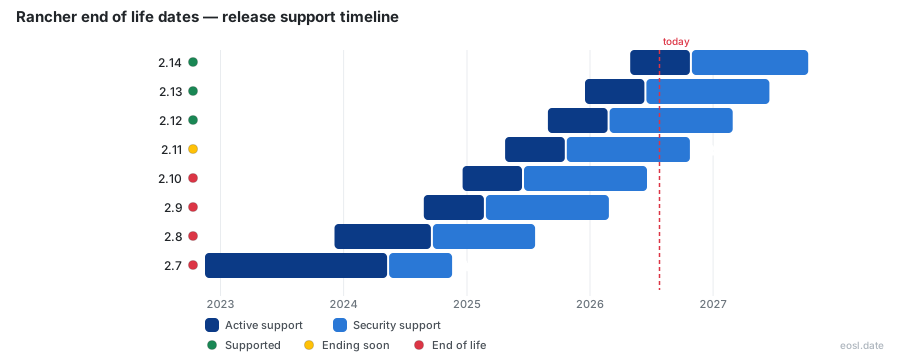
Currently Supported Rancher Releases - Active EOS/EOSL Support (3)
| Release | Released | Limited Support | Full Support | Latest |
|---|---|---|---|---|
| 2.15 | (2 months ago) | (in 1 year and 3 months) | (in 3 months) | 2.15.3 (3 weeks and 2 days ago) |
| 2.14 | (6 months ago) | (in 10 months) | (3 weeks and 1 day ago) | 2.14.7 (3 weeks and 3 days ago) |
| 2.13 | (11 months ago) | (in 6 months) | (5 months ago) | 2.13.11 (3 weeks and 3 days ago) |
Rancher Releases Nearing End of Life - Support Ending Soon (1)
| Release | Released | Limited Support | Full Support | Latest |
|---|---|---|---|---|
| 2.12 | (1 year and 2 months ago) | (in 3 months) | (8 months ago) | 2.12.15 (3 weeks and 3 days ago) |
Rancher End of Life (EOL) Releases - No Longer Supported (13)
| Release | Released | Limited Support | Full Support | Latest |
|---|---|---|---|---|
| 2.11 | (1 year and 6 months ago) | (4 weeks ago) | (1 year ago) | 2.11.19 (3 weeks and 3 days ago) |
| 2.10 | (1 year and 11 months ago) | (5 months ago) | (1 year and 5 months ago) | 2.10.12 (5 months ago) |
| 2.9 | (2 years and 2 months ago) | (8 months ago) | (1 year and 8 months ago) | 2.9.12 (1 year and 1 month ago) |
| 2.8 | (2 years and 11 months ago) | (1 year and 3 months ago) | (2 years and 1 month ago) | 2.8.15 (1 year and 6 months ago) |
| 2.7 | (4 years ago) | (2 years ago) | (2 years and 6 months ago) | 2.7.18 (2 years ago) |
| 2.6 | (5 years and 2 months ago) | (2 years and 6 months ago) | (3 years and 8 months ago) | 2.6.14 (2 years and 9 months ago) |
| 2.5 | (6 years and 1 month ago) | (3 years and 9 months ago) | (4 years and 10 months ago) | 2.5.17 (3 years and 9 months ago) |
| 2.4 | (6 years and 7 months ago) | (4 years and 7 months ago) | (5 years and 3 months ago) | 2.4.18 (4 years and 7 months ago) |
| 2.3 | (7 years and 1 month ago) | (5 years and 7 months ago) | (6 years and 1 month ago) | 2.3.11 (5 years and 8 months ago) |
| 2.2 | (7 years and 7 months ago) | (6 years and 1 month ago) | (6 years and 7 months ago) | 2.2.13 (6 years and 5 months ago) |
| 2.1 | (8 years and 1 month ago) | (6 years and 7 months ago) | (7 years and 1 month ago) | 2.1.14 (6 years and 10 months ago) |
| 2.0 | (8 years and 6 months ago) | (7 years ago) | (7 years and 6 months ago) | 2.0.16 (7 years and 4 months ago) |
| 1.6 | (9 years and 6 months ago) | (6 years and 4 months ago) | (6 years and 10 months ago) | 1.6.30 (6 years and 6 months ago) |
Rancher end of life (EOL) dates tell you how long each release of this Kubernetes management platform keeps receiving fixes before your containers and clusters are on their own. If your DevOps team runs Rancher, this guide shows which versions are covered today and the security risk of falling behind.
Rancher End of Life Dates by Version
Rancher has no fixed release policy, but every minor version carries documented dates. From the table below, each one gets roughly 6 months of full coverage and then about 12 months of reduced coverage. These rows are the free community version line, based on the endoflife.date tracker and SUSE's published schedule as of 27 October 2026.
| Release | Released | Coverage window ends | Final end date |
|---|---|---|---|
| 2.15 | 27 Aug 2026 | 27 Feb 2027 | 27 Feb 2028 |
| 2.14 | 30 Apr 2026 | 30 Oct 2026 | 10 Oct 2027 |
| 2.13 | 17 Dec 2025 | 17 Jun 2026 | 17 Jun 2027 |
| 2.12 | 29 Aug 2025 | 28 Feb 2026 | 28 Feb 2027 |
| 2.11 | 24 Apr 2025 | 24 Oct 2025 | 24 Oct 2026 |
Rancher Version Support Matrix
A support matrix pairs each release with the Kubernetes builds it can manage. Check it before any change, because an enterprise running a cloud, on-prem or edge cluster on an unlisted build can lose orchestration features. Every Rancher version has its own row.
Kubernetes Distributions and Downstream Clusters
Rancher manages RKE, RKE2, K3s and hosted offerings, and the Kubernetes versions each accepts change with every minor release. Compare your Kubernetes versions against the matrix first.
Lifecycle Policy: Full Support and Limited Support
The lifecycle policy runs in two phases. Full support covers defects and security issues across the board, while limited support narrows to urgent patches. When the final date passes, nothing else ships.
Bug Fixes in the First Phase
During the full-coverage phase, a Rancher bug or other functional defect is corrected in frequent updates until the end-of-maintenance date in the table.
Critical Security Fixes in the Second Phase
Afterwards, only critical security fixes arrive for Rancher. One recent CVE involved a logout flaw where a captured session token stayed valid after sign-out and was closed in 2.15.2. Vulnerabilities in a version past full coverage get no other attention, so treat security as the reason to move.
End of Maintenance and General Availability
General availability is the day a version ships as stable. EOM, the date full coverage stops, follows about 6 months later. Between releases, a patch release usually lands monthly and carries the latest corrections.
Rancher Release Calendar for Current Versions
The release calendar shows a new minor release about every four months: 2.12 in August 2025, 2.13 in December 2025, 2.14 in April 2026 and 2.15 in August 2026. Each Rancher release ships with release notes listing its fixes.
Supported Versions Right Now
Today, 2.15, 2.14, 2.13 and 2.12 still get patches. Version 2.11 ended on 24 October 2026, and 2.14 leaves full coverage on 30 October 2026, so plan to move your containers to 2.15.
Rancher End-of-Support (EoS) Explained
For Rancher, this point arrives before the final end date in the table, and hosting providers add their own wording. Hosting providers use their own wording. OVHcloud defines end-of-support as the point a version is no longer covered or open to new installs, and it labels the same moment end-of-sales. Then the clock starts, and 3 months later the instance is auto-upgraded to the next release.
RKE End-of-Life: Replatform to RKE2 or K3s
SUSE announced that RKE reaches its end-of-life on 31 July 2025, so every cluster still on it has to move to a newer distribution.
Why Move to RKE2 and containerd
RKE relied on Docker as its container runtime, and Dockershim left Kubernetes in release 1.24. RKE2 uses containerd, passes CIS Kubernetes benchmarks with little work, supports FIPS 140-2 and scans builds for CVEs, which eases compliance.
Replatform Steps for Stateless and Stateful Workloads
In-place conversion is not possible. Document each cluster, deploy RKE2, then move stateless apps first and stateful ones after a tested rollback plan. Your DevOps team can lean on SUSE consulting and training.
Rancher 1.6 EOL and the Upgrade Path
Rancher 1.6 closed out on 30 June 2020, when its support portal shut. Reaching 2.x meant rebuilding, since 2.x is a new architecture, so teams that waited had no shortcut. Compare that with the version dates in the table above.
Rancher Support in the Managed Rancher Service
Hosted offerings set their own schedule. OVHcloud's managed rancher service supports a minor version for 12 months after its upstream release date, and SUSE, which publishes Rancher, also sells the commercial Rancher Prime edition. Rancher support there follows the provider's dates, not the community table.
Upgrade Before EOM: Patch Release Updates
Only patches inside a supported line receive fixes, so staying on the newest one until its coverage window closes keeps you in full coverage; 2.15 through 2.12 are the lines still patched. Version 2.15.2, released 23 September 2026, closed CVE-class issues and corrected authentication and RBAC behavior. Verify the installation requirements before you start.
Known Issues and Fleet in the Latest Community Version
Read the known issues before moving, such as clusters with S3 snapshots hanging on deletion. Fleet now rejects Helm values paths outside a bundle and requires a webhook secret for its Git receiver, so recheck Helm, ingress and load balancer settings.