Protractor End of Life (EOL) Dates and End of Support (EOS) Dates
Protractor end of life (EOL) and end of support (EOS) dates: 7 Protractor versions have reached EOL, including Protractor 7.0 (EOL date: Aug 31, 2023) — no longer receiving security updates or patches. Also see Google Chrome lifecycle dates for related end-of-life information.
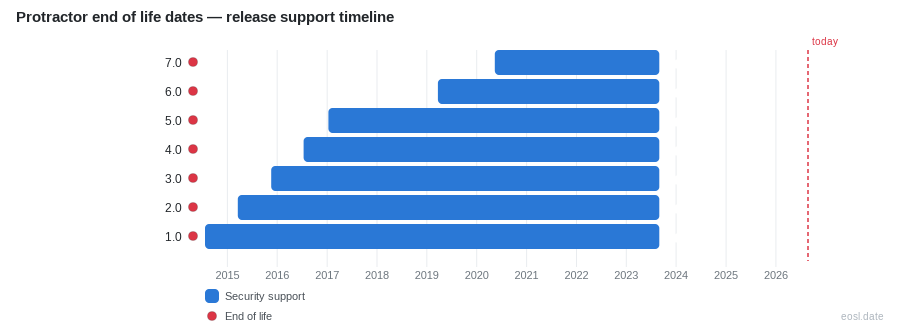
Protractor End of Life (EOL) Releases - No Longer Supported (7)
| Release | Released | Community Support | Commercial Support | Latest |
|---|---|---|---|---|
| 7.0 | (6 years and 6 months ago) | (3 years and 2 months ago) | Active | 7.0.0 (6 years and 6 months ago) |
| 6.0 | (7 years and 8 months ago) | (3 years and 2 months ago) | Active | 6.0.0 (7 years and 8 months ago) |
| 5.0 | (9 years and 10 months ago) | (3 years and 2 months ago) | Active | 5.4.4 (6 years and 7 months ago) |
| 4.0 | (10 years and 4 months ago) | (3 years and 2 months ago) | Active | 4.0.14 (9 years and 11 months ago) |
| 3.0 | (11 years ago) | (3 years and 2 months ago) | Active | 3.3.0 (10 years and 6 months ago) |
| 2.0 | (11 years and 8 months ago) | (3 years and 2 months ago) | Active | 2.5.1 (11 years and 1 month ago) |
| 1.0 | (12 years and 4 months ago) | (3 years and 2 months ago) | Active | 1.8.0 (11 years and 8 months ago) |
If your Angular projects still lean on the old browser test runner, Protractor end of life is no longer a future event: the project stopped receiving updates on August 31, 2023. Your existing E2E suites keep running, but nothing is being patched, so every Node.js or browser change pushes you closer to a broken pipeline. This page covers the dates, the reasons behind the shutdown, the realistic alternatives, and a migration path for end-to-end testing on AngularJS and Angular apps.
Protractor End of Life: Dates, Versions and Status
Protractor was the official test framework for Angular, created by the Angular team at Google in 2013. The team announced in August 2022 that long term support would end in August 2023, following the deprecation guidelines it applies to every Angular API. Community support and commercial support from the core team stopped on August 31, 2023, and the last version, 7.0.0, shipped on May 13, 2020.
| Date | What happened |
|---|---|
| April 2021 | The Angular team opened an RFC on the future of Angular E2E and Protractor |
| December 31, 2021 | Development of the legacy first-generation framework ended |
| August 2022 | Official announcement of the planned shutdown |
| August 31, 2023 | Support ended for every release line |
| July 29, 2024 | GitHub repository archived and made read-only |
The npm package is flagged as deprecated, but every old release stays downloadable, so existing builds keep installing.
Why Protractor Deprecation Happened
The Angular team explained the decision in an open RFC. Protractor was built in 2013, before WebDriver became a standard and before async and await existed, and it could not adopt modern JavaScript without forcing every user to rewrite their tests. A January 2021 survey of nearly 1,000 developers found fewer than 20% of respondents used it. Inside Google, the same tool served thousands of projects, so the cost of a breaking rewrite was real, while other open source tools had matured. The team concluded that a move to a modern, framework-agnostic tool would help the wider community more than a breaking Protractor release.
Control Flow Versus Async and Await
Protractor wrapped selenium-webdriver and hid asynchronous calls behind Control Flow, which made them look synchronous. Async and await are fundamentally incompatible with that model, and Control Flow was removed entirely in selenium-webdriver 4.0. Upgrading meant dropping legacy dependencies such as jasminewd2 and the Q promise library, which would have broken every existing test.
AngularJS Features That Aged Out
Many locators and mock modules only worked with AngularJS, whose development ended on December 31, 2021. Without Control Flow and those features, Protractor would have become a thin wrapper around selenium-webdriver that added nothing you could not get elsewhere.
What Deprecation Means for Your Angular Project
Nothing breaks on the day support ends; what changes is risk. Without critical security patches, any vulnerability found in the Protractor package or its dependencies stays open, and teams with audit requirements lose the ability to prove their tooling is maintained. Compatibility is the second casualty: new Chrome releases, newer Node.js versions and later Angular majors will eventually stop working with a pinned version of the tool. Because every E2E test runs through a real browser, even a small driver mismatch can turn a green pipeline red. Treat this as technical debt with a deadline rather than an emergency, but put the testing work on this quarter's plan, and let the wider community guides below shorten it.
Staying on Protractor with Never-Ending Support
If a rewrite is not possible yet, HeroDevs sells Never-Ending Support (NES) for Protractor, a maintained fork that delivers security fixes and compatibility updates. The Angular team's announcement said HeroDevs would offer free access to the community through August 2024, after which commercial licences apply. Think of it as the long term support option for a codebase you cannot migrate yet: it buys time and satisfies audits, but it is a bridge rather than a destination, because the design problems remain.
Best Protractor End of Life Alternatives for E2E Testing
The Angular blog names four tools with command-line integrations and documented migration routes, and two more appear in nearly every comparison. None is a drop-in replacement, so choose based on cross-browser needs, language support and how your team already writes tests.
Cypress
Cypress runs inside the browser and is a popular choice for Angular teams leaving Protractor. It offers a time-travel debugger, automatic waiting and readable failures, and it ships an official schematic. Its browser coverage is narrower than a WebDriver grid, which matters if you must test many browsers. Rewrite selectors first; Cypress specs are usually shorter than their Protractor equivalents.
Playwright
Playwright, from Microsoft, drives Chromium, Firefox and WebKit through one API and has strong TypeScript support. It is the natural pick when cross-browser confidence matters most, and its parallel runner shortens large suites.
Puppeteer
Puppeteer controls Chrome through the DevTools Protocol instead of WebDriver. It is fast and precise for Chrome-only coverage, but it is a browser automation library more than a full runner, so you add your own assertions and reporting.
WebdriverIO
WebdriverIO is closest in spirit to Protractor because it builds on the WebDriver standard and existing Selenium WebDriver grids, so current infrastructure keeps working. Teams with large browser matrices usually land here.
TestCafe
TestCafe skips WebDriver and injects its scripts into the page, which removes driver installs. It suits teams that want a simple setup with solid parallelism.
Choosing a Replacement After Deprecation
Once Protractor stops being an option, match its replacement to the constraint you cannot change. Use this table as a quick filter, then confirm with a one-week spike on your three most important flows.
| Tool | Best for | Official Angular schematic |
|---|---|---|
| Cypress | Fast feedback and in-browser debugging | Yes |
| Playwright | Cross-browser coverage | Install from the npm registry |
| Puppeteer | Chrome-only automation | Yes |
| WebdriverIO | Existing Selenium grids | Yes |
| Nightwatch | A bundled runner with assertions | Yes |
| TestCafe | Driver-free setup | Install from the registry |
Migration Guide After Deprecation: Moving Tests Off Protractor
A practical migration starts with an inventory, not a rewrite. The Angular team points to migration paths documented for each of its four listed tools. Count your specs, tag the flaky ones and decide which flows deserve an end-to-end test at all, since unit and component tests can replace many of them. This migration guide keeps the work incremental so releases never stop.
Angular CLI Commands for Each Tool
The Angular CLI scaffolds a replacement in one command, wiring up configuration and sample specs:
ng add @cypress/schematicfor Cypressng add @nightwatch/schematicsfor Nightwatchng add @puppeteer/ng-schematicsfor Puppeteerng add @wdio/schematicsfor WebdriverIO
A Step-by-Step Migration Plan
- Inventory your specs and rank them by business risk.
- Pick one tool from the table above and install it beside Protractor.
- Port the highest-risk flows first, then migrate the remaining E2E tests in batches.
- Run both suites in CI until results match, then remove the Protractor package.