postmarketOS End of Life (EOL) Dates and End of Support (EOS) Dates
postmarketOS end of life (EOL) and end of support (EOS) dates: 12 postmarketOS versions have reached EOL, including postmarketOS 25.12 (EOL date: Jul 31, 2026) — no longer receiving security updates or patches. postmarketOS 26.06 reaches its End of Support date on Jan 31, 2027 — plan your upgrade path now. Also see CentOS end of support dates for related end-of-life information.
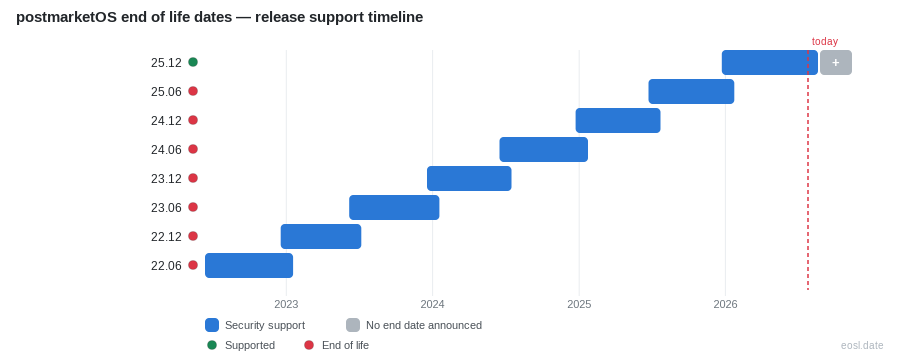
postmarketOS Releases Nearing End of Life - Support Ending Soon (1)
| Release | Released | Security Support |
|---|---|---|
| 26.06 | (5 months ago) | (in 2 months) |
postmarketOS End of Life (EOL) Releases - No Longer Supported (12)
| Release | Released | Security Support |
|---|---|---|
| 25.12 | (11 months ago) | (3 months ago) |
| 25.06 | (1 year and 5 months ago) | (10 months ago) |
| 24.12 | (1 year and 11 months ago) | (1 year and 4 months ago) |
| 24.06 | (2 years and 5 months ago) | (1 year and 10 months ago) |
| 23.12 | (2 years and 11 months ago) | (2 years and 4 months ago) |
| 23.06 | (3 years and 5 months ago) | (2 years and 10 months ago) |
| 22.12 | (3 years and 11 months ago) | (3 years and 4 months ago) |
| 22.06 | (4 years and 5 months ago) | (3 years and 10 months ago) |
| 21.12 | (4 years and 10 months ago) | (4 years and 4 months ago) |
| 21.06 | (5 years and 4 months ago) | (4 years and 9 months ago) |
| 21.03 | (5 years and 7 months ago) | (5 years and 3 months ago) |
| 20.05 | (6 years and 5 months ago) | (5 years and 6 months ago) |
postmarketOS End of Life is the point where a release stops receiving fixes, so you decide when your phone moves to a newer version. Here is when each pmos release ends and what to do about it. postmarketOS is an alternative phone operating system built on Alpine Linux for smartphones that others have abandoned.
postmarketOS End of Life: How the Release Cycle Ends Support
The project ships a new release every six months, following the release cycle of Alpine Linux. Each stable release gets security patches as necessary, from both Alpine and postmarketOS, and nothing more once it is retired. The rule is simple: an old release reaches EOL one month after the next release arrives. That gives you roughly a month to move once a new version is out. Check your current version any time with cat /etc/os-release.
Service packs and the release cadence
Between major versions, a service pack for the latest release ships fixes and feature updates. Service packs go only to the latest release, so once a release is superseded it stops getting them. The steady release cadence is what keeps this mobile operating system's maintainability manageable for a small team.
End-of-Life Dates and Security Support for Every pmos Release
This table lists recent versions and when security support ends, based on the endoflife.date tracker. The 26.06 date is still upcoming.
| Release | Released | Security support ends |
|---|---|---|
| 26.06 | 21 Jun 2026 | 31 Jan 2027 |
| 25.12 | 23 Dec 2025 | 31 Jul 2026 (ended) |
| 25.06 | 22 Jun 2025 | 23 Jan 2026 (ended) |
| 24.12 | 23 Dec 2024 | 23 Jul 2025 (ended) |
| 24.06 | 16 Jun 2024 | 23 Jan 2025 (ended) |
One more change affects every row. postmarketOS was renamed Nura in September 2026, and the tracker is discontinued: it no longer updates, so check Nura for current releases.
What Security Updates Cover Before a Release Ends
While a release is supported, security patches close known vulnerability reports in the base system. Once it ends, new flaws in firmware, the bootloader and userland stay open. Android handles this poorly: manufacturers patch a device for a limited time, and then you must buy a new one.
Alpine Linux release branches
Each release branch tracks Alpine, so fixes arrive from upstream with the shared packages. Only one small package per phone is unique; everything else is shared. When Alpine retires a branch, the matching release loses upstream fixes, which is why support ends on a fixed schedule.
Drivers, kernel and supported devices
Per-device drivers and the kernel decide how long a phone stays healthy. The long-term goal is the mainline Linux kernel, and the wiki lists over 200 supported devices, including phones and tablets. Wi-Fi works on many, but support varies by hardware, and an ended release stops getting driver fixes on every one of them.
Why Discontinued Smartphones Need a Longer Life-Cycle
A smartphone is capable hardware long after its maker walks away. The project was started in 2016 as a community-driven answer: a mobile Linux distribution that keeps a phone useful, which gives old hardware a new life. LineageOS is a practical option today, but Android-based builds trail behind Google, and Android vendors rarely patch old models, so an ended release leaves a phone unpatched.
- E-waste: the United Nations counted 53.6 million tonnes in 2019, so how long a release stays supported decides how long reuse helps sustainability.
- Privacy: an open source project lets users inspect what runs, but only while the release still gets patches.
- Maintenance: shared code means a device can be updated until it physically breaks, as long as you move to a supported release.
Keeping Your pmos Phone Usable After the Release Is Retired
When your release is about to retire, upgrade. Once its end-of-life date passes, you are running an unpatched distribution. Since version 22.06 the system supports in-place upgrades, so you do not have to reflash. Linux users can also build fresh images with the package manager based tool pmbootstrap.
Upgrade with pmbootstrap or in place
Take a backup, update the packages and move to the newest release. Reflash with pmbootstrap only if the upgrade fails.
Pick a phone interface
Your choice of phone interfaces, such as Phosh, Plasma Mobile or Sxmo, carries over when you upgrade to a supported release. Read the wiki page for your device before you move.