CentOS End of Life (EOL) Dates and End of Support (EOS) Dates
CentOS end of life (EOL) and end of support (EOS) dates: 4 CentOS versions have reached EOL, including CentOS 8 (EOL date: Dec 31, 2021) — no longer receiving security updates or patches. Also see AngularJS end of life dates for related end-of-life information.
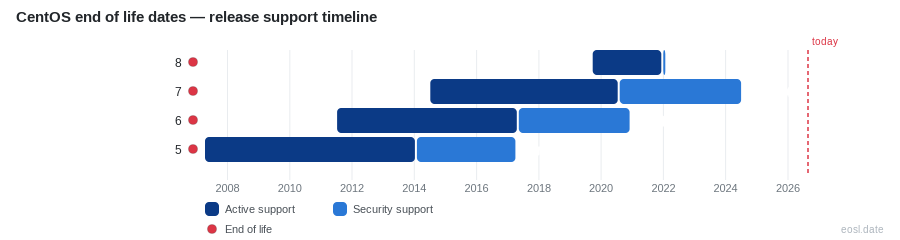
CentOS End of Life (EOL) Releases - No Longer Supported (4)
| Release | Released | Security Support | Active Support | Latest |
|---|---|---|---|---|
| 8 | (7 years and 2 months ago) | (4 years and 10 months ago) | (4 years and 10 months ago) | 8 (2111) (5 years ago) |
| 7 | (12 years and 4 months ago) | (2 years and 4 months ago) | (6 years and 3 months ago) | 7 (2009) (6 years ago) |
| 6 | (15 years and 4 months ago) | (5 years and 11 months ago) | (9 years and 6 months ago) | 6.10 (8 years and 4 months ago) |
| 5 | (19 years and 7 months ago) | (9 years and 7 months ago) | (12 years and 9 months ago) | 5.11 (12 years and 1 month ago) |
Wondering what CentOS end of life means for your servers? Every CentOS Linux release is now out of support, so the end of life for CentOS means no more security patches from the community. This guide lists each CentOS Linux EOL date, explains how CentOS Stream differs, and shows where a business running an enterprise Linux estate can go next.
CentOS EOL Dates for Every Release
The CentOS Project has shifted focus from CentOS Linux to CentOS Stream, and the table lists the final release date for each branch of the CentOS Linux and CentOS Stream platform.
| Release | End of life date |
|---|---|
| CentOS Linux 8 | December 31, 2021 |
| CentOS Linux 7 | June 30, 2024 |
| CentOS Stream 8 | May 31, 2024 |
| CentOS Stream 9 | May 31, 2027 |
CentOS Linux 7 End of Life
CentOS Linux 7 was the last supported version, so its retirement on June 30, 2024 means the whole distribution is discontinued. Retired content is removed from its mirrors and archived on vault.centos.org, a platform of frozen packages.
Version 8 Security Updates Ended in 2021
CentOS Linux 8 stopped early. The project shipped one last rebuild of the final RHEL point release with its zero-day updates, then published no further fixes, even for a critical bug scoring 9 or higher on VCSS.
CentOS Stream Lifecycle and Support Dates
CentOS Stream end of life follows Red Hat Enterprise Linux (RHEL): every version gets 10 years, with general availability for Stream 8 on May 7, 2019 and for Stream 9 on May 18, 2022. Maintenance for Stream 8 runs to May 31, 2029 and for Stream 9 to May 31, 2032, which matters for lifecycle planning.
Extended Life Cycle Support
Buyers can add three more years of extended life cycle support, as paid long-term support beyond the normal window.
Active Support vs Security Support
Each lifecycle splits five years of full support from five years of maintenance support, so active support is the first half and security support covers the second.
Upstream vs Downstream: Why the Discontinued Release Differs
CentOS Linux was a downstream rebuild of Red Hat Enterprise Linux (RHEL), valued as a stable, predictable, enterprise-class and community-supported open-source distribution with no commercial license fee, and a free open source alternative to Red Hat. CentOS Stream is upstream: it tracks just ahead of RHEL, so you preview what ships next.
Release Updates and Contribution
Linux rebuilds arrived in large batches with each minor release, while Stream pushes changes when ready. Anyone who wanted to contribute had to go through Fedora and wait years; Stream cuts that to weeks, and testing runs on a public suite.
Risks of Running an End-of-Life Linux Release
A CentOS server on an unsupported operating system keeps every new vulnerability, and the vulnerabilities behind CVEs published after retirement stay open, which invites cyberattacks and puts compliance at risk. One unpatched server can expose the rest. Software vendors also drop outdated platforms, so your environment, network and cloud infrastructure suffer compatibility problems.
CentOS Usage Statistics
Lansweeper found CentOS on 26.05% of the 200,000 Linux devices it scanned, second only to Ubuntu, with RHEL at 20.11%.
Migration Paths After CentOS End of Life
You can migrate to Red Hat Enterprise Linux 8 or 9 on a supported platform, or move to CentOS Stream if you want to collaborate on upcoming development. OpenLogic also sells commercial support after retirement. Each migration route needs a conversion plan and a test run before you cut over production.
Planning a Migration to RHEL
Because CentOS came from RHEL sources, Convert2RHEL and Red Hat Insights analyze your systems and perform the conversion, while Ansible scales it. Start with a free assessment.
Affordable Migration Options
- Third party Linux migration subscription: a conversion that keeps your configuration.
- Developer subscription for teams already using Red Hat.
Find Outdated CentOS Instances
Run a network report, such as Lansweeper's, to list every outdated host that still needs to move.