PostgreSQL End of Life (EOL) Dates and End of Support (EOS) Dates
PostgreSQL end of life (EOL) and end of support (EOS) dates: 28 PostgreSQL versions have reached EOL, including PostgreSQL 14 (EOL date: Nov 12, 2026) — no longer receiving security updates or patches. PostgreSQL 19.0 is the current supported release, with support through Nov 19, 2031 — 5 versions in active support. Also see CockroachDB end of support dates for related end-of-life information.
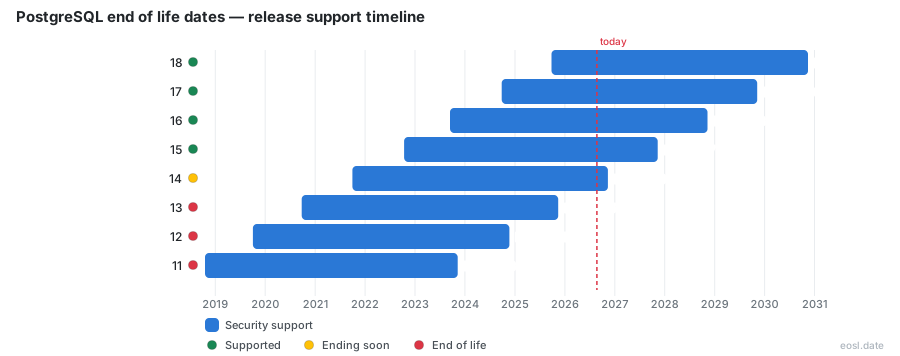
Currently Supported PostgreSQL Releases - Active EOS/EOSL Support (5)
| Release | Released | Support Status | Latest |
|---|---|---|---|
| 19 | (2 days ago) | (in 4 years and 11 months) | 19.0 (5 days ago) |
| 18 | (1 year and 1 month ago) | (in 3 years and 11 months) | 18.7 (1 week and 5 days ago) |
| 17 | (2 years and 1 month ago) | (in 2 years and 11 months) | 17.12 (1 week and 5 days ago) |
| 16 | (3 years and 2 months ago) | (in 1 year and 11 months) | 16.16 (1 week and 5 days ago) |
| 15 | (4 years and 1 month ago) | (in 11 months) | 15.20 (1 week and 5 days ago) |
PostgreSQL End of Life (EOL) Releases - No Longer Supported (28)
| Release | Released | Support Status | Latest |
|---|---|---|---|
| 14 | (5 years and 1 month ago) | (1 week and 2 days ago) | 14.25 (1 week and 5 days ago) |
| 13 | (6 years and 1 month ago) | (1 year ago) | 13.23 (1 year ago) |
| 12 | (7 years and 1 month ago) | (2 years ago) | 12.22 (2 years ago) |
| 11 | (8 years and 1 month ago) | (3 years ago) | 11.22 (3 years ago) |
| 10 | (9 years and 1 month ago) | (4 years ago) | 10.23 (4 years ago) |
| 9.6 | (10 years and 1 month ago) | (5 years ago) | 9.6.24 (5 years ago) |
| 9.5 | (10 years and 10 months ago) | (5 years and 9 months ago) | 9.5.25 (5 years and 9 months ago) |
| 9.4 | (11 years and 11 months ago) | (6 years and 9 months ago) | 9.4.26 (6 years and 9 months ago) |
| 9.3 | (13 years and 2 months ago) | (8 years ago) | 9.3.25 (8 years ago) |
| 9.2 | (14 years and 2 months ago) | (9 years ago) | 9.2.24 (9 years ago) |
| 9.1 | (15 years and 2 months ago) | (10 years ago) | 9.1.24 (10 years ago) |
| 9.0 | (16 years and 2 months ago) | (11 years and 1 month ago) | 9.0.23 (11 years and 1 month ago) |
| 8.4 | (17 years and 4 months ago) | (12 years and 3 months ago) | 8.4.22 (12 years and 4 months ago) |
| 8.3 | (18 years and 9 months ago) | (13 years and 9 months ago) | 8.3.23 (13 years and 9 months ago) |
| 8.2 | (19 years and 11 months ago) | (14 years and 11 months ago) | 8.2.23 (14 years and 11 months ago) |
| 8.1 | (21 years ago) | (16 years ago) | 8.1.23 (15 years and 11 months ago) |
| 8.0 | (21 years and 10 months ago) | (16 years and 1 month ago) | 8.0.26 (16 years and 1 month ago) |
| 7.4 | (23 years ago) | (16 years and 1 month ago) | 7.4.30 (16 years and 1 month ago) |
| 7.3 | (23 years and 11 months ago) | (18 years and 11 months ago) | 7.3.21 (18 years and 10 months ago) |
| 7.2 | (24 years and 9 months ago) | (19 years and 9 months ago) | 7.2.8 (21 years and 6 months ago) |
| 7.1 | (25 years and 7 months ago) | (20 years and 7 months ago) | 7.1.3 (25 years and 3 months ago) |
| 7.0 | (26 years and 6 months ago) | (21 years and 6 months ago) | 7.0.3 (26 years ago) |
| 6.5 | (27 years and 5 months ago) | (22 years and 5 months ago) | 6.5.3 (27 years ago) |
| 6.4 | (28 years ago) | (23 years ago) | 6.4.2 (27 years and 10 months ago) |
| 6.3 | (28 years and 8 months ago) | (23 years and 8 months ago) | 6.3.2 (28 years and 7 months ago) |
| 6.2 | (29 years and 1 month ago) | — | 6.2.1 (29 years and 1 month ago) |
| 6.1 | (29 years and 5 months ago) | — | 6.1.1 (29 years and 4 months ago) |
| 6.0 | (29 years and 9 months ago) | — | 6.0 (29 years and 9 months ago) |
PostgreSQL end of life arrives for version 14 on November 12, 2026, and every other major version follows the same five-year clock. Postgres is an open-source relational database, an object-relational RDBMS built around SQL and ACID guarantees, with performance and features that grew out of a University of California research project. From startups to enterprise shops, people run it in production for years, so you should know which release you run before an unsupported server puts your compliance at risk.
PostgreSQL Support Policy and the Five-Year Support Window
As open source software, PostgreSQL follows a fixed lifecycle. A new major version ships about once a year, and each gets a support window of five years from its first release. After that, one final minor release goes out, support ends, and the community stops issuing bug fixes. There is no LTS tier and no community support extension. The cadence is identical for every branch, and the release roadmap lists upcoming dates. A critical bug can ship out-of-band, ahead of schedule. Major upgrades are not backward compatible because the data directory format changes, so each jump needs a plan. Always run the current minor release of your branch.
Version Numbering and Each Major Version
Since PostgreSQL 10, a major version is the first number, so 14 becomes 15. Before 10, it used two numbers, such as 9.5 to 9.6. Read the versioning policy and the release notes of the major versions you skip, plus every one of their releases.
Minor Release Cadence and Security Patches
A minor release appears at least every three months and carries only security fixes, low-risk bug fixes and security patches. Installing a new minor version means stopping the server, swapping the binaries and restarting, with no dump and restore.
PostgreSQL End of Life Dates and the Release Date for Every Version
This reference table covers all supported versions and the recent releases that have already ended. Compare the first release date and the final release against your own timeline.
| Major version | First release | Final release | Support status | Amazon RDS Extended Support begins |
|---|---|---|---|---|
| 18 | September 25, 2025 | November 14, 2030 | Supported | March 1, 2031 |
| 17 | September 26, 2024 | November 8, 2029 | Supported | March 1, 2030 |
| 16 | September 14, 2023 | November 9, 2028 | Supported | March 1, 2029 |
| 15 | October 13, 2022 | November 11, 2027 | Supported | March 1, 2028 |
| 14 | September 30, 2021 | November 12, 2026 | Supported until final release | March 1, 2027 |
| 13 | September 24, 2020 | November 13, 2025 | Unsupported | March 1, 2026 |
| 12 | October 3, 2019 | November 21, 2024 | Unsupported | March 1, 2025 |
| 11 | October 18, 2018 | November 9, 2023 | Unsupported | April 1, 2024 |
Versions older than 11 ended years ago. The PostgreSQL end-of-life timeline is fixed far ahead, and once a branch reaches EOL, no updates ever arrive, so an EOL PostgreSQL install is frozen at its last patch level.
PostgreSQL 14 End of Life in November 2026
PostgreSQL 14 end of life lands on November 12, 2026, five years after its September 30, 2021 launch. Its last minor release ships around then, and the branch receives nothing afterward. Move to 15 or later now.
PostgreSQL 13 End of Life and PostgreSQL 12 End of Life
PostgreSQL 13 end of life passed on November 13, 2025, and PostgreSQL 12 end of life on November 21, 2024. Both have already ended, so any flaw found today stays open.
Unsupported Database Risks: Security Gaps and Compliance
When a PostgreSQL major version stops receiving fixes, three risks follow:
- Security exposure: every new vulnerability in the server, libpq and client tools stays unpatched, so open vulnerabilities pile up.
- Compatibility: managed providers and drivers stop testing against the old server and begin forced moves.
- Compliance: an audit scanner flags the EOL PostgreSQL server, and PCI DSS, HIPAA, SOC 2, FedRAMP and the Cyber Resilience Act expect maintained software.
Recent CVE Examples and Their CVSS Scores
Recent PostgreSQL disclosures, fixed in minor releases for 14 and earlier, show what an EOL version misses. One CVE rated 8.1 on the CVSS scale let SQL injection slip through libpq escaping and the psql terminal. Two 8.8 flaws hit pg_dump, pg_dumpall and pg_restore during restores. A 3.1 issue leaked optimizer statistics past row-level security, and a 5.9 encoding bug allowed a denial of service. Each required a minor update, a path an EOL branch no longer has.
Extended Support Options for an EOL Database Release
When a branch ends, you have three realistic paths:
- Upgrade to a supported major version, which is the right long-term answer for most teams.
- Pay for extended support from a managed provider. Amazon RDS, Google Cloud SQL and Azure Database for PostgreSQL bill a fee for old engines, and the pricing rises each year.
- Adopt never-ending support from a vendor: a drop-in replacement that ships patches after community support stops, backed by an SLA, with no migration.
Planning a PostgreSQL Upgrade Before EOL
A major upgrade is rarely trivial because the database is stateful and holds live production data. pg_upgrade converts the data directory in place, while logical replication keeps a new cluster in sync for a short cutover with little downtime. The classic dump/reload route is simplest but slowest. Whichever route you pick, work through this checklist:
- Confirm that extensions such as PostGIS and TimescaleDB support both the source and target versions.
- Run testing on a copy of production data to catch planner regression before the migration.
- Book a maintenance window and install the new binaries ahead of time.
- Pick a target that stays supported for years, such as 18 (final release November 2030), which also adds asynchronous I/O, skip scan, uuidv7() and virtual generated columns, and its upgrade tool keeps optimizer statistics.
Checking Your PostgreSQL Version Against the End-of-Life Calendar
Run this against each server to read which versions are running:
psql -c "SELECT version();"Next, inventory all installations across your network and IT environment, including bare servers, Docker images and Ubuntu packages on mixed operating systems. An audit that lists each version and flags anything out of date gives platform teams a clear queue. Treat PostgreSQL end of life as a fixed calendar item, with November 12, 2026 as the next deadline.