Oracle Linux End of Life (EOL) Dates and End of Support (EOS) Dates
Oracle Linux end of life (EOL) and end of support (EOS) dates: 2 Oracle Linux versions have reached EOL, including Oracle Linux 7 (EOL date: Dec 31, 2024) — no longer receiving security updates or patches. Oracle Linux 10.1 is the current supported release, with support through Jun 30, 2035 — 3 versions in active support. Also see Alpine Linux lifecycle dates for related end-of-life information.
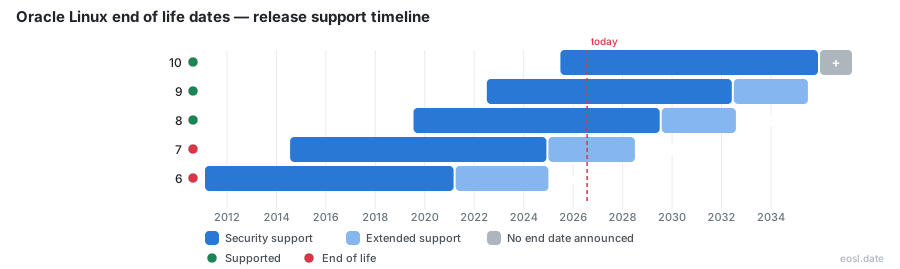
Currently Supported Oracle Linux Releases - Active EOS/EOSL Support (3)
| Release | Released | Basic/Premier Support | Extended Support | Latest |
|---|---|---|---|---|
| 10 | (1 year and 4 months ago) | (in 8 years and 7 months) | (in 11 years and 7 months) | 10.1 (11 months ago) |
| 9 | (4 years and 4 months ago) | (in 5 years and 7 months) | (in 8 years and 7 months) | 9.8 (4 months ago) |
| 8 | (7 years and 3 months ago) | (in 2 years and 8 months) | (in 5 years and 8 months) | 8.10 (2 years and 5 months ago) |
Oracle Linux End of Life (EOL) Releases - No Longer Supported (2)
Oracle Linux end of life arrives on a different date for every release, and the gap between Oracle Linux 6 and Oracle Linux 10 is more than a decade. This guide gives you each date, explains how Oracle's enterprise operating system support works, and shows what to do before your support runs out.
Oracle Linux End of Life Dates by Release
Every major release moves through Premier Support, Extended Support and then Sustaining Support, counted from general availability. The table below shows where each supported release stands in October 2026.
| Release | General availability | Premier Support ends | Extended Support ends |
|---|---|---|---|
| Oracle Linux 10 | June 2025 | June 2035 | June 2038 |
| Oracle Linux 9 | July 2022 | June 2032 | June 2035 |
| Oracle Linux 8 | July 2019 | July 2029 | July 2032 |
| Oracle Linux 7 | July 2014 | December 2024 | June 2028 |
| Oracle Linux 6 | February 2011 | March 2021 | December 2024 |
For most teams the supported release to plan around is version 8, with Premier Support through July 2029. Trackers disagree on one date: endoflife.date lists the Oracle Linux 7 Extended Support end as July 2029, while Oracle's own 2026 blog says June 2028. Confirm against Oracle's policy before you commit, because enterprise software and applications are usually certified against one specific release, and your vendor's cutoff may come first.
Oracle Linux Lifecycle and Its Support Tiers
The lifecycle is built on support tiers that decide which security patches, bug fixes, errata and security advisories reach you. Each tier narrows what you receive, so the tier you sit in sets how exposed your servers are.
Premier Support and Basic Support
Premier Support and Basic Support each run ten years from general availability. Premier adds live kernel patching through Ksplice, so certain security updates apply without a reboot.
Extended Support
Extended Support begins when Premier ends. It covers critical security errata and select high-impact fixes for listed packages only, still includes live kernel patching, and needs a paid agreement with Oracle.
Sustaining Support and Lifetime Support
Sustaining Support follows Extended Support and lasts indefinitely under Oracle's lifetime support promise. You keep existing fixes and alerts, but no new security fixes are written.
Oracle Linux 7 End of Support and the Extended Window
Oracle Linux 7 end of life is staged, not a single cutoff. Premier Support ended in December 2024, and Oracle says Extended Support continues through June 2028. Enable the Extended Support repository so your package manager and scanners see patched packages, then keep up the patching routine. Raise tickets through My Oracle Support.
Enterprise auditors flag unsupported systems quickly, and staying on Oracle Linux 7 beyond that window leaves vulnerabilities open and creates compliance gaps. Extended Support also depends on a contract with Oracle, so put it in next year's budget rather than discovering the cost at renewal.
Oracle Linux 6 End of Service Life and Sustaining Support
Oracle Linux 6 Extended Support ended in December 2024, so the release now sits in Sustaining Support. Oracle advises moving to Oracle Linux 8 or Oracle Linux 9. You still reach the Unbreakable Linux Network and the 24x7 Oracle Linux support specialists, but new flaws go unpatched, and every unpatched flaw raises your chance of a breach or downtime, a risk most enterprise teams will not accept.
Support Lifecycle Differences Between Oracle Linux and Upstream RHEL
Oracle Linux is a free, open source operating system that is binary compatible with RHEL, yet its updates work differently from the upstream distribution.
- Point releases: Oracle Linux keeps no old point release alive. Once a newer minor release such as 8.10 ships, the previous one is immediately unsupported, so you must update to keep receiving patches.
- Kernels: the default is the Unbreakable Enterprise Kernel (UEK). The Red Hat Compatible Kernel (RHCK) is the alternative.
- Hardware: Oracle Linux 8 runs on x86-64 and AArch64 servers, with updates served from the public yum server, and both follow the same support dates.
Check which version of the software you run with cat /etc/oracle-release, then match it to its end-of-support date in the table above.
Lifetime Support Policy for Kubernetes and OKE Users
Oracle's lifetime support policy matters most for containers. Kubernetes 1.35 standardizes on cgroup v2, which Oracle Linux 7 cannot offer, so OKE requires Oracle Linux 8 images or higher from that release on. Nodes have no in-place OS upgrade: add Oracle Linux 8 node pools, drain the old ones, then remove them.
On Oracle Cloud Infrastructure, every cloud image follows the same end-of-support dates as the table above, so tie the migration to that deadline and rebuild images on a schedule so scanners and signatures show current patches. Teams running on OCI or any private cloud, and on Oracle Cloud Infrastructure generally, should migrate workloads in small batches before the cloud platform blocks the upgrade.
Upgrade and Migration Planning for Oracle OS Lifecycle Changes
Planning for Oracle OS end of life works best as a short, dated checklist for your IT teams:
- Inventory every Oracle Linux host, image and node pool by release and its end-of-support date.
- Choose Oracle Linux 8 or 9 as the upgrade target for each application and its data, so you stay inside Premier Support.
- Test the move to a supported release of your software stack on one server first, with its monitoring.
- Pilot one service, then migrate in waves before Extended Support ends, keeping security updates flowing.
- Book Oracle Linux Consulting if the migration is too large to run alone.
Start well before your release's end-of-support date, because rushed moves cause most outages.