OpenJDK builds from Oracle End of Life (EOL) Dates and End of Support (EOS) Dates
OpenJDK builds from Oracle end of life (EOL) and end of support (EOS) dates: 18 OpenJDK builds from Oracle versions have reached EOL, including OpenJDK builds from Oracle 26 (EOL date: Sep 15, 2026) — no longer receiving security updates or patches. OpenJDK builds from Oracle 27 is the current supported release, with support through Mar 23, 2027. Also see GraalVM Community Edition EOSL dates for related end-of-life information.
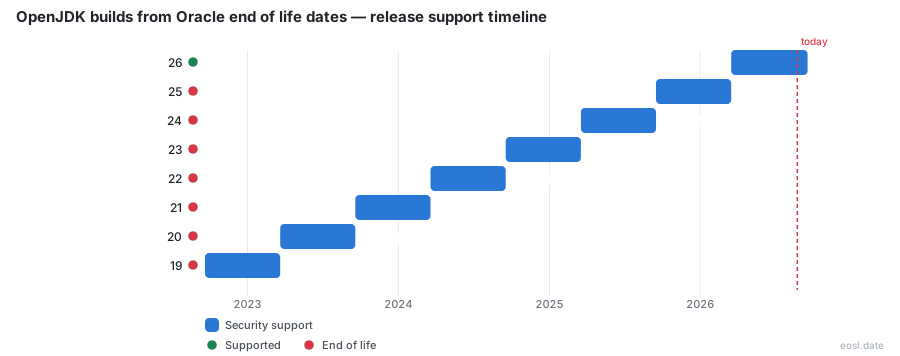
Currently Supported OpenJDK builds from Oracle Releases - Active EOS/EOSL Support (1)
| Release | Released | Security Support | Latest |
|---|---|---|---|
| 27 | (2 months ago) | (in 4 months) | 27 (2 months ago) |
OpenJDK builds from Oracle End of Life (EOL) Releases - No Longer Supported (18)
| Release | Released | Security Support | Latest |
|---|---|---|---|
| 26 | (8 months ago) | (2 months ago) | 26 (8 months ago) |
| 25 | (1 year and 2 months ago) | (8 months ago) | 25 (1 year and 2 months ago) |
| 24 | (1 year and 7 months ago) | (1 year and 2 months ago) | 24 (1 year and 7 months ago) |
| 23 | (2 years and 2 months ago) | (1 year and 7 months ago) | 23.0.2 (1 year and 9 months ago) |
| 22 | (2 years and 7 months ago) | (2 years and 2 months ago) | 22.0.2 (2 years and 4 months ago) |
| 21 | (3 years and 1 month ago) | (2 years and 7 months ago) | 21.0.2 (2 years and 10 months ago) |
| 20 | (3 years and 7 months ago) | (3 years and 1 month ago) | 20.0.2 (3 years and 3 months ago) |
| 19 | (4 years and 1 month ago) | (3 years and 7 months ago) | 19.0.2 (3 years and 10 months ago) |
| 18 | (4 years and 7 months ago) | (4 years and 1 month ago) | 18.0.2.1 (4 years and 2 months ago) |
| 17 | (5 years and 2 months ago) | (4 years and 7 months ago) | 17.0.2 (4 years and 9 months ago) |
| 16 | (5 years and 8 months ago) | (5 years and 2 months ago) | 16.0.2 (5 years and 3 months ago) |
| 15 | (6 years and 2 months ago) | (5 years and 8 months ago) | 15.0.2 (5 years and 9 months ago) |
| 14 | (6 years and 8 months ago) | (6 years and 2 months ago) | 14.0.2 (6 years and 4 months ago) |
| 13 | (7 years and 2 months ago) | (6 years and 8 months ago) | 13.0.2 (6 years and 10 months ago) |
| 12 | (7 years and 7 months ago) | (7 years and 2 months ago) | 12.0.2 (7 years and 4 months ago) |
| 11 | (8 years and 1 month ago) | (7 years and 7 months ago) | 11.0.2 (7 years and 10 months ago) |
| 10 | (8 years and 7 months ago) | (8 years and 1 month ago) | 10.0.2 (8 years and 4 months ago) |
| 9 | (9 years and 1 month ago) | (8 years and 7 months ago) | 9.0.4 (8 years and 10 months ago) |
Running Java in production means knowing exactly when your runtime stops getting fixes, and OpenJDK builds from Oracle end of life follows a different clock than the commercial Oracle JDK. This guide lays out the dates, the license rules and the options for every Oracle OpenJDK release you might still be running, so you can plan an upgrade before security updates stop.
OpenJDK Builds from Oracle End of Life Dates by Release
OpenJDK is the open-source reference for the Java platform, and Oracle, which leads the OpenJDK project, publishes its own binaries of it. Each Oracle OpenJDK build belongs to a Java SE feature release, and each release is either a long-term support version or a short-lived one. The date that matters is the point where Oracle stops shipping security fixes for the release you run. Check yours with java -version, then compare the release number against the table below. A supported release is one that still sits inside its window.
| Release | General availability | Premier Support until | Extended Support until |
|---|---|---|---|
| Java 8 (LTS) | March 2014 | March 2022 | December 2030 |
| JDK 11 (LTS) | September 2018 | September 2023 | January 2032 |
| JDK 17 (LTS) | September 2021 | September 2026 | September 2029 |
| JDK 21 (LTS) | September 2023 | September 2028 | September 2031 |
| JDK 25 (LTS) | September 2025 | September 2030 | September 2033 |
Oracle JDK end-of-life schedule for each LTS release
The table shows the commercial window for Oracle JDK. Premier Support for JDK 17 has already ended in September 2026, so a team on that release is now relying on Extended Support. JDK 11 is further along: Premier Support lapsed in 2023 and only the extended window remains. A non-LTS release such as 26 or 27 gets about six months. Once a newer feature release arrives, the older non-LTS one is superseded, and a release with a non-LTS label never gets an extended window. That makes any non-LTS build a poor fit for long-lived servers. A Java service that must run for years belongs on an LTS OpenJDK build, and a short-lived OpenJDK build suits only experiments. The end-of-life date for these builds is simply the day the next release ships.
Long-term support and the six-month release cadence
Java SE moved to a rapid-release cycle after version 10, so a feature release lands every March and September. This release cadence makes plain long-term support the safe default: Oracle designates Java 8, 11, 17, 21 and 25 as LTS, and plans a new LTS every two years, with Java 29 due in September 2027. Between LTS versions, the intermediate update releases carry feature work you may not want in a stable service. Pick one LTS and stay on it. In practice a Java team should record the OpenJDK version, vendor and update date of every Java service in an inventory, since an OpenJDK runtime nobody tracks is the one that quietly misses a patch.
Oracle JDK Licensing and Free Use Rules
People mix up three things: the OpenJDK source, the OpenJDK builds from Oracle, and the Oracle JDK itself. The source is licensed under the GNU General Public License with a linking exception, so programs linked to the class library are not pulled under the GPL. Since September 2017 Oracle has published Oracle OpenJDK releases under a free open source license, and community availability of those builds is listed separately on jdk.java.net. The Oracle JDK is a commercial, closed-source certified build of the same code. The OpenJDK source is open-source, while the Oracle JDK binary may or may not be free of charge depending on the release.
- JDK 25 and later: free for all users under the Oracle No-Fee Terms and Conditions license, with later updates planned under the Java SE OTN license after September 2028.
- Java 8, 11, 17 and 21: available under the Oracle Technology Network License Agreement, which is free for personal use and for development and testing, but not for production.
- Oracle customers: those holding a Java SE subscription or related support contract get commercial updates.
Java SE 8, 17 and 21 permissive license changes
Each older Java SE release left the permissive license on its own date. Java SE 8 left in April 2019, while public updates for 17 ran through September 2024 and for 21 through September 2025. After that, updates of the Oracle JDK build use the OTN terms, the same ones that cover Java 8 and 11. Free updates for personal desktops continue via java.com, but anyone wanting a permissive JDK build should move to JDK 25 or later. Whichever platform you run on, whether Windows, macOS or Linux, the same license logic applies, and the plain license text decides what you can do in production.
Support Roadmap: Premier Support, Extended Support and Sustaining Support
Oracle's support roadmap follows the Oracle Lifetime Support Policy, which defines three levels. They apply only to Oracle customers with a paid agreement, not to free users.
- Premier Support includes minor improvements, bug fixes and security updates for at least five years from general availability.
- Extended Support (LTS releases only) adds three more years of patches after Premier Support ends.
- Sustaining Support offers assistance for an indefinite period, but no new security fixes.
Fixes arrive in quarterly maintenance drops, built around the critical patch update in January, April, July and October. Entitlement matters here: your subscription decides which updates you can download, and an expired contract means the patches stop even if the calendar says the release is still alive. For an Oracle OpenJDK build, the practical reading is simple: once Premier Support and then Extended Support close, no further fixes arrive for that release. Treat the roadmap as a contract term and not as a promise to everyone who runs the code.
OpenJDK Life Cycle and Support Policy on RHEL and Windows
Many teams skip Oracle and take OpenJDK from a Linux vendor, so the Red Hat life cycle is worth reading next to Oracle's. Red Hat builds OpenJDK for RHEL and Microsoft Windows, ships it in containers, and delivers four updates a year for 8, 11, 17, 21 and 25, much as Oracle does for Java SE. Its support policy adds a twist: an OpenJDK release can fall out of support early if the underlying RHEL platform reaches retirement first. The Java SE runtime that ships on Linux therefore follows the operating system's calendar as much as the language's own.
Entitlements work differently too. An OpenJDK entitlement for Java workloads comes with a RHEL subscription, while Windows servers need an additional subscription unless the runtime is used with Red Hat middleware. On Windows, Red Hat lists OpenJDK 8, 11, 17 and 21 for Windows Server 2016 through 2025 plus Windows 10 and 11, and Windows Server 2012 R2 had its own retirement in October 2023. On RHEL, OpenJDK 25 needs RHEL 9.7 or 10.1 and later, and the system JDK on RHEL 9 is moving from 11 to 17 to reduce the risk of an outdated runtime. Check both the Windows and RHEL rows before you commit, because the end date of a Java SE release depends on the platform you run it on.
| Red Hat build | End of full support | End of ELS-1 |
|---|---|---|
| OpenJDK 8 | November 30, 2026 | December 31, 2032 |
| OpenJDK 11 | October 31, 2024 | January 31, 2032 |
| OpenJDK 17 | December 31, 2027 | January 31, 2029 |
| OpenJDK 21 | December 31, 2029 | September 30, 2031 |
| OpenJDK 25 | December 31, 2030 | September 30, 2033 |
Eclipse Temurin support from Red Hat
Eclipse Temurin is an OpenJDK distribution from Eclipse Adoptium, distributed as binaries and installers, and as official container images on Docker Hub. Red Hat also supports Eclipse Temurin on Linux, Windows and macOS for customers with the right entitlements, and Red Hat publishes a separate Eclipse Temurin life cycle and support table for each of the three operating systems. Another vendor, Azul, offers its own Zulu builds and has committers on staff, while Microsoft, IBM, Amazon, SAP and Apple also contribute to OpenJDK. That broad community is why a build from Red Hat, Azul or Adoptium can stay supported after an Oracle build is retired. Each vendor publishes its own table, so check that the Eclipse Temurin dates for your macOS, Linux or Windows hosts match your plan, and read how Red Hat describes the differences from the Oracle JVM before you switch.
Extended life cycle support (ELS) for older releases
Extended life cycle support is an optional, paid phase that keeps an older release patched. The ELS add-on for OpenJDK 11 runs to January 2032, long after full support ended in 2024, and it needs a separate subscription. Teams that cannot yet migrate can buy time this way, but the cheaper long-term path is to upgrade to a newer LTS and retire the old runtime.
Oracle OpenJDK Releases and Your Support Lifecycle Options
When a build runs out of road, you have four realistic choices, and the right one depends on your budget and risk tolerance. Compare the oracle openjdk releases you run with these paths:
- Upgrade the JDK: move to the newest LTS from Oracle, such as JDK 25, which is free for all users.
- Switch distributor: pick another vendor build with a longer window. The site
whichjdk.comgives recommendations on which JDK to use. - Buy a subscription: a Java SE subscription keeps patches flowing on the build you have.
- Pay for ELS: useful only as a bridge while you finish the move.
Consider a concrete case. A Java service on OpenJDK 17 from Oracle can stay on the Oracle JDK until Extended Support ends in 2029, move to Java 21 or 25 on the same vendor, or switch to OpenJDK 17 from Red Hat, whose full support runs to the end of 2027 and whose ELS-1 phase lasts into 2029. A Java application that is already on OpenJDK 21 has more time again, since Red Hat lists December 2029 for it. Java teams on OpenJDK 8 should note that Red Hat's full support for it ends in November 2026, so the OpenJDK 8 runtime needs a plan now rather than next year.
The support lifecycle you choose should match how fast you can test, so run your Java test suite on the next Java LTS well before the old build reaches end-of-life. Libraries compiled to older bytecode still run on a newer virtual machine, but the reverse fails, which is why Red Hat's own RHEL 9 notes warn that Java 8 apps cannot rely on components compiled for 11. The JRE is no longer a separate download for newer releases, so Oracle's guidance is to repackage each Java application with their own custom runtime. The source code of every OpenJDK build is public, so you can always verify what you are running.
Java SE Reference Implementation and TCK Compliance
OpenJDK is the official reference implementation of Java SE, and the Oracle-led community project produces the code that most vendors repackage. A build only counts as compatible once it passes the TCK, the Technology Compatibility Kit. The TCK is a test suite that checks a JDK against the Java platform specification, and Red Hat runs it on its builds. That certification is why vendor binaries are interchangeable for most workloads, and why a certified build is a safer choice than an untested community fork. The OpenJDK community, Red Hat and Oracle all run the same compatibility tests, so a Java application that passes on one OpenJDK build should behave the same on another. Java behaviour still differs in packaging, installers and bundled tools, and Red Hat documents those differences for its OpenJDK distribution. Together, the dates, licenses and certification determine when your OpenJDK build reaches the end of its useful life.