nix End of Life (EOL) Dates and End of Support (EOS) Dates
nix end of life (EOL) and end of support (EOS) dates: 36 nix versions have reached EOL, including nix 2.34 (EOL date: Jul 13, 2026) — no longer receiving security updates or patches. nix 2.35.6 is the current supported release. Also see Blender lifecycle dates for related end-of-life information.
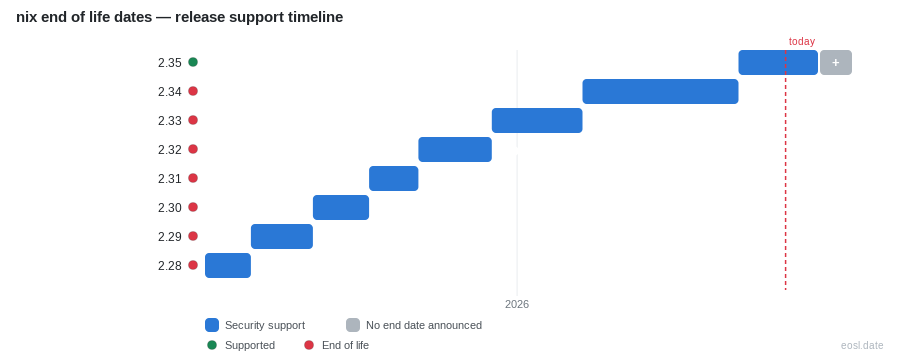
Currently Supported nix Releases - Active EOS/EOSL Support (1)
| Release | Released | Security Support | Latest |
|---|---|---|---|
| 2.35 | (4 months ago) | Active | 2.35.6 (1 week and 5 days ago) |
nix End of Life (EOL) Releases - No Longer Supported (36)
| Release | Released | Security Support | Latest |
|---|---|---|---|
| 2.34 | (8 months ago) | (4 months ago) | 2.34.9 (1 month and 1 week ago) |
| 2.33 | (11 months ago) | (8 months ago) | 2.33.6 (6 months ago) |
| 2.32 | (1 year and 1 month ago) | (11 months ago) | 2.32.8 (6 months ago) |
| 2.31 | (1 year and 2 months ago) | (1 year and 1 month ago) | 2.31.6 (1 month and 1 week ago) |
| 2.30 | (1 year and 4 months ago) | (1 year and 2 months ago) | 2.30.6 (1 month and 1 week ago) |
| 2.29 | (1 year and 6 months ago) | (1 year and 4 months ago) | 2.29.4 (6 months ago) |
| 2.28 | (1 year and 7 months ago) | (1 year and 6 months ago) | 2.28.8 (1 month and 1 week ago) |
| 2.27 | (1 year and 8 months ago) | (1 year and 7 months ago) | 2.27.1 (1 year and 7 months ago) |
| 2.26 | (1 year and 10 months ago) | (1 year and 8 months ago) | 2.26.4 (1 year and 4 months ago) |
| 2.25 | (2 years ago) | (1 year and 10 months ago) | 2.25.5 (1 year and 10 months ago) |
| 2.24 | (2 years and 3 months ago) | (1 year and 10 months ago) | 2.24.15 (1 year and 4 months ago) |
| 2.23 | (2 years and 5 months ago) | (2 years ago) | 2.23.4 (2 years ago) |
| 2.22 | (2 years and 6 months ago) | (2 years ago) | 2.22.4 (2 years ago) |
| 2.21 | (2 years and 8 months ago) | (2 years ago) | 2.21.5 (2 years ago) |
| 2.20 | (2 years and 9 months ago) | (2 years ago) | 2.20.9 (2 years ago) |
| 2.19 | (3 years ago) | (2 years ago) | 2.19.7 (2 years ago) |
| 2.18 | (3 years and 2 months ago) | (2 years ago) | 2.18.9 (2 years ago) |
| 2.17 | (3 years and 3 months ago) | (2 years and 8 months ago) | 2.17.2 (2 years and 8 months ago) |
| 2.16 | (3 years and 5 months ago) | (2 years and 8 months ago) | 2.16.3 (2 years and 8 months ago) |
| 2.15 | (3 years and 7 months ago) | (3 years and 1 month ago) | 2.15.3 (3 years and 1 month ago) |
| 2.14 | (3 years and 8 months ago) | (3 years and 8 months ago) | 2.14.1 (3 years and 8 months ago) |
| 2.13 | (3 years and 10 months ago) | (3 years and 1 month ago) | 2.13.6 (3 years and 1 month ago) |
| 2.12 | (3 years and 11 months ago) | (3 years and 8 months ago) | 2.12.1 (3 years and 8 months ago) |
| 2.11 | (4 years and 2 months ago) | (4 years and 2 months ago) | 2.11.1 (4 years and 2 months ago) |
| 2.10 | (4 years and 4 months ago) | (4 years and 4 months ago) | 2.10.3 (4 years and 4 months ago) |
| 2.9 | (4 years and 5 months ago) | (4 years and 4 months ago) | 2.9.2 (4 years and 4 months ago) |
| 2.8 | (4 years and 7 months ago) | (4 years and 5 months ago) | 2.8.1 (4 years and 6 months ago) |
| 2.7 | (4 years and 8 months ago) | (4 years and 7 months ago) | 2.7.0 (4 years and 8 months ago) |
| 2.6 | (4 years and 9 months ago) | (4 years and 8 months ago) | 2.6.1 (4 years and 9 months ago) |
| 2.5 | (4 years and 11 months ago) | (4 years and 9 months ago) | 2.5.1 (4 years and 11 months ago) |
| 2.4 | (5 years ago) | (4 years and 11 months ago) | 2.4 (5 years ago) |
| 2.3 | (7 years and 2 months ago) | (5 years ago) | 2.3.18 (2 years and 8 months ago) |
| 2.2 | (7 years and 10 months ago) | (7 years and 2 months ago) | 2.2.2 (7 years and 7 months ago) |
| 2.1 | (8 years and 2 months ago) | (7 years and 10 months ago) | 2.1.3 (8 years and 1 month ago) |
| 2.0 | (8 years and 9 months ago) | (8 years and 2 months ago) | 2.0.4 (8 years and 5 months ago) |
| 1 | (14 years and 6 months ago) | (8 years and 9 months ago) | 1.11.16 (8 years and 11 months ago) |
Wondering about nix end of life and whether your install is still safe to run? This guide covers when each release of the cross-platform package manager and its Linux distribution stops getting security fixes, how to check your own version, and what to do before software support disappears. Dates below reflect the lifecycle data published in late October 2026, so confirm them against the official Nix website before you plan an upgrade.
Nix End of Life: How Support Ends for Each Release
Nix installs every package into its own directory named after one of the cryptographic hashes computed from its dependencies, which is the functional deployment model (change one input and the hash changes, so the old packages stay untouched) that makes builds portable and reproducible. Each numbered version has the same short life: it receives updates until its successor ships and then retires. Treat the latest release as the only line you can count on, and read any nix end of life date as the day fixes stop arriving for that release number.
Which Nix Versions Still Get Security Fixes
Only the newest series is fully supported, while the one before it is usually retired within weeks of a new minor version. As of the data above, 2.35 is current and every older series has ended.
| Release | Released | Security support | Latest patch |
|---|---|---|---|
| 2.35 | 13 Jul 2026 | Active | 2.35.4 (23 Oct 2026) |
| 2.34 | 27 Feb 2026 | Ended 13 Jul 2026 | 2.34.9 (13 Oct 2026) |
| 2.33 | 10 Dec 2025 | Ended 27 Feb 2026 | 2.33.6 (4 May 2026) |
| 2.32 | 7 Oct 2025 | Ended 10 Dec 2025 | 2.32.8 (4 May 2026) |
A series can still publish a patch after its window closes, as 2.31 and 2.30 did in October 2026, but treat that as a courtesy rather than a promise of continued updates. For every upgrade you plan, an unsupported series is the one to leave first.
Checking Your Release With nix --version
Before comparing anything, find out what your system actually runs. Open a terminal and use this command:
nix --versionIt prints the version, such as nix (Nix) 2.34.9. Match the first two numbers against the table, and if your series has ended, plan the move. The same check works on your server and your laptop, so run it wherever the package manager is installed, because the configuration on each machine may have drifted.
Tracking EOL Dates With JSON, RSS Feed and iCalendar
You do not need to reread release pages. The endoflife.date project exposes each product through a JSON API, an RSS feed and an iCalendar file, so you can drop a retirement reminder straight into your calendar. A subscribed feed tells you when a new series lands and, by implication, when the previous one starts counting down.
Supported Release Windows for the NixOS Linux Distribution
NixOS is the Linux distribution built on top of Nix, and it follows a fixed twice-a-year rhythm instead of the rolling patch pace above. Each supported release receives security fixes for about seven months, then moves to the old release pile.
| NixOS release | Released | Support ends |
|---|---|---|
| 26.05 'Yarara' | 30 May 2026 | 31 Dec 2026 |
| 25.11 'Xantusia' | 30 Nov 2025 | 30 Jun 2026 (ended) |
| 25.05 'Warbler' | 23 May 2025 | 31 Dec 2025 (ended) |
| 24.11 'Vicuña' | 30 Nov 2024 | 30 Jun 2025 (ended) |
At the time of the data, 26.05 is the oldest supported release still receiving fixes, which makes it the only line a production server or desktop should run.
Stable Release and Unstable Release Channels
Two kinds of channels exist. A stable release such as 26.05 changes slowly and takes only fixes, while the unstable release channel is always supported and receives updates most often. Both are built from nixpkgs, the shared package collection, so a rolling-style system can follow unstable while an appliance stays pinned to a numbered channel, and each host system picks its own channel.
Release Branch Timing for a New Release
Every new release gets its own release branch cut from nixpkgs, and the previous branch is not retired immediately. An old release stays supported for one month after its successor appears, which gives you a short grace period to switch, not a long one.
Unmaintained Channels and the EOL Cleanup Process
Once a branch is past that month, maintainers mark its channels unmaintained, and nothing is backported to it afterwards. The release wiki documents the steps in a page titled EOL cleanup, which is worth knowing even if you never touch the infrastructure, because it shows what “gone” means in practice.
What the EOL Cleanup Involves
The checklist is mostly housekeeping around the repository:
- Switch the channel status from deprecated to unmaintained, then update
search.nixos.orgto reflect it. - Close pull requests that still target the retired release branch and staging branches.
- Remove the old release from periodic merge jobs, issue templates and the auto-labeler workflow.
- Update branch protection rules and drop the branches from the merge queue rulesets.
- Raise
oldestSupportedReleasein the library to match the oldest supported release.
Backport Labels and Old Release Pruning
Contributors normally tag a fix so it can be backported to the stable branch. After cleanup, the maintainers prune those backport labels for the old release, so a fix for a retired line will simply not be applied there, and you are expected to move up instead.
Upgrading the Package Manager Before Security Support Stops
The cheapest fix is to move before security support ends. Because Nix keeps every generation of your system and its packages, trying a newer release does not destroy what you have, and the broader Nix tooling lets you test without committing. Plan the move for a quiet day, since a security patch you skip stays unpatched across all the packages you use, and the wider community cannot help you once a channel is retired.
Major Version Upgrades
With flakes, major version upgrades are mostly a one-line change: point the input URL at the next channel, then rebuild. Expect a few renamed options that the build output tells you about. To test something first, use nix run for a one-off program, or nix-shell to open one of the ephemeral shells that vanish when you leave, so you can try a newer tool without touching your profile.
Rollbacks and Build Errors
If a rebuild fails, the build error usually names the option or package at fault, and the previous generation is still selectable at boot, which is why rollbacks are the feature people praise most. Users who manage dotfiles with home-manager can roll those back the same way. That safety net is what makes moving off a retiring release low risk: if the new series misbehaves, you step back one generation and keep running while you investigate. Experienced users still report that upgrade day is where the learning curve bites.
Deprecated Releases: Is Staying on Nix Still Worth It?
Even a deprecated release keeps working, but you gain no new security patches. For some people that is the moment to ask whether the whole approach suits them. A widely read 2025 account of two years on the desktop concluded the community, language and documentation all still demand effort, while the declarative model remained its best feature.
Declarative Configuration and Reproducible Builds
The reason people stay is declarative configuration: a single file describes the machine, so a rebuild is reproducible. Some features, like flakes, still ship behind the experimental features switch, for example nix --extra-experimental-features "nix-command flakes", which is another reason to read the release notes before you move.
Desktop Integration With Gnome, KDE and Flatpak
The desktop is where friction shows most. Gnome and KDE work, but extensions, theming and sandboxed apps often need extra configuration. Many users install Flatpak for large proprietary apps instead of packages from nixpkgs, which keeps the base system clean at the cost of a second packaging world.
Docker, Dependency Hell and Development Shells
Nix was designed to end dependency hell, and for development shells it largely does. Teams that used Docker for reproducibility often find a flake gives a deterministic result without the image weight, though Docker remains handy for deployment. Each team still has to decide whether a deprecated Nix setup is worth keeping once its window has closed.