Guzzle End of Life (EOL) Dates and End of Support (EOS) Dates
Guzzle end of life (EOL) and end of support (EOS) dates: 4 Guzzle versions have reached EOL, including Guzzle 6 (EOL date: Oct 31, 2023) — no longer receiving security updates or patches. Guzzle 8.5.4 is the current supported release — 2 versions in active support. Also see Akeneo PIM EOSL information for related end-of-life information.
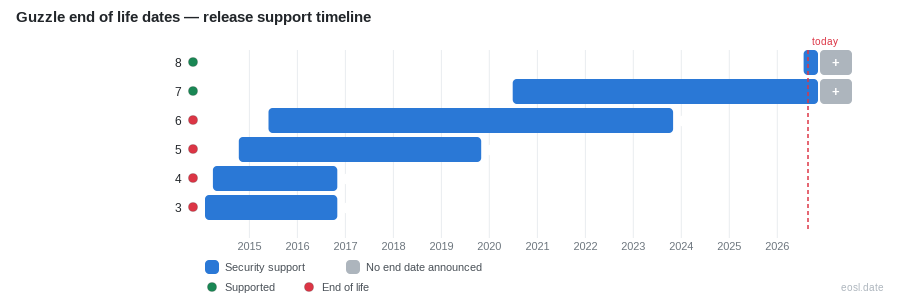
Currently Supported Guzzle Releases - Active EOS/EOSL Support (2)
| Release | Supported Phpversions | Released | Security Support | Latest |
|---|---|---|---|---|
| 8 | >=7.4,<8.6 | (4 months ago) | Active | 8.5.4 (2 days ago) |
| 7 | >=7.2.5, <8.6 | (6 years and 4 months ago) | Active | 7.16.5 (2 days ago) |
Guzzle End of Life (EOL) Releases - No Longer Supported (4)
| Release | Supported Phpversions | Released | Security Support | Latest |
|---|---|---|---|---|
| 6 | >=5.5, <8.0 | (11 years and 5 months ago) | (3 years ago) | 6.5.8 (4 years and 5 months ago) |
| 5 | >=5.4, <7.4 | (12 years and 1 month ago) | (7 years ago) | 5.3.4 (7 years ago) |
| 4 | >=5.4, <7.0 | (12 years and 7 months ago) | (10 years ago) | 4.2.4 (10 years and 4 months ago) |
| 3 | >=5.3.3, <7.0 | (14 years and 1 month ago) | (10 years ago) | 3.8.1 (12 years and 9 months ago) |
If you run PHP code that talks to other servers, Guzzle end of life dates decide when your HTTP client stops getting security fixes. Only the 7.x and 8.x lines are supported today, and every older major release has ended, so check your composer.lock and plan the upgrade before a new advisory lands.
Guzzle End of Life Status at a Glance
The project follows one simple rule: after each new major release, the previous version keeps getting fixes for no less than two years. Here is where every release stands, based on the dates listed by endoflife.date.
| Release | PHP versions | Released | Security support | Latest |
|---|---|---|---|---|
| 8 | 7.4 up to 8.5 | 20 Jul 2026 | Yes | 8.3.1 |
| 7 | 7.2.5 up to 8.5 | 27 Jun 2020 | Yes | 7.16.1 |
| 6 | 5.5 up to 7.4 | 26 May 2015 | Ended 31 Oct 2023 | 6.5.8 |
| 5 | 5.4 up to 7.3 | 12 Oct 2014 | Ended 31 Oct 2019 | 5.3.4 |
| 4 | 5.4 up to 6.x | 29 Mar 2014 | Ended 31 Oct 2016 | 4.2.4 |
| 3 | 5.3.3 up to 6.x | 15 Oct 2012 | Ended 31 Oct 2016 | 3.8.1 |
In short, if your project still resolves to anything below 7, it is a stable but unsupported library, and nobody will patch it.
Supported Versions of the PHP HTTP Client
Guzzle has two supported lines right now: the active 8 line and the 7.x line, which still gets fixes. Everything below 7 has ended. The Packagist page for this package shows the same split and tags the 8.3 line as the latest, so your runtime decides which of the two you can use.
Minimum PHP version for each release
Version 8 needs at least PHP 7.4, while the 7.x line works from 7.2.5. Anything older, including PHP 5, can only run the ended 6, 5, 4 and 3 lines, and those cannot run on current PHP 8 builds at all, which is another reason to move.
Guzzle 8 and the Latest Major Release
Guzzle 8 arrived on 20 July 2026 as a significant major release. It adds persistent connections that live across PHP-FPM requests, HTTP/3 support and an improved exception hierarchy (HTTP/2 through cURL was discussed in the 2023 roadmap thread), which matters if your code catches errors by class. Its release also starts the two-year clock for the 7 line.
PSR-7 and promises requirements
The release raises its floor on its dependencies: the guzzlehttp/psr7 package must be at ^3.2 and guzzlehttp/promises at ^3.1 in the current build. It still provides a PSR-18 client and needs psr/http-client ^1.0. Check each dependency in Composer, because another vendor library pinned to psr7 2.x will block the install. The ext-curl extension remains recommended for the cURL handler.
Guzzle 7 Security Support and Release Notes
Guzzle 7 shipped on 27 June 2020, and the maintainers say the previous major receives fixes for at least two years after the next one appears. Counting from 8.0, that puts the 7 line under security cover until at least July 2028, roughly 630 days from today. That date is our own reading of the policy, not a published schedule, so watch the project page for an official one.
Release notes from the 7.0 launch
The 7.0 changelog removed PHP 5, which is why PHP 5 apps cannot stay supported, and the project estimated that most users could upgrade without changes, as Laravel News reported. The old deprecated code paths and their deprecations were left in place, and every HTTP client call kept its familiar shape.
Guzzle 6 EOL on 31 October 2023
Version 6 lived the longest of any line, about 8.4 years from release to its final date, and stayed covered for roughly 40 months after 7.0 appeared. Its last tag, 6.5.8, dates from June 2022, so apps still on it carry every issue found since. The sooner you upgrade, the fewer jumps you make.
Guzzle 5 and Earlier Releases
Guzzle 5 ended on 31 October 2019 after about five years. Versions 4 and 3 ended together on 31 October 2016, after 2.6 and 4.0 years respectively. These lines predate the breaking changes that PSR support required, so skipping straight to a supported line means touching every call site. Treat them as a rewrite rather than a bump, and note that no maintenance will ever return.
Guzzle Long-Term Support and the Two-Year Rule
There is no formal LTS label. What you get instead is the two-year promise, which the maintainers have used to answer planning questions from big projects, with long-term support dates as a recurring ask. In 2019 the Drupal team asked whether version 6 would last through the end of 2023, the date Drupal 9 was due to end. The answer was yes in practice, as 6.x did stay covered until October 2023.
Why Drupal asked about Guzzle 6
Drupal asked for an explicit Guzzle end date because a framework depends on an open source HTTP client project whose API it cannot control. The answer is in the thread on GitHub.
Version Guidance: Which Guzzle Release to Use Before EOL
The project README and Packagist label each line as latest, maintenance or ended. Pick the one that matches your PHP version: a REST or web service integration on PHP 7.3 fits the 7 line for that HTTP client, while PHP 8.4 can run either client line. Since 6 and below are past EOL, only 7 or 8 qualify, so stay on one of those lines and avoid pinning to a single patch.
Security Advisories for Every Supported Release
The security advisories list on GitHub shows how active the project is. Between June and July 2026 it published fixes for cookies kept at the wrong scope, a proxy header sent to origin servers, a URI fragment leaked in a redirect Referer header, and a host check bypass rated high. Those fixes ship in the supported lines, which is the practical value of staying on a supported release. A line that has ended receives none of them, so your redirect handling and proxy settings stay exposed in every HTTP client you ship.
Tidelift also provides commercial coverage for teams that cannot leave an ended line yet.
Reporting a vulnerability
If you find a flaw in a supported line, email [email protected] rather than filing a public issue. Ended lines get no fix, so move first.
Upgrade Guide: Leaving an EOL Release
Follow the official documentation first, then work through these steps:
- Run composer show guzzlehttp/guzzle to see the installed version.
- Read the 6.0 to 7.0 section before changing anything.
- Require the target line, for example ^7.16 or ^8.3, and let Composer report conflicts.
- Test each HTTP client call, plus your redirect middleware, retry middleware and any custom handler stack.
- Roll out behind a feature flag and watch for a timeout or error that you have not seen before.
Symfony HTTP client as an alternative
If you would rather leave the library behind, If you do not want to follow Guzzle's two-year cycle, Symfony offers its own HTTP client with a defined lifecycle. Because both implement PSR-18, swapping needs small changes.
Guzzle Backward Compatibility Across Maintenance Releases
Within a major, you can expect semver: patch and minor releases should not break callers. A new major is where removals happen: 6 to 7 is a major bump, while 7.x updates are non-breaking. Libraries that type-hint against interfaces rather than concrete classes survive a major bump most easily, and your own tests are the only real proof.
PSR-18 compatibility
Because the client implements PSR-18, you can hide the HTTP client behind the standard interface, then move off an ended Guzzle line in one place. A thin wrapper class keeps every client call in one file. The same applies to PSR-7 messages, and it is what makes a future framework-level swap cheap.