Foreman End of Life (EOL) Dates and End of Support (EOS) Dates
Foreman end of life (EOL) and end of support (EOS) dates: 48 Foreman versions have reached EOL, including Foreman 3.18 (EOL date: Sep 08, 2026) — no longer receiving security updates or patches. Foreman 5.0.1 is the current supported release — 2 versions in active support. Also see Chef Infra Server EOSL dates for related end-of-life information.
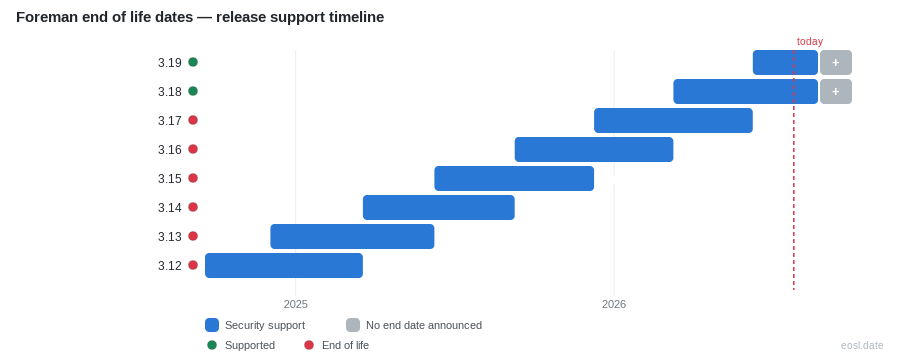
Currently Supported Foreman Releases - Active EOS/EOSL Support (2)
Foreman End of Life (EOL) Releases - No Longer Supported (48)
| Release | Released | Security Support | Latest |
|---|---|---|---|
| 3.18 | (8 months ago) | (2 months ago) | 3.18.2 (4 months ago) |
| 3.17 | (11 months ago) | (5 months ago) | 3.17.2 (7 months ago) |
| 3.16 | (1 year and 2 months ago) | (8 months ago) | 3.16.3 (7 months ago) |
| 3.15 | (1 year and 5 months ago) | (11 months ago) | 3.15.1 (1 year ago) |
| 3.14 | (1 year and 8 months ago) | (1 year and 2 months ago) | 3.14.0 (1 year and 8 months ago) |
| 3.13 | (1 year and 11 months ago) | (1 year and 5 months ago) | 3.13.1 (1 year and 7 months ago) |
| 3.12 | (2 years and 2 months ago) | (1 year and 8 months ago) | 3.12.1 (2 years ago) |
| 3.11 | (2 years and 4 months ago) | (1 year and 11 months ago) | 3.11.5 (1 year and 11 months ago) |
| 3.10 | (2 years and 8 months ago) | (2 years and 2 months ago) | 3.10.1 (2 years and 2 months ago) |
| 3.9 | (2 years and 11 months ago) | (2 years and 4 months ago) | 3.9.3 (2 years and 6 months ago) |
| 3.8 | (3 years and 1 month ago) | (2 years and 8 months ago) | 3.8.0 (3 years and 1 month ago) |
| 3.7 | (3 years and 5 months ago) | (2 years and 11 months ago) | 3.7.1 (3 years ago) |
| 3.6 | (3 years and 8 months ago) | (3 years and 1 month ago) | 3.6.2 (3 years and 3 months ago) |
| 3.5 | (3 years and 11 months ago) | (3 years and 5 months ago) | 3.5.3 (3 years and 7 months ago) |
| 3.4 | (4 years and 2 months ago) | (3 years and 8 months ago) | 3.4.1 (3 years and 11 months ago) |
| 3.3 | (4 years and 5 months ago) | (3 years and 11 months ago) | 3.3.1 (4 years and 1 month ago) |
| 3.2 | (4 years and 8 months ago) | (4 years and 2 months ago) | 3.2.1 (4 years and 5 months ago) |
| 3.1 | (4 years and 11 months ago) | (4 years and 5 months ago) | 3.1.3 (4 years and 6 months ago) |
| 3.0 | (5 years and 2 months ago) | (4 years and 8 months ago) | 3.0.2 (4 years and 8 months ago) |
| 2.5 | (5 years and 5 months ago) | (4 years and 11 months ago) | 2.5.4 (5 years and 1 month ago) |
| 2.4 | (5 years and 8 months ago) | (5 years and 2 months ago) | 2.4.1 (5 years and 5 months ago) |
| 2.3 | (5 years and 11 months ago) | (5 years and 5 months ago) | 2.3.5 (5 years and 5 months ago) |
| 2.2 | (6 years ago) | (5 years and 8 months ago) | 2.2.3 (5 years and 8 months ago) |
| 2.1 | (6 years and 4 months ago) | (5 years and 11 months ago) | 2.1.4 (6 years and 1 month ago) |
| 2.0 | (6 years and 7 months ago) | (6 years ago) | 2.0.3 (6 years and 2 months ago) |
| 1.24 | (6 years and 11 months ago) | (6 years and 4 months ago) | 1.24.3 (6 years and 6 months ago) |
| 1.23 | (7 years and 2 months ago) | (6 years and 7 months ago) | 1.23.2 (6 years and 8 months ago) |
| 1.22 | (7 years and 5 months ago) | (6 years and 11 months ago) | 1.22.2 (7 years ago) |
| 1.21 | (7 years and 8 months ago) | (7 years and 2 months ago) | 1.21.4 (7 years and 2 months ago) |
| 1.20 | (8 years ago) | (7 years and 4 months ago) | 1.20.3 (7 years and 4 months ago) |
| 1.19 | (8 years and 2 months ago) | (7 years and 8 months ago) | 1.19.1 (8 years ago) |
| 1.18 | (8 years and 4 months ago) | (8 years ago) | 1.18.3 (8 years ago) |
| 1.17 | (8 years and 7 months ago) | (8 years and 2 months ago) | 1.17.4 (8 years and 2 months ago) |
| 1.16 | (8 years and 11 months ago) | (8 years and 4 months ago) | 1.16.2 (8 years and 5 months ago) |
| 1.15 | (9 years and 6 months ago) | (8 years and 7 months ago) | 1.15.7 (8 years and 7 months ago) |
| 1.14 | (9 years and 10 months ago) | (8 years and 11 months ago) | 1.14.3 (9 years and 7 months ago) |
| 1.13 | (10 years and 1 month ago) | (9 years and 6 months ago) | 1.13.4 (9 years and 9 months ago) |
| 1.12 | (10 years and 4 months ago) | (9 years and 10 months ago) | 1.12.4 (10 years and 1 month ago) |
| 1.11 | (10 years and 7 months ago) | (10 years and 1 month ago) | 1.11.4 (10 years and 3 months ago) |
| 1.10 | (10 years and 10 months ago) | (10 years and 4 months ago) | 1.10.4 (10 years and 6 months ago) |
| 1.9 | (11 years and 3 months ago) | (10 years and 7 months ago) | 1.9.3 (11 years ago) |
| 1.8 | (11 years and 6 months ago) | (10 years and 10 months ago) | 1.8.4 (11 years and 2 months ago) |
| 1.7 | (11 years and 11 months ago) | (11 years and 3 months ago) | 1.7.5 (11 years and 6 months ago) |
| 1.6 | (12 years and 2 months ago) | (11 years and 6 months ago) | 1.6.3 (12 years ago) |
| 1.5 | (12 years and 6 months ago) | (11 years and 11 months ago) | 1.5.3 (12 years and 2 months ago) |
| 1.4 | (12 years and 9 months ago) | (12 years and 2 months ago) | 1.4.5 (12 years and 5 months ago) |
| 1.3 | (13 years and 1 month ago) | (12 years and 6 months ago) | 1.3.2 (12 years and 10 months ago) |
| 1.2 | (13 years and 4 months ago) | (12 years and 9 months ago) | 1.2.3 (13 years and 1 month ago) |
Running Foreman end of life checks before your next maintenance window saves you from surprise outages. This guide shows which Foreman software releases still get fixes, which ones are retired, and how this tool treats the servers it manages once its own releases stop receiving updates.
Foreman End of Life Dates and Supported Versions
Foreman is an open source project, so each version of its software stops getting fixes on a schedule set by the community rather than a vendor contract. The table below lists the newest branches and when each stopped receiving fixes, following the endoflife.date record updated on 3 October 2026.
| Release | Released | Support ended | Status | Latest maintenance release |
|---|---|---|---|---|
| 5.0 | 8 Sep 2026 | Still active | Yes | 5.0.1 |
| 3.19 | 9 Jun 2026 | Still active | Yes | 3.19.2 |
| 3.18 | 10 Mar 2026 | 8 Sep 2026 | Ended | 3.18.2 |
| 3.17 | 9 Dec 2025 | 9 Jun 2026 | Ended | 3.17.2 |
| 3.16 | 9 Sep 2025 | 10 Mar 2026 | Ended | 3.16.3 |
| 3.15 | 9 Jun 2025 | 9 Dec 2025 | Ended | 3.15.1 |
| 3.14 | 19 Mar 2025 | 9 Sep 2025 | Ended | 3.14.0 |
| 3.13 | 3 Dec 2024 | 9 Jun 2025 | Ended | 3.13.1 |
| 3.12 | 19 Sep 2024 | 19 Mar 2025 | Ended | 3.12.1 |
If you run 3.18 or older, your stable release is already out of support in practice. Each software branch ends roughly one branch after the next appears, so the latest two branches, each with a fresh maintenance release, are the only safe targets.
Foreman release policy and release cycles
The project has no documented release policy, but the history shows a new version about every three months and fixes for two of them at a time. Treat any supported release as the one in the last column of the table, and plan to move when it drops off.
Tracking Foreman release notes with feeds
You can follow dates without checking a page by hand. The endoflife.date entry offers a JSON view through its API, an RSS feed and an iCalendar feed, plus CPE and Repology identifiers for scanners. Pair this API data with the release notes and the project's Redmine tracker for details on each change.
Foreman as a Lifecycle Management Tool
Foreman is a lifecycle management tool and software suite for physical and virtual servers, a take on life cycle systems management that covers provisioning, configuration management and monitoring from one console. It installs bare-metal and bare metal machines, virtual machines and instances across a hybrid cloud, and uses host groups so an administrator can change many hosts at once, then review hosts and all hosts in one list. A single server or an entire data center fits the same model, which is why one outdated release can affect all of your infrastructure, operating systems, orchestration and deployment jobs at once. That reach is why an out-of-support release puts every managed machine at risk.
Foreman Release History and the Support Life Cycle
The release history began in 2009 and now spans 1.x, 2.x, 3.x and 5.x branches, and each branch keeps a support window of roughly two to three releases. Builds of the Ruby on Rails code, shared under the GPL, stop receiving updates on Linux distributions such as Ubuntu, Debian, Fedora, CentOS and RHEL when their branch ends. Community pages and documentation for retired branches stay online, but they describe software that no longer gets fixes.
Upgrade Warnings and Deprecations Ahead of EOL
Read the upgrade warnings and deprecations before you move. The 3.12 notes stated that there were no warnings, yet they marked Puppet 8 as fully handled and flagged that Puppet 7 was heading to retirement. This software also adds features such as bulk actions on all hosts in the web interface and host registration fixes arrive only on newer branches, and each change affects compatibility with plugins. The deprecated items matter most, and Puppet's own puppetserver packages matter too, since a removal can block a later move.
Enterprise Linux 8 and Java installer changes
Running Foreman on Enterprise Linux 8 was deprecated in 3.11 and dropped in 3.13, although clients keep working. The foreman-installer and the main installer also gained fixes for Java and OpenJDK 17, katello-certs-check and the PostgreSQL module switch. Package changes touched RPMs, packaging and SELinux policy too, so allow time for each step; these changes can force your move sooner than planned.
Security Support for Unsupported Foreman Releases
Once a branch ends, no one patches a new CVE in it, and a fix such as the 3.12.1 template correction never reaches you. Foreman stores LDAP logins, RBAC roles and audits, so an unpatched console is a tempting target. Sites built on Red Hat content through Katello should plan around the same dates.
Smart Proxy and Plugin Support in an EOL Release
A retired branch strands software that its smart proxy, its plugins and the REST API or Hammer CLI scripts built on it. Puppet, Ansible, Chef and Salt integrations, compute resources such as VMware, libvirt and OpenStack, and the DHCP, DNS, TFTP and PXE services follow the core release, so one old component can stall provisioning for every managed cloud target.
Planning Your Foreman Upgrade Away from an Unsupported Release
- Check the table and note your current branch.
- Read the notes for every branch you will skip.
- Back up the database and test on a clone.
- Move one branch at a time, then verify your hosts.
A careful migration keeps you inside the two active branches.