Devuan End of Life (EOL) Dates and End of Support (EOS) Dates
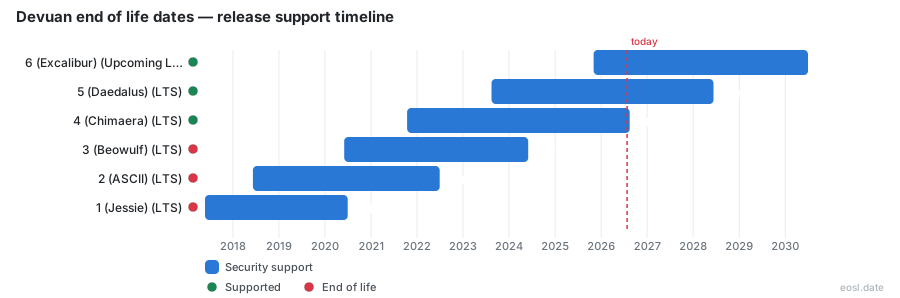
Devuan end of life (EOL) and end of support (EOS) dates: 4 Devuan versions have reached EOL, including Devuan 4 (Chimaera) (LTS) (EOL date: Aug 15, 2026) — no longer receiving security updates or patches. Devuan 6.1.1 is the current supported release, with support through Jun 30, 2030 — 2 versions in active support. Also see Alpine Linux end of support life for related end-of-life information.
Currently Supported Devuan Releases - Active EOS/EOSL Support (2)
Devuan End of Life (EOL) Releases - No Longer Supported (4)
| Release | Released | Security Support | Latest | LTS |
|---|---|---|---|---|
| 4 (Chimaera) (LTS) | (5 years and 1 month ago) | (3 months ago) | 4.0.0 (5 years and 1 month ago) | LTS |
| 3 (Beowulf) (LTS) | (6 years and 5 months ago) | (2 years and 5 months ago) | 3.1.0 (5 years and 9 months ago) | LTS |
| 2 (ASCII) (LTS) | (8 years and 5 months ago) | (4 years and 4 months ago) | 2.1 (6 years and 11 months ago) | LTS |
| 1 (Jessie) (LTS) | (9 years and 5 months ago) | (6 years and 4 months ago) | 1.0.0 (9 years and 5 months ago) | LTS |
Wondering how long your Linux install will keep getting patches? This guide covers Devuan end of life dates for every release of this Linux distribution, from Jessie to Excalibur, so you can see which versions still receive security updates and when to upgrade.
Devuan End of Life Dates for Every Release
Devuan is a Debian fork, and every Linux release it ships follows a Debian release, so its end of support date tracks Debian LTS. As of October 2026, only Daedalus and Excalibur are still maintained. Every other release below is unsupported.
| Devuan release | Debian base | Released | Support ends | Status |
|---|---|---|---|---|
| 1 Jessie | Debian 8 Jessie | 25 May 2017 | 30 June 2020 | Unsupported |
| 2 ASCII | Debian 9 Stretch | 8 June 2018 | 30 June 2022 | Unsupported |
| 3 Beowulf | Debian 10 Buster | 1 June 2020 | June 2024 | Unsupported |
| 4 Chimaera | Debian 11 Bullseye | 14 October 2021 | August 2026 | Unsupported |
| 5 Daedalus | Debian 12 Bookworm | 14 August 2023 | 30 June 2028 | Supported |
| 6 Excalibur | Debian 13 Trixie | 2 November 2025 | 30 June 2030 | Supported |
Chimaera is the newest casualty: its security patches stopped in August 2026, so move those machines to Daedalus or Excalibur soon.
How the Devuan Support Lifecycle Works
Devuan makes a new stable release when it is ready, and each one is released not on a fixed schedule, roughly following the Debian release cadence. When a new version ships, the previous one becomes oldstable and stays maintained until it is archived. The whole lifecycle usually spans about five years, and the Linux software inside stays frozen apart from fixes.
Security Support and Long Term Support
Update source code is often pulled from the Debian Long Term Support (LTS) project, so a release typically gets around three years of full security patches, then two more years of long term support. In that final stretch only a limited set of packages receives fixes, so check that yours is covered. Point releases bundle package versions and fixes, and Excalibur reached 6.1 in January 2026.
Stable, Testing and Unstable Suites
Development happens in suites that signal stability. Stable is the suite recommended for production. Testing, currently Freia (Debian Forky), is where the next stable is built, and unstable is always called Ceres, an alias for Debian sid. Each suite name points to a different release over time.
Devuan Releases and Their Codenames
Where Debian borrows Toy Story names, Devuan picks every codename from the Minor Planet Center list. These release codenames start with the first Devuan release, which shared the Jessie name, and later ones run alphabetically: ASCII, Beowulf, Chimaera, Daedalus, Excalibur, then Freia and Gryphon. That is why the version history above reads A to E.
Why Devuan Support Differs from Debian
This open source operating system exists to keep init freedom. When Debian 8 adopted systemd as its init system, some developers and users felt alienated, and the Debian fork they started offers sysvinit, OpenRC and runit instead. Devuan does not provide systemd in its repositories, and it swaps in eudev and elogind where needed, keeping libsystemd0 until every dependency is gone. A small team merges Debian packages through Amprolla, so Devuan trails Debian slightly. That Linux kernel and userland stack defaults to the Xfce desktop, and the installer supports amd64, ARM and ppc64el. Derivative projects such as Refracta build on it.
Excalibur runs Linux kernel 6.12 and ships no official i386 kernel, which is why a forum thread on the Dev1 Galaxy community board asks for one. Other Linux distribution projects follow similar rules, but the Linux software here is released only when Devuan developers consider it ready, so dates can move. That systemd-free Linux promise is the reason many admins stay on the Devuan forum, and the reason they watch each release carefully. Every Linux admin should read the official notes before relying on an older version.
What Archived Means at EOL
Once a Linux release hits EOL, Devuan marks it archived. That means it is frozen, development stops, it receives no updates, security fixes included, and its assets move to the Devuan archive. An archived install still boots, but every new vulnerability stays unpatched, so treat it as a liability on any networked Linux machine, and plan the move before systemd-free security fixes dry up.
Checking Your Devuan Stable Release and sources.list
Run cat /etc/os-release to see your version. Then open /etc/apt/sources.list: a codename such as excalibur keeps you on that release until you edit the file, while stable or testing silently follows the next one. Devuan recommends codenames so you control when an upgrade happens, and you should point every repository line at the same release to avoid mixing incompatible ones.
Upgrading Before Devuan End of Support
Move your Linux install one release at a time, for example Chimaera to Daedalus, then Daedalus to Excalibur:
- Back up your data and list the latest installed packages.
- Change each codename in sources.list to the next release.
- Run
apt updatethenapt full-upgrade. - Reboot and confirm the new version with os-release.
To track dates automatically, endoflife.date for Devuan offers a JSON API, an RSS feed and a calendar feed, and the Devuan wiki keeps its own release notes.