AngularJS End of Life (EOL) Dates and End of Support (EOS) Dates
AngularJS end of life (EOL) and end of support (EOS) dates: 9 AngularJS versions have reached EOL, including AngularJS 1.8 (LTS) (EOL date: Dec 31, 2021) — no longer receiving security updates or patches. Also see CentOS EOSL information for related end-of-life information.
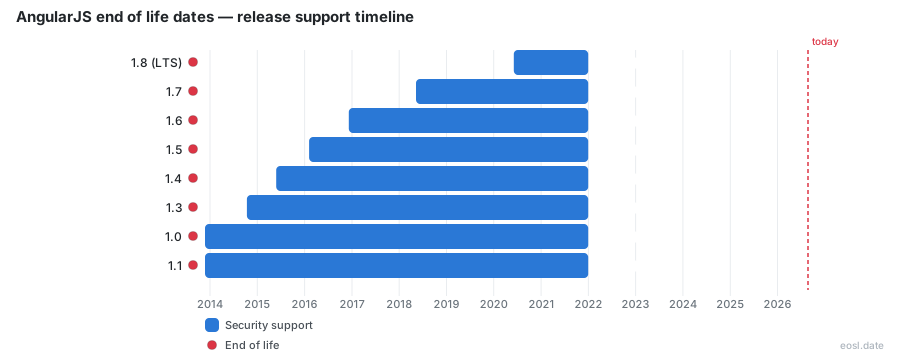
AngularJS End of Life (EOL) Releases - No Longer Supported (9)
| Release | Eoes Provider | Released | Support | Extended Long Term Support | Latest | LTS |
|---|---|---|---|---|---|---|
| 1.8 (LTS) | HeroDevs, OpenLogic | (6 years and 5 months ago) | (4 years and 10 months ago) | Active | 1.8.3 (4 years and 7 months ago) | LTS |
| 1.7 | - | (8 years and 6 months ago) | (4 years and 10 months ago) | Active | 1.7.9 (7 years ago) | - |
| 1.6 | OpenLogic | (9 years and 11 months ago) | (4 years and 10 months ago) | Active | 1.6.10 (8 years and 7 months ago) | - |
| 1.5 | HeroDevs | (10 years and 9 months ago) | (4 years and 10 months ago) | Active | 1.5.11 (9 years and 10 months ago) | - |
| 1.4 | - | (11 years and 5 months ago) | (4 years and 10 months ago) | Active | 1.4.14 (10 years and 1 month ago) | - |
| 1.3 | - | (12 years and 1 month ago) | (4 years and 10 months ago) | Active | 1.3.20 (11 years and 1 month ago) | - |
| 1.0 | - | (12 years and 11 months ago) | (4 years and 10 months ago) | Active | 1.0.8 (12 years and 11 months ago) | - |
| 1.1 | - | (12 years and 11 months ago) | (4 years and 10 months ago) | Active | 1.1.5 (12 years and 11 months ago) | - |
| 1.2 | - | (12 years and 11 months ago) | (4 years and 10 months ago) | Active | 1.2.32 (10 years and 1 month ago) | - |
AngularJS end of life arrived when Google, which had maintained the discontinued JavaScript framework since the start, stopped all updates on December 31, 2021. If you still run an Angular 1 codebase, or an EOL AngularJS dependency buried in a larger system, this guide explains what the retirement of this open-source web framework changes for your single-page applications and web applications, and which support, security and upgrade choices you have left.
AngularJS End of Life Timeline and Support Status
The end of life AngularJS schedule was announced in January 2018: once 1.7.0 shipped, active development continued until June 30, 2018, and a long-term maintenance phase then covered the 1.7 line until December 31, 2021. From January 1, 2022, AngularJS support stopped for security, browser compatibility and jQuery changes. The final stable version, 1.8.3, appeared on April 7, 2022, and the project stays frozen there.
Support Status by Release
Every 1.x line shares the same cutoff, yet only some still have paid options. Lines as old as AngularJS 1.5 run in production today, so check yours below. After the cutoff, open source contributors no longer ship fixes, and security support comes only from commercial vendors.
| Version | Release date | Final release | Paid vendor coverage |
|---|---|---|---|
| 1.8 (LTS) | June 4, 2020 | 1.8.3 | Yes |
| 1.7 | May 11, 2018 | 1.7.9 | No |
| 1.6 | December 8, 2016 | 1.6.10 | Yes |
| 1.5 | February 5, 2016 | 1.5.11 | Yes |
Unpatched Vulnerabilities and Security Risks in Unsupported AngularJS
Once security patches stop, each newly disclosed vulnerability stays open for good. Attackers scan for known weaknesses, and one exposed template can turn into a data breach.
Known CVEs After the Sunset
Researchers keep filing new CVEs against the final lines, and none gets an upstream fix. Any patch you need must come from a vendor or your own team, so the risk compounds every year. Treat these security risks as permanent, since the vulnerabilities will never close upstream.
XSS and ReDoS Exposure
XSS is the persistent threat, because AngularJS templating was already a weak point. ReDoS attacks, short for regular expression denial of service, abuse slow regex patterns to spike CPU load until the app stops responding.
Why Teams Keep Running Deprecated AngularJS Applications
Years past its end-of-life date, AngularJS still runs business software because a stack that works rarely gets rewritten. In finance, healthcare and government, an enterprise often keeps legacy systems alive because developers who know both the code and the business rules are scarce, and the wider industry has moved on. Running unsupported software is therefore usually a staffing decision, not a technical one.
- Budget: a port competes with work that earns revenue.
- Skills: few engineers still know directives and scopes well.
- Status: the app is deprecated on paper but still works, so nothing forces a change.
Migration Costs and Developer Resources
The first blocker is money. Migration costs balloon when a full rewrite means months of effort, and the developer resources for it are usually committed elsewhere.
Technical Debt and Compliance Pressure
Technical debt makes it worse, since each skipped upgrade widens the gap. Regulated teams also face compliance reviews: unpatched code can conflict with SOC 2, PCI-DSS, HIPAA and GDPR controls, and regulatory auditors ask about it.
AngularJS Long-Term Support for Teams That Cannot Migrate Yet
When a port cannot happen this year, AngularJS long-term support from a commercial vendor buys time. HeroDevs sells its Never-Ending Support program, formerly called extended long-term support, while OpenLogic offers AngularJS LTS for 1.5.x, 1.6.x and 1.8.x through December 2030.
Extended Support From HeroDevs and OpenLogic
Extended support typically bundles fixes for browser updates that break your app, jQuery changes, and response guarantees (an SLA) for severe flaws. Access usually arrives through a private npm repository.
CVSS-Based Patch Coverage
OpenLogic covers medium and high severity flaws, meaning a CVSS score of 4 or above, with delivery guarantees from a score of 7. Ask any vendor for the same terms in writing before you sign.
Planning Your Move Off Angular 1: Angular, React or Vue
Moving on is the only fix that ends the exposure. The successor, Angular, is an incompatible TypeScript rewrite of the original, so you port a codebase rather than upgrade it. Google recommends Angular first, and a modern front-end framework gives you long-term updates plus better testing.
Angular Upgrade Paths and Alternatives
Angular 4 followed Angular 2 in March 2017, skipping 3 to match the router package. Angular 5 landed on November 1, 2017, and Angular 6 arrived on May 3, 2018. Each Angular major version can break compatibility, so plan to stay current after you land. React and Vue are the common alternatives, and both organize interfaces into components with an active ecosystem, though neither includes an automatic conversion tool.
Interim Safeguards Before You Migrate
Until the cut-over, treat the app as exposed and keep it behind a web application firewall. Ignoring the problem is the most dangerous choice, because an interim fix is cheaper than an incident.
How the AngularJS Framework Worked Before Its End-of-Life
AngularJS extended HTML with custom attributes, which the framework read as directives that bound page parts to JavaScript variables. Two-way data binding kept view and model in sync, dependency injection brought server-style services to the client, and the MVC pattern, with MVVM variants, separated presentation, data and logic. The MEAN stack paired it with MongoDB, Express.js and Node.js.
Legacy Browser Support and Internet Explorer
Versions 1.3 and later dropped Internet Explorer 8 and earlier, though 1.2 still ran on IE8, which matters when you audit old intranet apps.