Amazon RDS for PostgreSQL End of Life (EOL) Dates and End of Support (EOS) Dates
Amazon RDS for PostgreSQL end of life (EOL) and end of support (EOS) dates: 5 Amazon RDS for PostgreSQL versions have reached EOL, including Amazon RDS for PostgreSQL 13 (EOL date: Feb 28, 2026) — no longer receiving security updates or patches. Amazon RDS for PostgreSQL 18.6 is the current supported release, with support through Feb 28, 2031 — 5 versions in active support. Also see Amazon Corretto end of support dates for related end-of-life information.
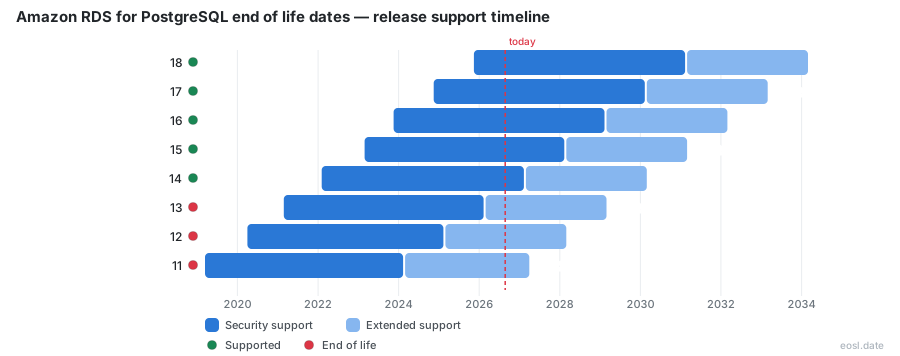
Currently Supported Amazon RDS for PostgreSQL Releases - Active EOS/EOSL Support (5)
| Release | Released | Security Support | Extended Support | Latest |
|---|---|---|---|---|
| 18 | (1 year ago) | (in 4 years and 3 months) | (in 7 years and 3 months) | 18.6 (2 months ago) |
| 17 | (2 years ago) | (in 3 years and 3 months) | (in 6 years and 3 months) | 17.11 (2 months ago) |
| 16 | (3 years ago) | (in 2 years and 3 months) | (in 5 years and 3 months) | 16.15 (2 months ago) |
| 15 | (3 years and 8 months ago) | (in 1 year and 3 months) | (in 4 years and 3 months) | 15.19 (2 months ago) |
| 14 | (4 years and 9 months ago) | (in 3 months) | (in 3 years and 3 months) | 14.24 (2 months ago) |
Amazon RDS for PostgreSQL End of Life (EOL) Releases - No Longer Supported (5)
| Release | Released | Security Support | Extended Support | Latest |
|---|---|---|---|---|
| 13 | (5 years and 8 months ago) | (8 months ago) | (in 2 years and 3 months) | 13.23 (1 year ago) |
| 12 | (6 years and 7 months ago) | (1 year and 8 months ago) | (in 1 year and 3 months) | 12.22 (2 years ago) |
| 11 | (7 years and 8 months ago) | (2 years and 8 months ago) | (in 4 months) | 11.22 (3 years ago) |
| 10 | (8 years and 8 months ago) | (3 years and 6 months ago) | — | 10.23 (3 years and 9 months ago) |
| 9.6 | (10 years ago) | (4 years and 6 months ago) | — | 9.6.24 (4 years and 9 months ago) |
Your Amazon RDS for PostgreSQL end of life date is not a single deadline but a ladder of dates, and the one that matters first is when AWS stops covering your version under standard terms. This guide lays out every managed database milestone in the cloud, so you can see what each stage costs and when to act.
Amazon RDS for PostgreSQL End of Life at a Glance
Each PostgreSQL major version passes through the same stages on RDS: it is released, supported under standard terms, then covered by a paid extension, and finally upgraded for you. Because RDS version numbers match the community engine, you can read any date here against the version printed in your AWS console.
What RDS Manages for You
RDS handles installation, patching, storage, automated backups with point in time recovery, Multi-AZ failover and read replicas. That convenience is why a missed deadline hurts: the platform decides when your instance gets upgraded if you do not.
How Version Currency Timelines Work
AWS publishes its pace for new engines: a new major version arrives within 30 days of the community release of its first minor, and a new minor version arrives within 7 days of the community release. Fast arrival means the supported release you test today is rarely the last one for long.
End of Standard Support Dates for Major Versions
The table lists the major versions still in play. Dates with only a month are approximate until AWS confirms the exact day.
| PostgreSQL version | RDS release | Community end of life | RDS end of standard support | End of Extended Support |
|---|---|---|---|---|
| 18 | 14 November 2025 | November 2030 | 28 February 2031 | 28 February 2034 |
| 17 | 14 November 2024 | November 2029 | 28 February 2030 | 28 February 2033 |
| 16 | 20 November 2023 | November 2028 | 28 February 2029 | 29 February 2032 |
| 15 | 27 February 2023 | November 2027 | 29 February 2028 | 28 February 2031 |
| 14 | 3 February 2022 | 12 November 2026 | 28 February 2027 | 28 February 2030 |
| 13 | 24 February 2021 | November 2025 | 28 February 2026 | 28 February 2029 |
| 12 | 31 March 2020 | 14 November 2024 | 28 February 2025 | 29 February 2028 |
| 11 | 13 March 2019 | 9 November 2023 | 29 February 2024 | 31 March 2027 |
Reading the RDS End of Standard Support Date
Take version 14 as a worked case. Its RDS end of standard support date is 28 February 2027, which from 27 October 2026 is 124 days away. Extended Support starts on 1 March 2027, year 3 pricing begins on 1 March 2029, and coverage stops on 28 February 2030.
Community End of Life Versus RDS Dates
The community stops patching a major version first, yet RDS keeps standard coverage a few months longer, which is why version 14 loses community fixes on 12 November 2026 but stays on standard terms until the end of February 2027.
Minor Versions of RDS for PostgreSQL and Their Deadlines
Minor releases age faster than their parent. RDS keeps each one on standard terms for roughly a year, and a minor can expire well before its major does. On 31 October 2026, minors 17.5, 17.6, 16.9, 16.10, 15.13, 15.14, 14.18 and 14.19 reach the end of their standard window.
- Minors released in November 2025 and February 2026 run until March 2027.
- Minors released from May to August 2026 run until September 2027.
- Version 14 minors follow the major's 28 February 2027 date.
Deprecated Minor Versions and Forced Upgrades
When AWS marks a release deprecated, usually after a security issue or when it expires, you are expected to move within three months for a minor. Upgrades run inside your scheduled maintenance windows, which you can change in the console, so pick a quiet slot early.
RDS Extended Support After End of Standard Support
This paid offering lets a database stay on an older major version for up to three years past its standard date. It adds critical and high CVE security updates, bug fixes for critical issues, and the right to open support cases under the normal service level agreement.
When Billing for Paid Coverage Starts
On the standard date, Amazon RDS automatically enrolls your databases, with no engine change and no downtime, and charges begin the next day. Check current pricing on the AWS pricing page, because the cost steps up as the years pass, and plan your move before then.
Enrolling and Opting Out
You can change enrollment at any time through the EngineLifecycleSupport setting in the AWS CLI or RDS API. Opting out of an instance that is already past its date upgrades it to the next supported major version straight away, so rehearse first.
Deprecated Versions and the Deprecation Policy
PostgreSQL 10 and 9.6 are fully deprecated: their standard support ended in April 2023 and April 2022, and neither offers extended coverage. Under the deprecation policy, a retired major version is upgraded automatically, typically after a six-month notice period.
Why Versions 10 and 9.6 Have No Extended Support
Extended Support only applies to versions that were still on standard terms when the program began, so any database still on these releases is already facing a forced move rather than a choice.
Plan an Upgrade Before Deprecation Catches Up
Work backwards from your date: allow time for testing, a rehearsal and a rollback plan. Pick the target engine version from the table, ideally the newest major your applications support.
Use Maintenance Windows and Blue/Green Deployments
Blue/Green Deployments let you stage the new major version beside production and switch over in seconds. Schedule the cutover inside your maintenance windows, and confirm read replicas follow the change.
Test Extensions and Engine Version Changes
Restore a snapshot, upgrade the copy, and run your workload against it. Check every extension, since some are dropped between versions, and review security settings before you switch traffic.