Alibaba ACK End of Life (EOL) Dates and End of Support (EOS) Dates
Alibaba ACK end of life (EOL) and end of support (EOS) dates: 14 Alibaba ACK versions have reached EOL, including Alibaba ACK 1.34 (EOL date: Sep 30, 2026) — no longer receiving security updates or patches. Also see Azure Kubernetes Service EOSL information for related end-of-life information.
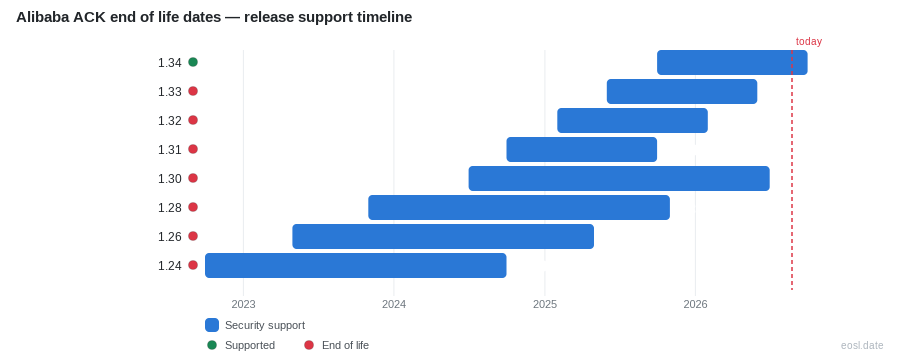
Alibaba ACK End of Life (EOL) Releases - No Longer Supported (14)
| Release | Released | End of Support |
|---|---|---|
| 1.34 | (1 year and 1 month ago) | (1 month and 3 weeks ago) |
| 1.33 | (1 year and 5 months ago) | (5 months ago) |
| 1.32 | (1 year and 9 months ago) | (9 months ago) |
| 1.31 | (2 years and 1 month ago) | (1 year and 1 month ago) |
| 1.30 | (2 years and 4 months ago) | (4 months ago) |
| 1.28 | (3 years ago) | (1 year ago) |
| 1.26 | (3 years and 6 months ago) | (1 year and 6 months ago) |
| 1.24 | (4 years and 1 month ago) | (2 years and 1 month ago) |
| 1.22 | (4 years and 10 months ago) | (3 years ago) |
| 1.20 | (5 years and 6 months ago) | (3 years and 6 months ago) |
| 1.18 | (6 years and 1 month ago) | (4 years and 1 month ago) |
| 1.16 | (6 years and 8 months ago) | (4 years and 4 months ago) |
| 1.14 | (7 years and 2 months ago) | (5 years and 3 months ago) |
| 1.12 | (7 years and 7 months ago) | (5 years and 10 months ago) |
Alibaba ACK end of life dates decide how long your Kubernetes clusters stay supported. Container Service for Kubernetes (ACK) follows the Kubernetes community, so each of the Kubernetes versions gets technical support and maintenance for a fixed window before it is retired. Use this guide to see when end of support arrives and to protect your business continuity.
Alibaba ACK End of Life: Kubernetes Versions by Release Date
Every ACK managed cluster runs a community minor release. The release history below shows each ACK release date and the matching ACK end of support date. After that date the Alibaba Cloud documentation marks the version as discontinued, so alibaba ack EOL status is easy to read. ACK allows cluster creation only on the three most recent versions, in step with the upstream project, which protects stability for every managed cluster.
| Version | Status | ACK release date | ACK end of support |
|---|---|---|---|
| 1.36 | Released | May 2026 | May 30, 2027 |
| 1.35 | Released | February 2026 | February 28, 2027 |
| 1.34 | Released | September 2025 | September 30, 2026 |
| 1.33 | Discontinued | May 2025 | May 31, 2026 |
| 1.32 | Discontinued | January 2025 | January 31, 2026 |
| 1.31 | Discontinued | September 2024 | September 30, 2025 |
| 1.30 | Discontinued | June 2024 | June 30, 2026 |
The 1.34 date has already passed, so confirm that version's current status in the ACK console before you rely on it.
ACK Support Policy and Version Lifecycle
The Kubernetes community releases a new minor version about every four months. ACK follows that release cycle and runs a risk assessment before it offers the new Kubernetes version. A new patch version ships only when the fixed issues justify it, and patches for serious vulnerabilities (a CVE) usually appear within 24 hours. The latest patch version is the only upgrade target, and older patches are blocked for cluster creation. ACK numbers each version with semantic versioning in the x.y.z-aliyun.n format. Read the release notes for bug fixes and new features, and run kubectl version to see what your cluster runs. This lifecycle keeps Kubernetes versions, and every container workload on them, current on patches.
Outdated Versions and the Forceful Update
An outdated version brings security risks and security flaws: no new features, no bug fixes and no technical support. Once a release leaves the community window, nobody discloses its CVE risks, so ACK does not let Kubernetes clusters stay on a fixed version, and Kubernetes versions past the window face forced change. Before a forceful update begins, ACK sends notifications by SMS, email and internal messages at least one month ahead. It upgrades components, the control plane, then node pools and nodes.
It skips clusters that need manual work: ACK dedicated clusters (hot migrate them to ACK Pro), clusters on Docker as the container runtime (move to containerd) and clusters with an older NGINX Ingress controller. A version that is no longer supported is a risk you accept, not a plan.
ACK Edge and ACK Lingjun Discontinue Date and Support Cycle
ACK Edge gives version 1.32 and later a one-year support cycle, while ACK Lingjun lists its discontinue date as subject to the actual situation. ACK Serverless is not affected by the operating system notices. As a managed service, ACK stays conformant with the community, but hardening still matters: keep RBAC and network policies on, keep the API server private, and run a cluster check regularly. You can also follow dates through the endoflife.date RSS feed or its API.
Cluster Upgrade Steps Before ACK End of Support
You can upgrade a cluster only one minor version at a time. Skipping minor versions and downgrades are not supported, so old clusters need several upgrade passes on Kubernetes. Or create a new cluster on the latest version and migrate your workloads gradually.
Choose Manual or Automatic Upgrade
To manually upgrade, choose the nodes, concurrency, upgrade intervals and pause policies. To automatically upgrade, enable automatic cluster upgrades and pick a frequency, which keeps every upgrade routine.
Switch From Docker to containerd
Migrate each Docker node pool to containerd before you upgrade past 1.22.
Alibaba Cloud Linux 2 and CentOS 7 End-of-Life Impact
Alibaba Cloud Linux 2 reached end-of-life on March 31, 2024, and CentOS 7 followed on June 30, 2024. Alibaba Cloud added one year of extended support for Linux 2. After that, the operating system gets no feature updates or CVE fixes. Choose Alibaba Cloud Linux 3 or ContainerOS for each new node pool, and plan your clusters' existing node pools the same way. An operating system update replaces the system disks in batches, so back up first; data disks are untouched.