ROS End of Life (EOL) Dates and End of Support (EOS) Dates
ROS end of life (EOL) and end of support (EOS) dates: 4 ROS versions have reached EOL, including ROS Noetic Ninjemys (EOL date: May 01, 2025) — no longer receiving security updates or patches. Also see Clear Linux EOSL information for related end-of-life information.
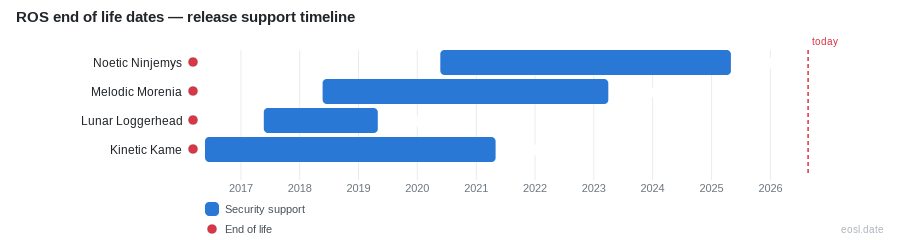
ROS End of Life (EOL) Releases - No Longer Supported (4)
| Release | Released | End Of Life |
|---|---|---|
| Noetic Ninjemys | (6 years and 5 months ago) | (1 year and 6 months ago) |
| Melodic Morenia | (8 years and 5 months ago) | (3 years and 7 months ago) |
| Lunar Loggerhead | (9 years and 5 months ago) | (7 years and 6 months ago) |
| Kinetic Kame | (10 years and 5 months ago) | (5 years and 6 months ago) |
If you still run the Robot Operating System (ROS) on version 1, ROS end of life is no longer a future date. The last ROS 1 version, ROS Noetic Ninjemys, has lost its official support, and the framework is now discontinued, so this guide shows you what changed and what to do next.
What ROS End of Life Means for Robot Developers
When a version reaches end-of-life, its maintainers stop shipping fixes. For ROS 1 that means no more security patches, no more bug fixes and no community support on the forums. The rosdistro index stops taking new release submissions, and pull requests that add features or risk regressions get closed. Over time, compatibility with newer operating systems erodes and third-party packages become unmaintained.
Because ROS is open source, nothing stops you from running ROS 1 after that date. The catch is that every vulnerability found from now on stays unpatched, so the software, its libraries and your own dependent packages all age together. Robotics teams that ship to customers feel this first.
End of Life for ROS 1 Distributions: Noetic, Melodic and Kinetic
Every ROS 1 version has now ended its support period. Noetic end-of-life arrived on May 31, 2025, and earlier releases, including the long term support ones, followed the same path.
| ROS 1 version | Released | End of life |
|---|---|---|
| ROS Noetic Ninjemys (LTS, paired with Ubuntu 20.04) | May 2020 | May 31, 2025 |
| Melodic Morenia | May 2018 | April 2023 |
| Lunar Loggerhead | May 2017 | May 2019 |
| Kinetic Kame | May 2016 | April 2021 |
Staying Secure After ROS Noetic EOL
Unsupported software on a company network is often treated as a compliance violation, and rules such as the EU Cyber Resilience Act raise the stakes for cybersecurity. Fresh vulnerabilities and each new CVE will not get an upstream fix, so mission-critical robots in the field carry growing risk. Migration is the long-term answer and a supported distribution is the goal, but a large codebase cannot move overnight, and downtime in a deployment is expensive. Backported security updates buy you time to get there.
ROS ESM and Ubuntu Pro Coverage
Canonical added ROS Noetic to ROS ESM, part of Ubuntu Pro, which delivers CVE fixes and critical stability patches through Extended Security Maintenance. Coverage runs five years past the upstream cutoff, aligned with Ubuntu 20.04 through 2030. Once you enable the service, a dedicated PPA delivers the updates, with no change to your application.
Docker and Snaps on Ubuntu 24.04
If you build with Docker, you can pass your Ubuntu Pro token as a BuildKit secret so it never lands in a final image layer. Canonical also maintains ROS Noetic as snaps, which run on any supported Ubuntu version, including Ubuntu 24.04.
Migrating from Sunsetted Noetic Code to ROS 2
A sunsetted stack needs a plan: inventory your dependencies, pick a target, then run testing in simulation before any production rollout. The transition to ROS 2 is a bigger upgrade than a version bump, and the migration brings real-time capable, safety-critical designs for robotics, industrial and autonomous systems.
Choosing a ROS 2 Distribution
Many teams pick ROS 2 Humble. Humble Hawksbill, released in May 2022, is an LTS release supported until May 2027, while Foxy has already ended.
Key Migration Challenges
- Build system: catkin gives way to colcon.
- Communication: quality of service settings in the DDS middleware must now be configured explicitly.
- Launch system: Python-based files replace XML.
- Parameters: node-level settings replace the parameter server, and a node lifecycle adds managed states.
- Simulation: Gazebo replaces Gazebo classic, so robot models need updating.
- Stacks: move_base becomes Nav2, and MoveIt becomes MoveIt2.