Red Hat build of OpenJDK End of Life (EOL) Dates and End of Support (EOS) Dates
Red Hat build of OpenJDK end of life (EOL) and end of support (EOS) dates: 3 Red Hat build of OpenJDK versions have reached EOL, including Red Hat build of OpenJDK OpenJDK 11 (EOL date: Oct 31, 2024) — no longer receiving security updates or patches. Red Hat build of OpenJDK 25 is the current supported release, with support through Dec 31, 2030 — 4 versions in active support. Also see GraalVM Community Edition end of service life for related end-of-life information.
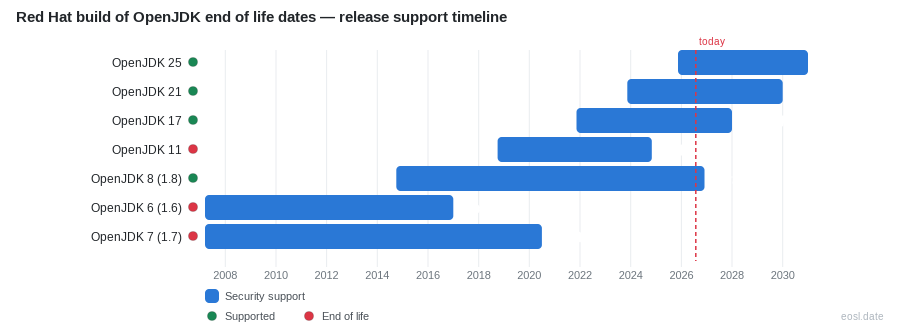
Currently Supported Red Hat build of OpenJDK Releases - Active EOS/EOSL Support (4)
| Release | Released | Support | Latest |
|---|---|---|---|
| OpenJDK 25 | (1 year ago) | (in 4 years and 1 month) | 25 (1 year ago) |
| OpenJDK 21 | (3 years ago) | (in 3 years and 1 month) | 21.0.9.0.10-1 (1 year and 1 month ago) |
| OpenJDK 17 | (5 years ago) | (in 1 year and 1 month) | 17.0.17.0.10-1 (1 year and 1 month ago) |
| OpenJDK 8 (1.8) | (12 years and 1 month ago) | (in 1 week and 2 days) | 1.8.0.472.b08-1 (1 year and 1 month ago) |
Red Hat build of OpenJDK End of Life (EOL) Releases - No Longer Supported (3)
| Release | Released | Support | Latest |
|---|---|---|---|
| OpenJDK 11 | (8 years and 1 month ago) | (2 years ago) | 11.0.25.0.9-3 (1 year and 10 months ago) |
| OpenJDK 6 (1.6) | (19 years and 8 months ago) | (9 years and 10 months ago) | 1.6.0.41-1.13.13.1 (9 years and 10 months ago) |
| OpenJDK 7 (1.7) | (19 years and 8 months ago) | (6 years and 4 months ago) | 1.7.0.261-2.6.22.2 (6 years and 7 months ago) |
Planning for Red Hat build of OpenJDK end of life starts with one fact: every major Java release has its own full support date and its own optional paid extension, and neither matches what other vendors publish. This guide lists those dates for the open source JDK that Red Hat ships, explains what EOL means for a Java SE runtime and JRE in production, and shows how to keep your lifecycle covered.
Red Hat Build of OpenJDK End of Life Dates
Red Hat packages OpenJDK 8, 11, 17, 21 and 25 for Red Hat Enterprise Linux (RHEL) and Windows. For each release its customer portal lists two end of life dates: when full support stops and when the extended phase, ELS-1, stops. If the underlying RHEL platform retires earlier, that earlier life cycle wins. Red Hat ships four update releases a year for each supported version, so these support timelines assume you keep patching.
| Release | Supported RHEL | Full support ends | ELS-1 ends |
|---|---|---|---|
| OpenJDK 8 | RHEL 7, 8, 9 | Nov 30, 2026 | Dec 31, 2032 |
| OpenJDK 11 | RHEL 7.6+, 8, 9 | Oct 31, 2024 | Jan 31, 2032 |
| OpenJDK 17 | RHEL 8.4+, 9 | Dec 31, 2027 | Jan 31, 2029 |
| OpenJDK 21 | RHEL 8.9+, 9.3+, 10 | Dec 31, 2029 | Sep 30, 2031 |
| OpenJDK 25 | RHEL 9.7+, 10.1+ | Dec 31, 2030 | Sep 30, 2033 |
OpenJDK 11 Lifecycle on RHEL
OpenJDK 11 left full support on October 31, 2024, so only the paid ELS-1 phase remains for enterprise Linux teams. Treat the OpenJDK 11 EOL as a decision point: buy ELS-1 or move to 17. The next deadline is closer. As of late October 2026, full support for OpenJDK 8 ends in about five weeks, and the same dates cover Java 11 builds on Windows Server.
OpenJDK 21 and OpenJDK 25 on Windows
On Windows, Red Hat covers 8, 11, 17 and 21 on Windows Server 2016 and later plus Windows 10 and 11. OpenJDK 21 and OpenJDK 25 are the longest-lived choices, reaching full support ends of December 2029 and December 2030. Windows Server 2012 R2 itself reached end of support in October 2023, so that platform is no longer a supported target, and macOS is limited to developer support on the same platform list.
Eclipse Temurin Support Dates
Red Hat also supports Eclipse Temurin, the community distribution from Eclipse Adoptium, on Linux x86_64 and aarch64 and on Windows. Eclipse Temurin follows the same dates: Eclipse Temurin 8 reaches the end of full support on November 30, 2026, Eclipse Temurin 17 on December 31, 2027 and Eclipse Temurin 25 on December 31, 2030. Eclipse Temurin 21 and later dropped 32-bit Windows. Its upstream builds suit container images and mixed estates.
Red Hat OpenJDK Support Lifecycle Explained
The Red Hat OpenJDK support policy has three stages: full support, optional ELS-1, then nothing. Vendor support rides on subscriptions you already hold, and the end-of-life date for each release is fixed years ahead.
Extended Lifecycle Support ELS-1
Extended lifecycle support is an optional paid subscription layer added after full support. It keeps security updates and critical fixes flowing for production workloads that cannot upgrade yet, but it needs its own entitlement and does not extend the standard terms.
Subscription Entitlement for Java Workloads
The entitlement for Java workloads comes with your Red Hat Enterprise Linux subscription. A Red Hat Middleware subscription adds the Windows entitlement when you run alongside middleware; other Windows workloads need an extra subscription. The open source license lets anyone run the code, but it does not include support.
Java SE Update Releases Each Year
Red Hat issues four updates a year, roughly every three months, matching Oracle's quarterly critical patch update rhythm. For older versions it can backport fixes from newer ones, so patches still arrive when upstream stops.
OpenJDK 17 End of Life and Java 8 EOL Dates by Vendor
There is no single OpenJDK 17 EOL, and the same holds for Java 8 EOL. The upstream community supports a release for about six months, so long-term support is a vendor job, and every build follows its own openjdk lifecycle.
Oracle JDK Premier Support and Extended Support
Oracle JDK 8 lost free public updates in January 2019, Premier Support in March 2022, and Extended Support ends December 2030 under a commercial support contract. Oracle JDK 17 was free until September 2024, with Premier Support to September 2026 and extended support to September 2029. These dates describe Oracle JDK 8 and 17 only, not OpenJDK builds that offer free updates.
Amazon Corretto and Microsoft Build of OpenJDK
For version 17, Red Hat ends full support on December 31, 2027. Amazon Corretto is published as supported until at least October 2029, and the Microsoft build of OpenJDK until at least September 2027. Azul Zulu is another commercial route.
Java 17 and the LTS Release Cadence
Java follows a six-month release cadence, in March and September, and an LTS every two years since Java 21. Java 17, 21 and 25 are the current long-term support releases, while Java 11 is vendor-dependent. Red Hat supports only the LTS releases, which is why its date table has just five rows. Pick an LTS, not a feature release.
What Happens After OpenJDK 11 EOL
Your JVM keeps running after OpenJDK 11 EOL, and nothing breaks on day one. Since October 31, 2024 only Red Hat's paid ELS-1 phase delivers fixes for it, and without that, the flow of fixes stops, and your security exposure grows each quarter. Check your vendor's support policy before assuming anything is still covered.
Security Patches Stop
Without security patches, new CVE patches never reach your build. Security vulnerabilities in TLS, deserialization and the class library are fixed only in supported releases, so every quarterly Oracle critical patch update widens the gap. Unpatched Java runtimes are a common entry point for ransomware.
Compliance Gets Harder
Frameworks such as PCI DSS and HIPAA expect supported software. Vulnerability scanners flag EOL runtimes by default, every audit needs documented exceptions, and compliance reviews become slower. For Red Hat's OpenJDK 11, an active ELS-1 entitlement is what gives auditors a supported answer.
Dependency Decay and Legacy Code
Dependencies move on even if your JDK does not. Frameworks drop old baselines, and Spring Boot 3 requires Java 17. A legacy runtime forces custom workarounds, and the upgrade you postponed lands in the worst sprint. Applications on an EOL runtime accumulate that debt, and moving to 17 or 21 is the Red Hat-supported way out.
Java 8 End of Life: Upgrade Options
Red Hat's full support for OpenJDK 8 ends on November 30, 2026, with ELS-1 running to December 31, 2032. With that Java 8 end of life near, you have four upgrade options: move to a newer LTS, change distribution, buy outside help, or accept the risk. An upgrade is not only a JVM swap.
Why Migration Is Harder Than It Looks
Before the November 30, 2026 cutoff, plan migration around what breaks. Libraries pinned to old bytecode need new versions, reflection-heavy code hits stronger encapsulation, and build tools, JDK images and CI runners change together. If you migrate from 8 to 17, write a regression test plan covering real databases and load, because garbage collection and JIT behavior differ and testing on a JRE-only image misses them.
Upgrade to Java 21 or Java 25
Moving to Java 21 or Java 25 restores updates and performance. Java 21 gives the widest library compatibility today, while Java 25 gives the longest runway. Both beat a fresh move to 17.
Switch to a Different Distribution
If your current distribution has stopped, a switch to another vendor with premier support or extended support buys time without touching code. Keep the version constant and change only the distribution, never both at once.
Endless Lifecycle Support from TuxCare
Endless lifecycle support from TuxCare delivers third-party support patches for OpenJDK 8, 11 and 17 after the vendor ends, with no upgrade needed. Use it if you skip Red Hat ELS-1 or once ELS-1 itself ends. Compare TuxCare terms with your auditor's expectations.
Accept the Risk Deliberately
Staying put means running past Red Hat's full-support or ELS-1 end date. It is valid only when it is a written decision with an owner and a review date.
OpenJDK Migration from Oracle JDK Before End of Support
If you still run Oracle JDK, moving to the Red Hat build of OpenJDK is usually simple and cheap. Differences between Oracle JDK and OpenJDK are small, though fonts, encryption and proprietary extensions may need attention. Keep the Java SE version unchanged on the first move, then upgrade the version separately. Developers on a Red Hat Enterprise Linux subscription already hold the entitlement, so a subscription change is not needed.
- Inventory which teams use Oracle JDK today.
- Scan applications with the Red Hat Application Migration Toolkit.
- Run the regression suite, watching performance.
- Deploy to RHEL and apply every update.
Whatever you choose, record the end of support date for each runtime so migration is scheduled before, not after, the deadline.