Raspberry Pi End of Life (EOL) Dates and End of Support (EOS) Dates
Raspberry Pi end of life (EOL) and end of support (EOS) dates: 3 Raspberry Pi versions have reached EOL, including Raspberry Pi Compute Module 1 (EOL date: Jan 01, 2026) — no longer receiving security updates or patches. Raspberry Pi 500+ is the current supported release, with support through Jan 01, 2035 — 21 versions in active support. Also see Intel Processors end of support dates for related end-of-life information.
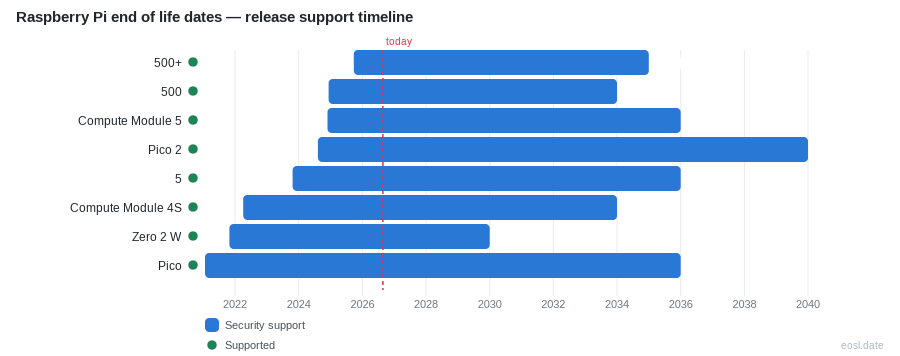
Currently Supported Raspberry Pi Releases - Active EOS/EOSL Support (21)
| Release | Released | Discontinued |
|---|---|---|
| 500+ | (1 year and 1 month ago) | (in 8 years and 1 month) |
| 500 | (1 year and 11 months ago) | (in 7 years and 1 month) |
| Compute Module 5 | (1 year and 11 months ago) | (in 9 years and 1 month) |
| Pico 2 | (2 years and 3 months ago) | (in 13 years and 1 month) |
| 5 | (3 years ago) | (in 9 years and 1 month) |
| Compute Module 4S | (4 years and 7 months ago) | (in 7 years and 1 month) |
| Zero 2 W | (5 years ago) | (in 3 years and 1 month) |
| Pico | (5 years and 9 months ago) | (in 9 years and 1 month) |
| 400 | (6 years ago) | (in 1 year and 1 month) |
| Compute Module 4 | (6 years ago) | (in 7 years and 1 month) |
| 4 Model B | (7 years and 4 months ago) | (in 7 years and 1 month) |
| Compute Module 3+ | (7 years and 9 months ago) | (in 1 year and 1 month) |
| 3 Model A+ | (8 years ago) | (in 3 years and 1 month) |
| 3 Model B+ | (8 years and 8 months ago) | (in 3 years and 1 month) |
| Zero W/WH | (9 years and 8 months ago) | (in 3 years and 1 month) |
| Compute Module 3 | (9 years and 10 months ago) | (in 1 year and 1 month) |
| 3 Model B | (10 years and 8 months ago) | (in 1 year and 1 month) |
| Zero | (10 years and 11 months ago) | (in 3 years and 1 month) |
| 2 Model B | (11 years and 9 months ago) | Active |
| 1 Model A+ | (12 years ago) | (in 3 years and 1 month) |
| 1 Model B+ | (12 years and 4 months ago) | (in 3 years and 1 month) |
Raspberry Pi End of Life (EOL) Releases - No Longer Supported (3)
| Release | Released | Discontinued |
|---|---|---|
| Compute Module 1 | (12 years and 7 months ago) | (10 months ago) |
| 1 Model A | (13 years and 9 months ago) | (12 years ago) |
| 1 Model B | (14 years and 8 months ago) | (12 years and 4 months ago) |
Your Raspberry Pi end of life date decides how long these low-cost single-board computers stay in production, whether they run embedded systems, IoT sensors or a hobby Linux box with GPIO pins. Here is how each model's lifecycle works, what happens afterwards and what to do before it arrives.
What Raspberry Pi End of Life Means for Support Status
End of life is the point where a manufacturer stops supporting a product. A product lifecycle moves through four stages, and the gap between the first and last is the support timeframe:
- Testing: the hardware or software is not public yet.
- Active: the manufacturer fully supports it.
- Phasing out: the end is near, so look at upgrade options.
- End of life: no more support, so secure your system yourself.
Obsolescence is gradual. A board keeps working once its support status changes, but updates, stock and software compatibility stop being guaranteed.
Raspberry Pi Lifecycle by Model
The Raspberry Pi lifecycle is published as a guaranteed production window rather than a shutdown date: each model stays in manufacture until a stated month. Older families, the Raspberry Pi 3 among them, sit closer to their end dates, so look up your exact board.
| Model | Production guaranteed until |
|---|---|
| Pi 5 | January 2035 |
| Pi 4B | 2033 and beyond |
| Zero 2 W | January 2028 |
| Pi 2B | January 2026 (ended) |
| CM1 | January 2026 (ended) |
Raspberry Pi 5 and Raspberry Pi 4 Status
The newest board stays in production longest, while its predecessor runs through at least 2033, so neither is near retirement. Deployments that need a long runway should start here.
Raspberry Pi Zero and Compute Module Status
Small boards age fastest: the Zero 2 W is guaranteed only until January 2028, and the first Compute Module finished its run in January 2026 after nearly twelve years. A compute module is built into custom products, so check its date before designing around one.
Official Support and Production Lifecycles for Discontinued Models
A discontinued board is not a dead board. Production lifecycles only promise that new units keep being made. Official support for the software side comes through Raspberry Pi OS, which keeps covering older models, and through other Linux distributions that run on the same chips.
After end of life you lose the manufacturer's guarantee of replacement stock and any warranty-style assurance. Treat the date as the end of the board's supported useful life, not its working life.
Raspberry Pi Lifespan and Hardware Longevity
Separate from the manufacturer's calendar is the physical Raspberry Pi lifespan. User reports commonly cite seven to ten years of operational life, against four to six for mini PCs and five to seven for desktops. Longevity depends on usage intensity, cooling, power quality and environmental conditions, and a board running 24/7 wears faster. Durability and reliability gains are cheapest to buy up front, where hardware replacement visits are costly.
Cooling Solutions and Heat Dissipation
Boards ship without integrated cooling, so good cooling solutions matter. Heatsinks or a fan improve heat dissipation for continuous work, and a lower temperature slows component wear, which keeps a board in service until its production end date instead of failing years before it.
Power Supply and Environmental Protection
A stable power supply with steady voltage prevents premature failure, so use an official unit. Enclosures that keep out dust and moisture protect industrial installations, so a board outlasts its guaranteed production window and you migrate on your schedule.
Migration Options Before Obsolescence Hits Your IoT Projects
When a board enters its phasing out window, review the roles it plays first:
- IoT sensor networks
- Edge computing gateways
- Industrial monitoring systems
- Home automation controllers
- Network appliances and mini servers
Pick among your migration options by comparing total cost of ownership, not board price. A low-cost replacement is cheap, but remote edge computing sites make every service visit expensive. Begin by testing your software on a newer board, then upgrade your deployments in stages.